Why Is My Curly Hair Frizzy and How to Fix It
Why is my curly hair frizzy? Match humidity, damage, dry air, or wash-day handling to a routine that keeps curls clumped.
More moisture isn't always the answer to frizz. If your curls already absorb water from humid air, adding a heavier cream may leave them puffier and flatter at the same time.
When you ask, “Why is my curly hair frizzy?” the useful question is what made individual strands separate from their curl clumps. Swelling, surface damage, dry air, and rough handling can create similar-looking halos, but they need different routine changes.
Match Your Frizz to the Real Cause
Frizz is a shape problem, not a single dryness problem. Curls look defined when neighboring strands bend together. They look frizzy when some strands swell, catch against each other, or get pulled away from the group.
Before buying anything, choose the row that best matches when and where your frizz appears.
Frizz clues, likely causes, and the first change
| What you see | Likely cause | First change |
|---|---|---|
| Puff and split clumps on humid days | Fiber swelling as it absorbs water | Seal damp hair with a film-forming styler, then dry fully before going out |
| Halo during or right after drying | Clumps disturbed while wet | Hands off until dry; soft microplop; low diffuser airflow |
| Flyaways in winter, desert, indoor heat, or AC | Dry air, static, and friction | Light surface oil or cream; satin at night |
| Short sticks poking from the curl mass | Breakage from a worn cuticle | Less heat and tension; trim damaged ends |
| Frizz only on colored or heat-styled areas | Higher porosity and a lifted cuticle there | Richer conditioner and a film-forming styler on those zones |
| Defined indoors, frizzy on the commute | Incomplete drying or insufficient hold | Finish drying and let the cast set before humidity |
Use timing to narrow the cause
Look at your hair before drying, once it's dry, and after the activity that usually changes it. A halo that develops while you towel-dry points toward handling. Curls that stay grouped indoors but expand outside suggest a weather response, especially if the roots or inner layers were still damp when you left.
Location matters too. If your uncolored roots behave well but your lightened ends look fuzzy, treating the whole head with a heavier product misses the useful clue. Those sections may need different amounts of conditioning.
Short hairs need a closer look. New growth can also stick out, so a halo alone doesn't prove breakage. Uneven short pieces, rough ends, and a history of repeated heat or tight styling make breakage more plausible.
Start with observation: Notice when the frizz begins, not just how large it looks at the end of the day.
Some softness around a curl is normal. The aim isn't to make every strand lie flat; it's to reduce the change you find frustrating without sacrificing movement, volume, or scalp comfort.
Pick the strongest match and keep the other rows out of your test week. Stacking a mask, oil, cream, and humidity spray makes it difficult to tell whether your hair needed better hold, gentler drying, or less rubbing.
How Humid Air Swells a Curl
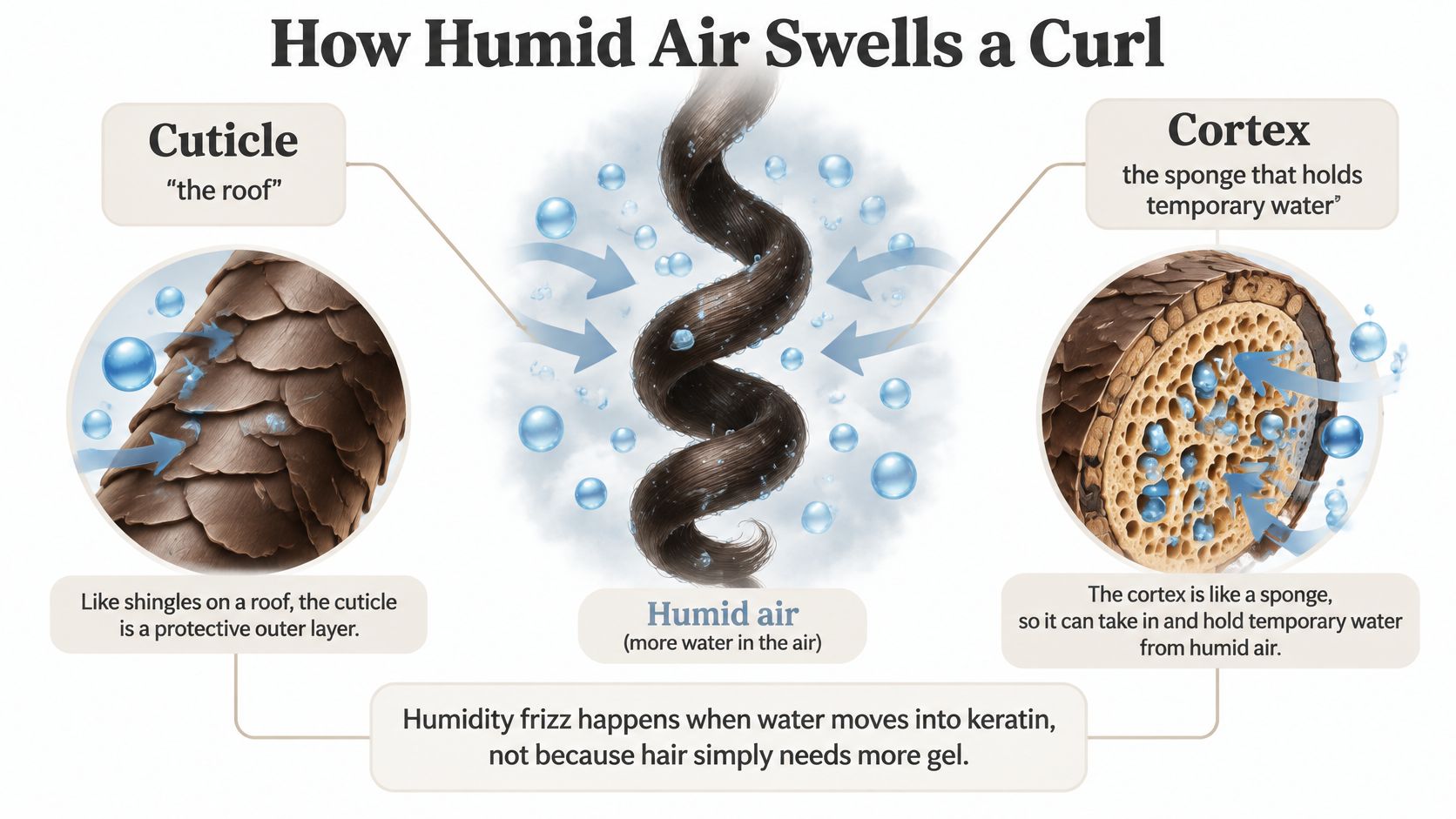
Humidity frizz begins when water moves into the hair fiber. Hair contains keratin, a structural protein with temporary hydrogen bonds that change as water enters and leaves. During drying, those bonds help establish the shape your hair holds.
Think of the cuticle as a shingled roof and the cortex beneath it as a sponge. The roof helps regulate exposure, while the inner fiber takes up water. Neither behaves like a waterproof container.
This diagram shows how the outer and inner structures interact with humid air.
What changes as humidity rises
The measurements summarized in the International Journal of Cosmetic Science study on curly-hair needs describe water regain increasing approximately linearly across 40% to 85% relative humidity, remaining elasticity decreasing approximately linearly across 50% to 80%, and virgin hair absorbing 25.78% of its dry weight in water at 95% relative humidity.
Relative humidity and what the hair fiber does
| Relative humidity | What research shows | What curls often do |
|---|---|---|
| Lower-to-higher humidity within the measured water-regain range | Water regain rises approximately linearly | Gain internal water, increasing the chance of a shape shift |
| Mid-to-high humidity within the measured elasticity range | Remaining elasticity decreases approximately linearly | Change mechanical behavior while taking on water |
| Very high humidity in the virgin-hair measurement | Substantial water uptake relative to dry weight | Swell visibly, allowing clumps to separate and volume to read as frizz |
These measurements describe fiber behavior, not a personal frizz forecast. Reduced elasticity also isn't the same as a simple promise that hair becomes easier to bend. Your visible result depends on the fiber's condition, shape, and how the style dried.
Why curls make swelling more visible
Curly and coily fibers tend to have more elliptical cross-sections than straighter fibers. Think of an oval rather than a circle. Changes across those unequal dimensions can alter curvature, so neighboring hairs no longer follow quite the same path.
That helps explain why a curl can look larger and less defined without feeling particularly dry. Water has entered the fiber, but the strands aren't moving together anymore.
The same damp street won't affect every head equally. Relatively intact, low-porosity hair tends to resist water movement more than porous, chemically altered lengths, which can respond unevenly.
This video offers another visual explanation of humidity-related frizz.
Watch for styling in a steamy bathroom, leaving with damp inner layers, and unevenly weathered lengths. Product choice matters, but the guide to humectants for curly hair can help you separate an ingredient's water-attracting role from the hold and protective film your finished style needs.
When Frizz Is a Damaged Cuticle
Weather changes the water content of a strand. Damage changes the strand itself. You can have either problem, or both at once.
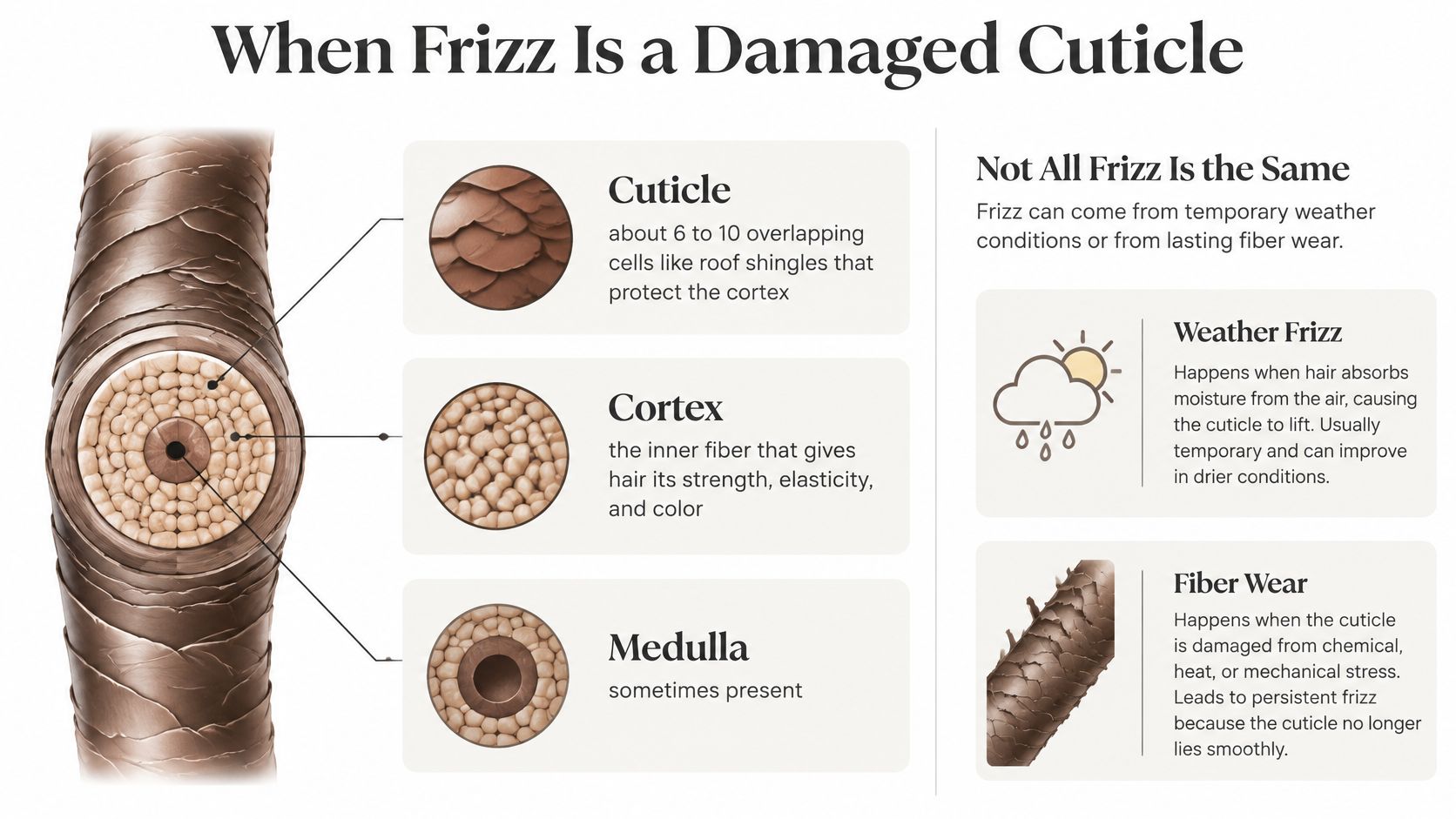
The cuticle protects the cortex, which supplies much of the hair's strength and shape; a medulla may also be present. A review in the International Journal of Dermatology describes the cuticle as roughly 6–10 overlapping cells, like roof shingles, and discusses heat, chemical processing, grooming, and environmental wear that can deteriorate that protection.
The fiber structure helps explain why surface damage changes both feel and appearance.
Rough surfaces make clumps harder to maintain
Smooth, overlapping cuticle cells help neighboring strands slide past one another. Split, chipped, or lifted edges create more opportunities for catching and tangling. Water can also enter less uniformly, so a damaged section may react strongly to weather even when the rest of your hair behaves.
Blow-drying can contribute to cuticle splitting and altered scale edges. Thermal straightening can weaken or rupture the shaft, while color processing, relaxers, and repeated grooming add other forms of wear.
Greater curliness has also been associated with lower break stress. That doesn't mean tightly coiled hair is unhealthy; it means pulling harder isn't a sensible answer to a knot. Curved fibers need careful handling, especially where repeated grooming and environmental exposure have already produced internal cracks.
Damage-related frizz isn't unusual. In a February 2024 U.S. online study of more than 3,300 female hair-care consumers, The Benchmarking Company found that 56% experienced damaged hair resulting in frizz, as reported by GCI Magazine.
Look for pieces that won't join the curl
Inspect the crown, hairline, and previously straightened lengths after a gentle wash and an undisturbed dry.
- Possible breakage: Uneven short pieces with blunt or frayed ends remain outside otherwise formed curls.
- Possible new growth: Short hairs with tapered tips appear around the scalp without an obvious pattern of snapping.
- Possible mixed damage: Rough, tangly lengths and short broken pieces occur together, particularly in processed areas.
These are clues, not a diagnosis. Avoid repeatedly stretching a fragile strand to test its strength; the test itself can cause more breakage.
A styler can smooth the appearance of a damaged strand. It can't turn a snapped hair back into a full-length one.
If the protruding pieces persist, reduce heat and tension and have visibly damaged ends assessed for trimming. Don't try to cut every halo hair, since some may be healthy new growth. Sudden shedding, scalp symptoms, or unexplained thinning need a dermatologist's attention rather than another finishing spray.
Frizz When the Air Is Dry
Not every halo comes from humid weather. If your hair becomes flyaway-prone in a heated office, on a plane, or beneath an air-conditioning vent, adding a stronger anti-humidity product may solve the wrong problem.
In dry air, hair can lose water and become rougher and more static-prone, unlike the swelling associated with humid conditions. The practical distinction appears in Hair.com's guidance on keeping curls defined across humidity conditions: both dry and humid environments can disrupt definition, but they don't do it in the same way.
Separate water from slip and hold
People often use moisture to describe several different needs. Keep these separate when choosing a routine change.
| Need | What it means | What to notice |
|---|---|---|
| Internal water | Water within the fiber | Changes in flexibility, roughness, or shrinkage |
| Surface lubrication | Slip between strands | Catching, friction, and difficult detangling |
| Curl hold | Support that keeps strands grouped | Clumps falling apart despite feeling soft |
| Scalp comfort | How the skin feels | Itching, tightness, irritation, or flaking |
A curl can feel conditioned yet lack hold. It can also need a little surface lubrication without needing a richer wash-out mask.
Fine or low-density curls are especially easy to flatten with heavy butter. The flyaways may become less obvious, but the loss of lift can make the whole style look limp. Dense hair creates a different challenge: you may need better distribution through hidden layers rather than a heavier formula everywhere.
Find the friction that accompanies dry air
Pay attention to the contact points around your head, not only the weather forecast.
- At night: A cotton pillowcase can rub against the outer layer of curls. Try a satin pillowcase or bonnet that doesn't pull at the hairline.
- Around clothing: Wool collars, scarves, and coat seams can separate curls at the nape.
- During styling: Tight elastic loops and dry brushing can pull strands out of formed clumps.
Compare a day spent mostly outdoors in humid air with a day spent in heated or cooled rooms, keeping your usual products unchanged. Record where you were when the flyaways appeared.
If only the dry indoor setting causes trouble, test less rubbing and a light lubricating finish before increasing hold. If both environments cause frizz, handling or damage may be contributing too.
Useful distinction: A rough surface needs slip. A collapsing curl needs support. Neither automatically needs more product weight.
Check Your Porosity Before Blaming Humidity
Porosity describes how readily hair takes up and releases water. You can't measure it precisely by dropping a strand into a glass: surface tension, oils, and product residue can change whether it floats.
Home observations are still useful, provided you treat them as clues rather than a definitive diagnosis.
Check clean hair and compare its history
Start with freshly cleansed hair, before conditioner or styler changes how the surface behaves.
- Watch wetting: Does water initially bead and take effort to spread, or do the lengths wet readily? Beading can suggest a more resistant surface, but leftover oils can produce the same effect.
- Compare sections: Examine untreated roots against colored, relaxed, or frequently flat-ironed lengths. Faster wetting, persistent tangling, and roughness in the treated areas suggest a different conditioning need there.
Drying time alone won't settle the question. Dense hair, thick strands, generous product application, and limited airflow can all slow drying. Hair that feels gummy or stretches unusually when wet may be substantially damaged, not just in need of a high-porosity label.
Match the treatment to the strongest clues
For resistant, relatively intact hair, prioritize even product distribution, a lightweight film, and complete drying. A heavy cream may sit on the surface and reduce movement without improving your result. The low-porosity hair routine guide offers a more focused approach to conditioning and buildup.
For porous or chemically treated lengths, use richer conditioning selectively, then support the style with a film-forming product. Fine damaged hair still needs restraint: target the worn ends instead of coating healthy roots with the same amount.
Short curls and growing-out fades follow the same rules. Neckline rubbing and pillow friction may be easier to see when there's less surrounding length.
Porosity guides the intensity of care, not the amount of frizz you're allowed to have. Use your section-by-section observations to choose how lightly or richly to condition, rather than treating your entire head according to a single label.
Build the Routine for That Cause
Use a consistent wash-day foundation, then change the part that matches your main clue. Conditioner and film-forming stylers can improve lubrication and humidity resistance, while complete drying reduces the opportunity for a newly formed style to shift before you leave home, as discussed in the hair-fiber review indexed by PubMed.
Keep the shared wash-day steps gentle
- Detangle wet hair with slip. Use conditioner, your fingers, or a wide-tooth comb. Begin at the ends and move upward, stopping once the knot is gone rather than repeatedly combing an already clear section.
- Condition for easy separation. Put a richer layer on porous or processed lengths, while keeping fine roots lighter.
- Distribute styler before clumps dry apart. Rake through very wet hair, or smooth it between flat palms using praying hands. For dense hair, work in manageable sections so the inner layers receive product too.
- Remove dripping water with a soft microplop. Cup and gently squeeze curls in a microfiber towel or smooth cotton T-shirt; don't rub them back and forth.
- Dry without repeatedly rearranging the curls. Air-dry in a suitable environment or hover a diffuser on low airflow and comfortable heat. Let any gel cast, the firm coating around the curls, set before softening it.
- Check the roots and sheltered layers before going outside. A dry-looking surface can hide damp hair underneath.
The flow below separates the shared foundation from cause-specific care.
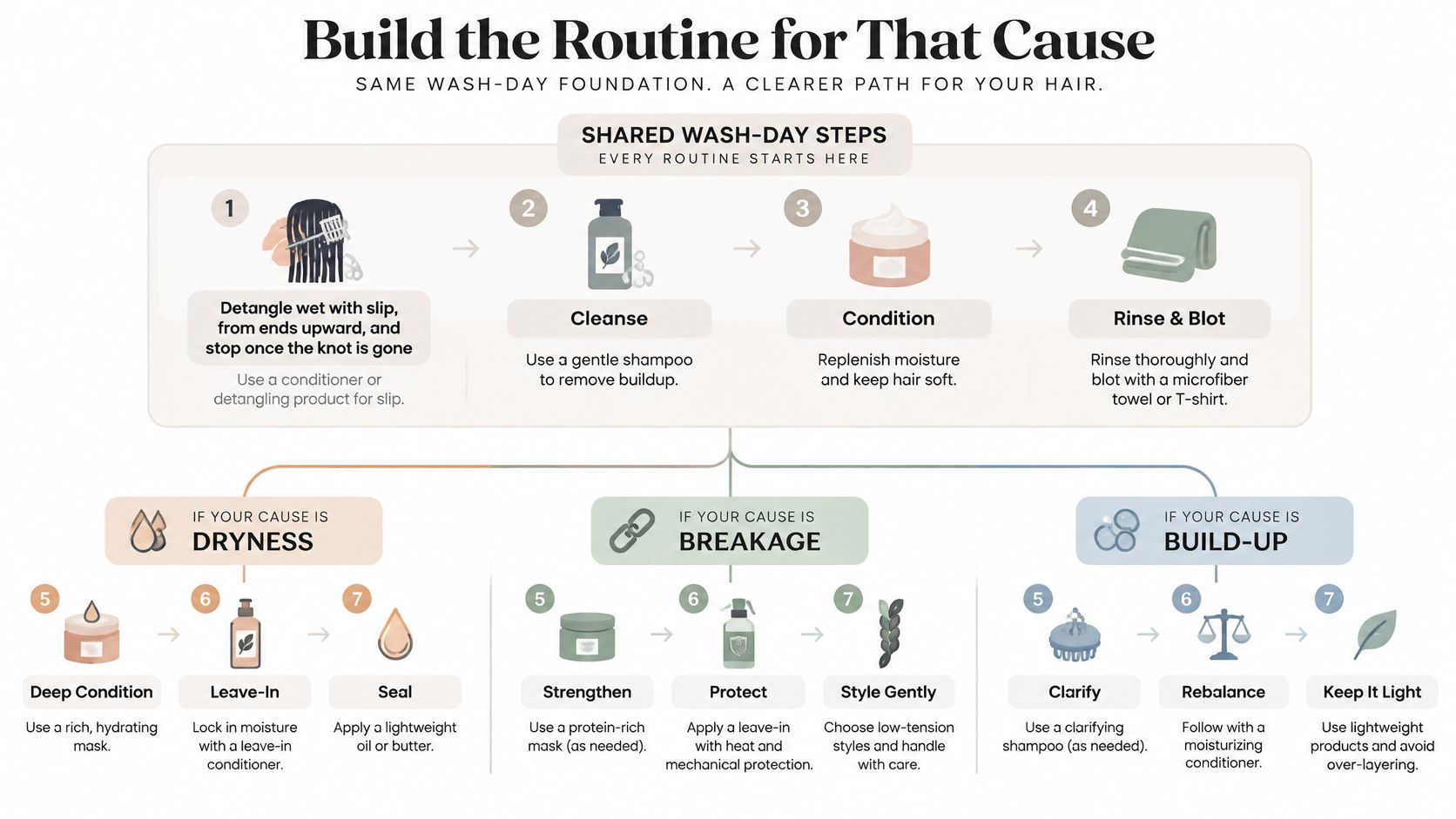
Choose the branch that fits
For humid-day puff or commute frizz, use a film-forming leave-in or gel and make complete drying essential. Sealing means applying a protective film, not making hair waterproof. Fine curls may tolerate a lightweight gel better than layers of cream and oil; dense curls need thorough distribution and enough drying time.
For a halo that forms during drying, change the handling first. Lower diffuser airflow, stop lifting the same section repeatedly, and leave the clumps alone until set. More gel won't compensate for a towel rub that separates them.
For dry-air flyaways, try a small amount of lightweight cream or finishing oil on the surface and reduce nighttime friction. Oil adds lubrication rather than water. Keep the application away from roots if your hair loses volume easily.
For damaged or processed zones, lower heat, loosen elastics, and condition those lengths separately. Don't alternate increasingly strong protein treatments and heavy masks in pursuit of an assumed balance. Neither replaces trimming ends that are splitting or breaking.
The curl cream versus gel guide can help distinguish softness from hold before you add another layer. If the matched change produces no improvement across repeat wash days, reconsider the cause instead of adding another styler.
Test One Cause for Seven Days
Choose your test, then keep the rest of your routine as steady as practical for the week. If you change everything together, you may improve the style without learning what helped.
Make the variable specific: complete drying before the commute, hands-off diffusing, reduced pillow friction, or less styling tension. Keep your cleanser, conditioner, and usual styling amount unchanged unless one of those is the variable you're testing.
Record enough to spot a pattern
- Environment: Note humid outdoor exposure, indoor heating, cooling, or prolonged time under a vent.
- Drying: Record the method and whether the roots and inner layers were fully dry.
- Products: Write down what you used and where you applied it.
- Result: Compare clump edges and halo size in similar daylight, from the same angle.
A paper log or notes app is enough. Judge repeatable changes, not a single flattering bathroom mirror or a photo taken immediately after showering.
If definition improves without unwanted weight, keep that adjustment and stop adding products. If nothing changes, reassess your chosen cause rather than assuming you need a richer cream. Breakage won't disappear within a week, so judge that branch by gentler handling and fewer new snapped pieces, not instant length recovery.
Our hair advice is general information, not medical advice. Scalp pain, sudden shedding, patches of hair loss, and persistent scalp or hair-loss problems should be checked by a dermatologist.
We build your routine around your curl type, porosity, density, and scalp, so your frizz plan doesn't have to start with heavier products. Our AI hair scan reads frizz, definition, and moisture from a selfie you add at check-in, helping you follow visible changes alongside your observations. Visit Coil to build a routine around the cause you're testing.