Humectants for Curly Hair: A Climate-Smart Guide
Learn how humectants for curly hair interact with humidity, porosity, and curl pattern — and get a climate-aware framework for choosing products that actually

“Avoid glycerin whenever it's humid” sounds like a tidy rule. It's also too simple to explain why the same styling product can give one person soft, defined curls and leave another with puffier, less consistent results.
Humectants don't act alone. Their effect depends on the moisture in the air, how readily your hair takes up and releases water, and what else is in the formula. For humectants for curly hair, the useful question isn't “Is this ingredient good or bad?” It's “How does this product behave on my hair in my usual conditions?”
Why Humectants Confuse Curly Hair Routines
Many people arrive at this topic after a disappointing wash day and a search for “glycerin ruined my curls.” The frustration makes sense: humidity can affect curl shape and frizz, and a product that worked in one kind of weather may not work the same way in another. But that doesn't prove glycerin was the sole cause.
A humectant is an ingredient that binds water. Glycerin is one example, along with panthenol and propylene glycol. Hair also responds to moisture in the air, so the result depends on both the ingredient and the conditions around the strand.
Humidity changes the behavior of hair even before you consider a styling product. Hair water regain rises as relative humidity increases from roughly 40% to 85%, while elasticity declines across approximately 50% to 80% relative humidity. Naturally curly and kinky fibers can be particularly sensitive because their more elliptical cross-sections amplify moisture-related changes in curvature and volume, as described in research on humidity and hair mechanics.
That's why blanket advice tends to fail. A humectant-rich gel might feel comfortable and help your curls in one setting, then contribute to a different feel or shape in another. Porosity, damage, curl structure, and the product's conditioning and styling ingredients all influence what you notice.
A better starting point: Don't judge a humectant by its name alone. Notice what your hair does when you use it, and consider the weather and the rest of your routine.
The aim is not to memorize a list of ingredients to avoid. It's to work out how your hair responds and adjust one variable at a time.
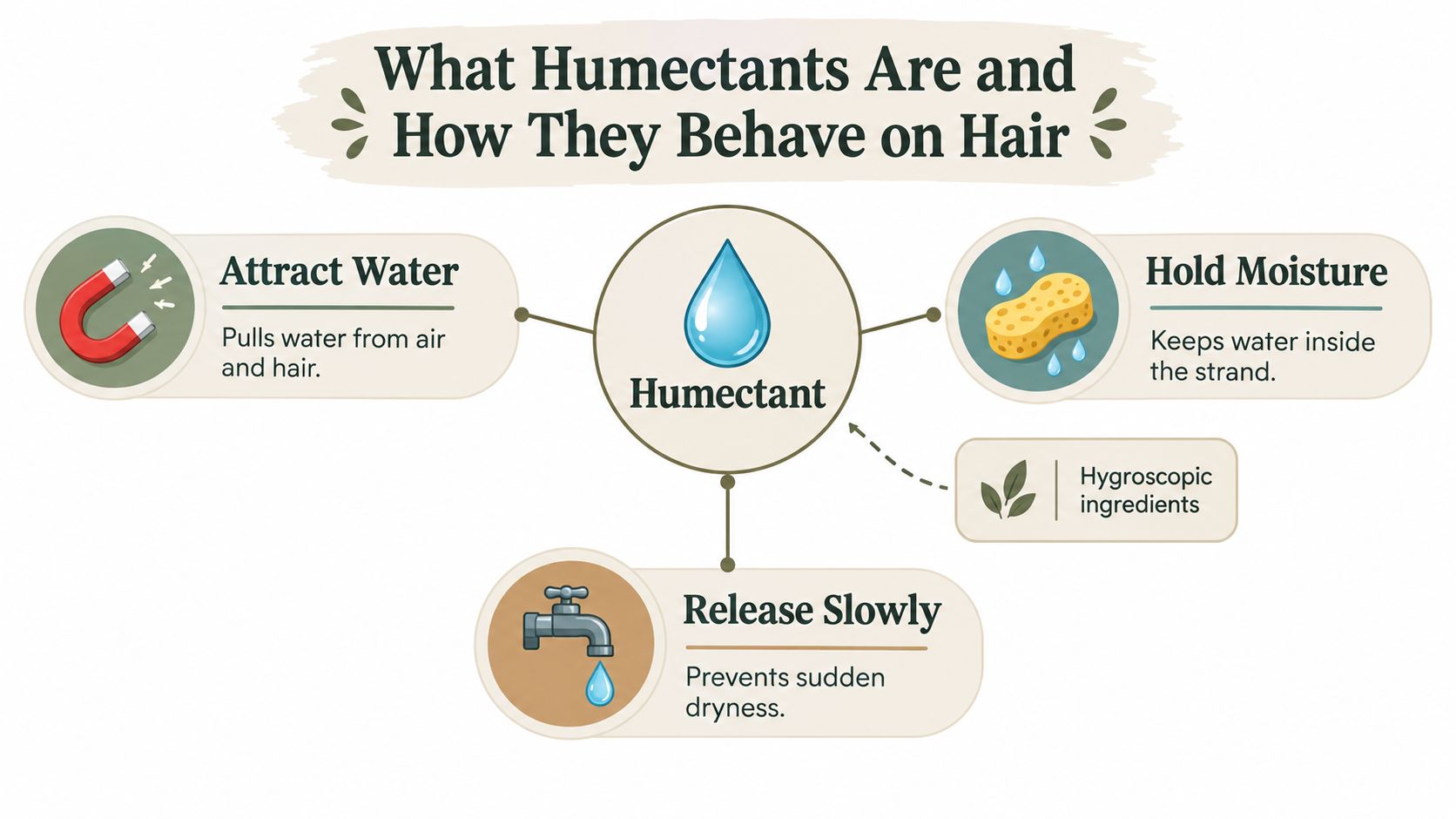
What Humectants Are and How They Behave on Hair
Think of a humectant as part of a sponge's relationship with water. In a damp environment, a sponge can take up water; in a dry one, there may be less available to take up. Humectants aren't literal sponges, but the analogy helps: they bind water, and their effect depends on the moisture around them and the material they're acting on.
Hair is hygroscopic, too. That means it interacts with water rather than staying unchanged as the air gets more or less humid. Humectants bind water through hydrogen-bond interactions and can slow moisture loss from the hair surface. But they don't create water from nothing, and putting one in a formula doesn't guarantee the same result for every head of curls. Ambient humidity, fiber porosity, and the rest of the formula all matter, as summarized in this overview of humectants and their water-binding behavior.
Common humectants in curl products
You may see glycerin, propylene glycol, panthenol, sodium PCA, and sodium lactate on product labels. They all fit the humectant category, but they aren't interchangeable switches. Their concentration and the ingredients surrounding them can change how a product feels and performs.
It helps to think of the humectant as one dial in a formula. A leave-in also might include conditioning ingredients for slip, polymers that form a styling film, or oils and other ingredients that change the product's feel. Those components can affect softness, flexibility, and how well curls stay grouped.
So, if a product feels sticky, limp, or less defined, don't jump straight to “humectants are bad.” Consider the whole formula and how much you applied, as well as the weather and your hair's condition. The same ingredient can be part of a formula that suits your routine or one that doesn't.
Matching Humectants to Low, Medium, and High Porosity
Porosity describes how readily hair takes up and releases water. It's useful for thinking about routine choices, but it isn't a complete prediction of how one ingredient will behave. The same label can produce different results depending on the condition of the hair, the formula, and the surrounding humidity.
A review of curly-hair needs reports that virgin hair can absorb 25.78% of its dry weight in water at 95% relative humidity, based on water-sorption measurements. That finding helps explain why humid conditions can affect curl shape, shrinkage, volume, and frizz, rather than only changing how hair feels to the touch. The review of curly-hair needs also underscores why it's worth considering hair structure alongside product choice.
Low porosity
Low-porosity hair can be slower to take up water. A rich or layered product may feel like too much if it sits on the hair or weighs curls down. Try a lighter formula and a smaller amount first, then assess how your curls feel as they dry. If you're building a routine, this guide to a low-porosity hair routine offers another way to think through product weight and routine choices.
Medium porosity
Medium-porosity hair may tolerate a range of formulas, but that doesn't mean every humectant-heavy product will suit it. Start with the amount you'd normally use, keep other styling steps consistent, and watch whether your hair stays defined and flexible in your usual weather.
High porosity
High-porosity hair can take up water readily and may also lose moisture quickly, especially when its cuticle is raised or the hair is damaged. A humectant can be part of the routine, but judge it alongside conditioning and styling ingredients rather than expecting it to do the whole job.
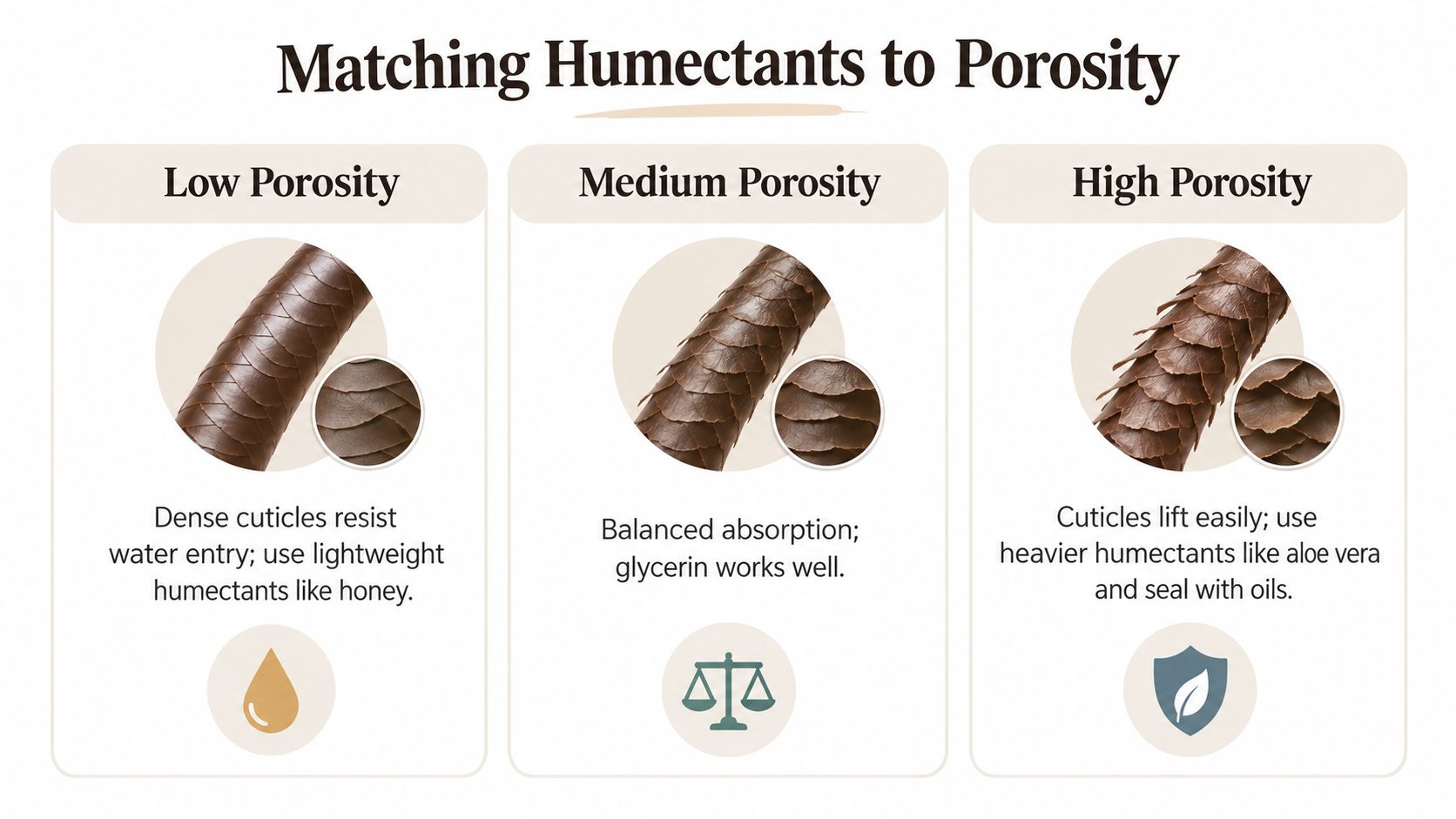
Porosity is only one piece of the picture. Curly and kinky fibers can be more sensitive to moisture-driven changes in shape, so note what happens to definition and volume, not just whether your hair feels soft.
Common Humectant Myths Worth Retiring
Myth 1: Glycerin always ruins curls in humidity
Humidity can change hair's water uptake and curl shape, but that doesn't mean glycerin is automatically the culprit. In humid air, hygroscopic ingredients can contribute to water uptake by the fiber. The cortex can swell, cuticle scales can lift, and curl bundles can expand or separate. But hair's response also depends on porosity, its condition, and the rest of the formula.
The reverse claim about dry weather needs care, too. Available evidence doesn't support the familiar rule that glycerin reliably “pulls water out” of hair in dry air. When little atmospheric moisture is available, humectants may provide less hydration, and a styling film may feel less flexible or more brittle, as discussed in this overview of humectants and humidity.
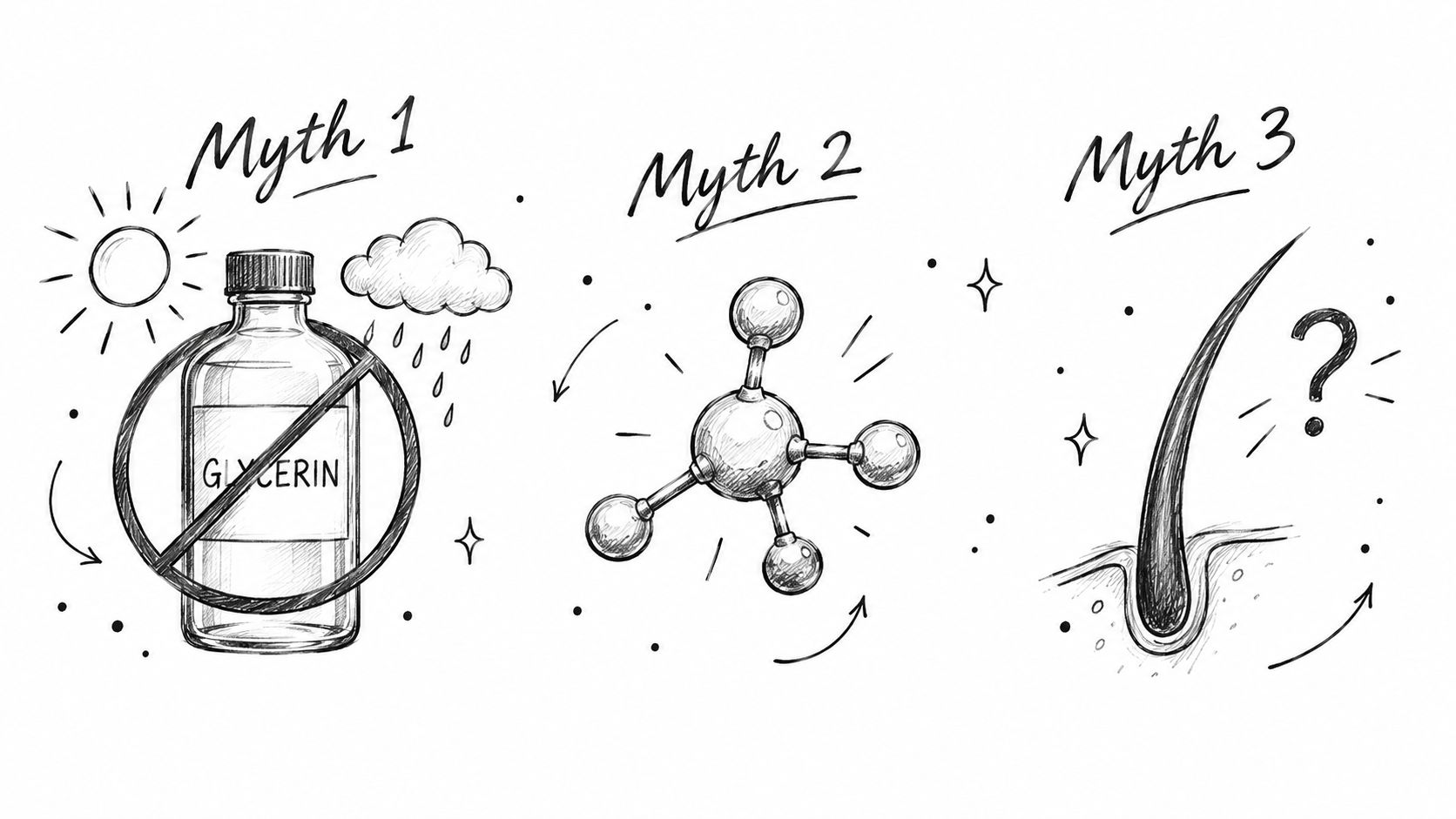
Myth 2: A humectant alone moisturizes hair
A humectant binds water, but its effect depends on water availability and the other parts of the formula. Conditioning agents, film-formers, and other ingredients may influence how the hair feels and how well curls hold together. A product label that says “moisturizing” doesn't tell you by itself how your hair will respond.
Myth 3: Low-porosity hair should never use humectants
Low-porosity hair doesn't have to avoid an entire ingredient category. It may respond better to a lighter product, less product, or a different combination of ingredients. Try a modest amount and look for how your curls behave, rather than ruling out a humectant based on porosity alone.
Shopping rule: Think humectants plus climate plus porosity, not humectants alone.
Layering Humectants With the Rest of Your Formula
A humectant is one part of a routine, not a complete styling plan. To assess a product, look at what else it offers: conditioning, film formation, and the feel it leaves behind. You don't need to assemble every ingredient category as a separate step. This checklist is a way to read the formula and understand what job each product might be doing.
Start with water-binding ingredients. Glycerin, panthenol, and other humectants can help bind water, but their effect depends on the conditions and the complete formula.
Look for conditioning support. Conditioning ingredients can make hair feel smoother and easier to manage. If curls feel rough or tangled, consider whether your routine needs more conditioning, not just more humectant.
Consider hold. Film-forming polymers can help a styling product hold curls together as it dries. The word “moisturizing” doesn't guarantee that a product will control frizz or give enough hold.
Treat oils and richer ingredients as formula choices, not automatic fixes. A richer cream may suit one person and weigh down another. Pay attention to the amount you apply and whether your curls still feel flexible after drying.
Research on humidity-resistant hair products found that tested cationic polymers didn't all perform alike. PQ-70 showed better anti-frizz performance than the comparison formulations, while some shampoos containing PQ-67 or guar showed no humidity-resistance benefit. The finding reinforces a practical point: a product's overall formulation matters more than a broad label. Research on humidity-resistant hair products can help explain why two products with similar marketing claims may act differently.
For example, if a glycerin-rich leave-in leaves your high-porosity curls soft but less defined, you could test it with a styling product that gives more hold. If a richer cream makes low-porosity hair feel coated, try changing the amount or product texture before adding another layer. If you're weighing cream against a lighter styler, this guide to volumizing mousse for wavy hair can help you consider how product weight fits into styling.
Adapting Your Routine to Different Climates
The same routine can feel different when the air changes. Rather than replacing every product with the season, start by noticing what the weather and your curls are doing, then adjust one step.
Dry winter or air-conditioned spaces
When the air feels dry, a humectant may have less atmospheric moisture to work with. If your hair feels less supple, try a conditioning product that suits your texture and consider whether a styling film or another part of your routine is leaving your curls stiff. Don't assume that applying more humectant will solve the problem; see how your hair responds to the whole formula.
Temperate conditions
In moderate weather, your usual leave-in or styler may be a sensible baseline. Keep the routine steady long enough to observe how your curls feel and hold their shape. If you're already happy with the result, there's no need to change products because a label contains glycerin.
Tropical or humid conditions
If humidity rises, watch for changes in volume, curl grouping, and frizz. A curly hair tress in one cosmetic-science study became more voluminous and curlier as relative humidity increased from 50% to 80%. Another study found that humidity changes influenced how people perceived frizz in curly hair, connecting the environment with both feel and manageability, as described in this account of why humidity affects hair.
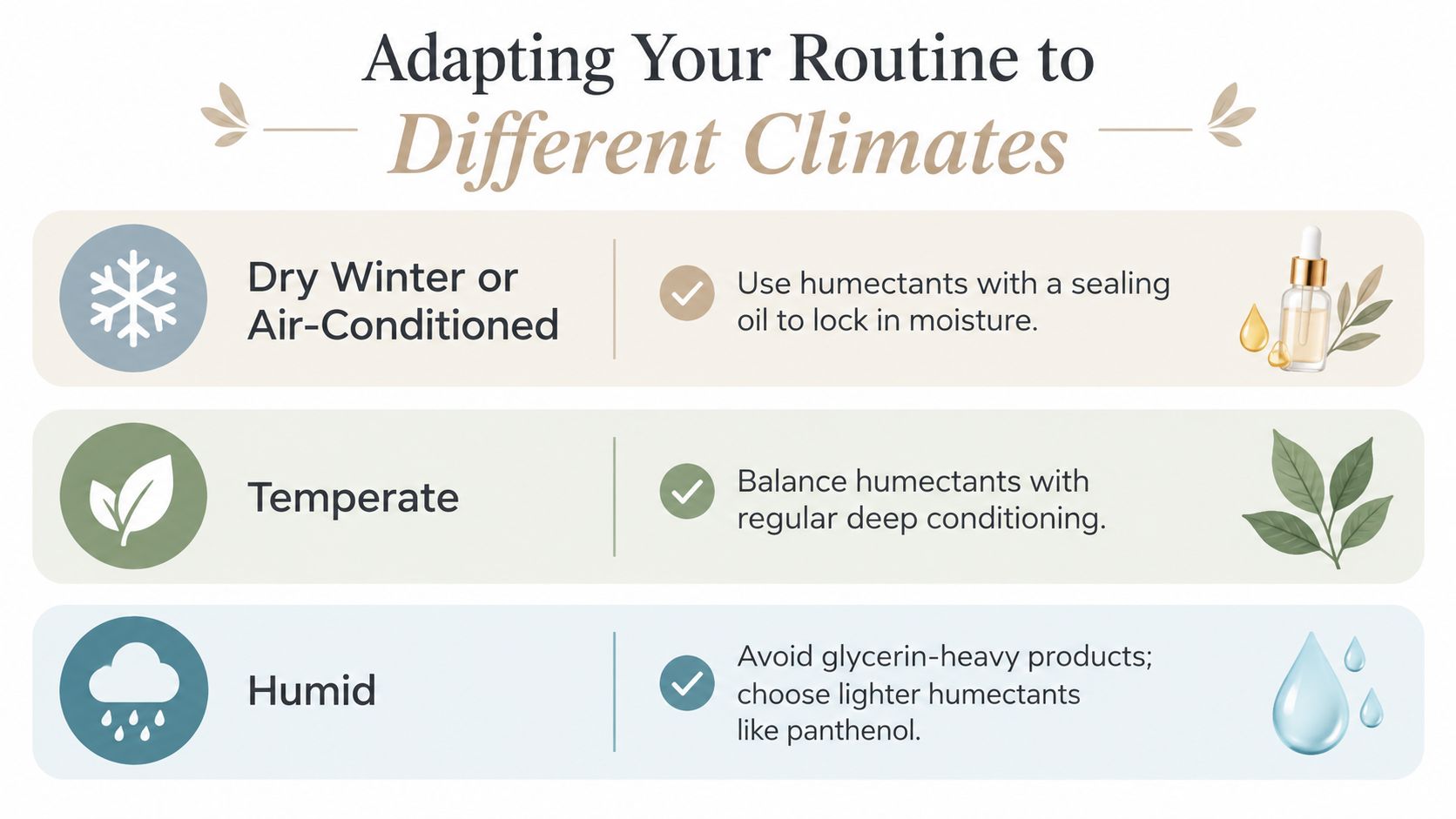
When weather shifts from one wash day to the next, keep your core routine familiar and change just one product or amount. That makes it easier to tell whether a result reflects the new conditions, the product change, or both.
Running Your Own Humectant Trial at Home
A useful test doesn't need a complicated setup. Pick one humectant-containing product and compare it with your usual approach while keeping as many other routine choices as possible the same. The point is to notice patterns, not to prove that one ingredient is universally right or wrong.
Set up a fair comparison
Choose comparable wash days and keep your cleansing, conditioning, application, and drying steps consistent. Change only the product you're testing, or the amount you apply, so you can interpret the result. If you change several products at once, it becomes harder to tell which change mattered.
Record the local relative humidity if you can. Take a photo when your hair has dried, then another later, using similar lighting and angles where possible. A quick note about whether the day was unusually humid or dry can also help you interpret what you see.
Track the result, not just first impressions
Rate definition, frizz, and moisture feel in the same way each time. Note whether your curls stay grouped, feel flexible, or become puffier or less defined as the day goes on. If one result seems mixed, repeat the comparison under similar conditions before making a firm decision.
A single wash day can be misleading because weather and routine details change. If you use a daily check-in or photo timeline, keep the notes together so you can compare outcomes over time instead of relying on memory. The most helpful conclusion may be specific: a product works for you in one set of conditions but not another.
Bringing It Together With a Decision Framework
When you're choosing a humectant-containing product, weigh three things: climate, porosity, and curl structure. Then watch the outcomes that matter to you, such as definition, frizz, and how your hair feels. That gives you a more useful guide than a universal ingredient ban.
| Porosity | Dry climate | Moderate climate | Humid climate |
|---|---|---|---|
| Low | Try a lighter formula and assess whether your hair feels coated. | Start with a modest amount and track softness and definition. | Watch for loss of definition; test product amount and hold. |
| Medium | Use a formula that leaves curls feeling flexible. | Keep a balanced routine that already works. | Observe frizz and curl grouping before changing products. |
| High | Assess whether conditioning support helps hair feel supple. | Test humectants with a suitable styling product. | Monitor swelling, volume, and definition; adjust one product at a time. |
Your curl pattern and the condition of your hair also matter, so use the table as a starting point rather than a fixed prescription. If another routine factor is affecting your results, this guide to an oily hair care routine may help you think about scalp needs alongside your styling choices.
Choose one product, test it under comparable conditions, and note what your hair does. A repeatable record of weather, routine, and results can turn ingredient confusion into a practical decision.
Coil builds and adapts curly-hair routines around your hair characteristics and habits, with ingredient analysis, photo tracking, and feedback on definition, frizz, and moisture. Try Coil to track a humectant trial and see how your routine performs across changing weather.