Curl Cream vs Gel: Which One Your Hair Needs
Curl cream vs gel compared on hold, humidity, finish, porosity and layering, with clear picks for wavy, curly and coily hair.
The most popular advice about curl cream vs gel is to use both: cream for moisture, gel for hold. That's a useful option, not a universal prescription. On fine, low-density hair, the extra cream can flatten an otherwise successful style. On dry, coarse curls, skipping conditioning may leave a defined result that feels rough.
The better choice starts with what's missing from your current result. Choose conditioning when your curls need softness and manageability, structure when they lose shape, and layering only when it improves both without adding unwanted weight.
Curl Cream and Gel Side by Side
Gel is built primarily for hold and shape. Curl cream is built primarily for conditioning and manageability. Neither wins on every head of hair, and neither product name guarantees a particular result.
The functional distinction aligns with the styling categories described by Mordor Intelligence's hair-styling-products overview: gel serves the hold-oriented role, while creams generally emphasize conditioning and softer definition. Use the comparison below as a starting point, not a promise about every formula.
Curl cream vs curl gel on core criteria
| Criterion | Curl cream | Curl gel |
|---|---|---|
| Primary job | Conditioning, slip and manageability | Hold, shape and definition |
| Base formulation | Emulsion with oils, esters and conditioning agents | Water-based or alcohol-containing formula with film-forming polymers |
| Hold level | Usually modest; may be insufficient alone | Flexible to strong; can form a firm cast |
| Finish | Soft, glossy and touchable | Defined and set; sometimes temporarily crunchy |
| Humidity resistance | Often limited without a fixative polymer | Usually stronger when formulated for humidity resistance |
| Drying time | Rich layers can prolong drying | Alcohol-containing formulas may set faster; wet application still needs thorough drying |
| Buildup risk | Heavy layers can coat fine or low-density hair | Repeated applications can leave residue |
| Best-fit hair | Dry, coarse or frizz-prone curls needing softness | Curls needing shape retention, humidity control or longevity |
Product names aren't performance grades
A gel can feel light and flexible, while a cream can contain enough styling polymer to provide noticeable hold. Water-based and alcohol-containing gels also behave differently, and cream-gel hybrids combine conditioning ingredients with a gelled polymer system.
The formulation differences described in Mordor Intelligence's hair-gel overview reinforce why the category name alone isn't enough. Alcohol type and concentration matter, as do the amount applied and the condition of your hair.
Match the table to your main problem rather than shopping for the richest or strongest product. Hold and humidity determine whether definition lasts; finish determines how it feels; porosity and density help set the amount your hair can carry. Layering, residue, ingredient labels and a controlled home test then help separate a useful routine from unnecessary product.
How Hold and Humidity Resistance Differ
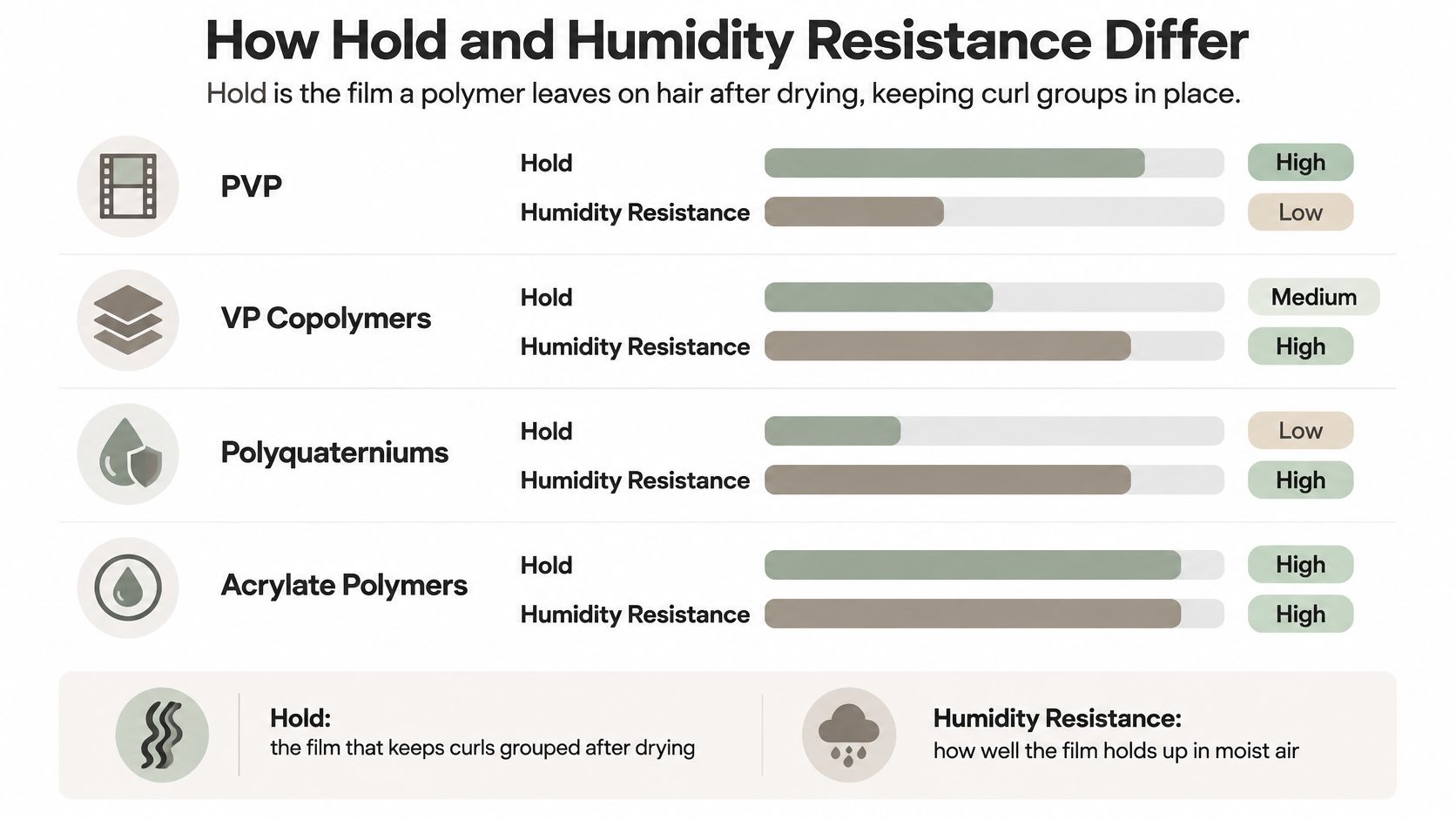
A gel that feels firm indoors can still lose its grip in moist air, because hold and humidity resistance are related without being identical. Hold is the film a styling polymer leaves on hair after drying; that film keeps the curl groups you formed during styling from separating or changing shape. Gel formulas commonly use PVP, VP copolymers, polyquaterniums or acrylate polymers for this job.
Polymer chemistry, concentration and the rest of the formula then decide how that film behaves once the air turns damp.
The visual below identifies common polymer families. Treat family-level rankings as a broad guide, not proof that every product containing that ingredient performs alike.
What humidity testing actually measures
A curl-retention test starts with wet-set hair, dries it into a controlled shape, then exposes it to humid conditions. The remaining curl shape indicates how well the styling film resisted deformation.
In Univar Solutions' MaizeCare application testing, a gel containing 2% MaizeCare Style Polymer reduced frizz and improved definition compared with its base gel, with humidity-resistance measurements conducted at 25°C and 90% relative humidity. The treated gel also matched a commercial benchmark containing dehydroxanthan gum and acacia gum on curl retention.
That is useful evidence for the tested formulation. It does not establish that every gel will outperform every cream, or predict your results during a commute, workout and night's sleep.
Read brand humidity claims for their test conditions rather than their headline figure. Temperature, humidity level and exposure time vary from one test to the next, so two products quoting different conditions cannot be compared head to head.
Practical rule: Choose a humidity-resistant formula for a humid day, not merely the product that feels hardest when it dries.
Put the film where you need it
Start with very wet hair and spread a thin, even gel layer through each section. Smooth or rake it through before scrunching, then let the hair dry completely before judging whether the hold is sufficient.
More gel isn't always better. Excess can leave stiffness, tack or flakes, particularly when distribution is uneven. If the surface feels coated but inner sections lose shape, improve coverage before increasing the total amount.
The rest of the formula matters too. A guide to humectants for curly hair can help you weigh moisture-attracting ingredients alongside the hold system rather than blaming a single component when a humid day undoes your styling.
Cream alone is usually the weaker starting point for prolonged humidity exposure. Some creams contain effective fixatives, but softness without enough structural hold won't reliably preserve a carefully styled curl grouping.
Finish, Softness and When Crunch Helps
Crunch-free isn't automatically better. A soft finish straight after drying can be appealing, but it's less useful if your curls separate before you've finished getting ready.
Cream generally gives a lubricated, glossy finish with less surface friction. Gel often gives a more deliberately set appearance, especially before its cast is softened. The right choice depends on whether you prioritize immediate touchability, lasting definition or a compromise between them.
Judge the finish after the cast softens
A temporary gel cast isn't the same thing as damaged or dehydrated hair. Once your hair is completely dry, gently squeeze a section upward with clean hands. A suitable cast should soften while leaving the curl springy and grouped.
If the section stays board-like, feels powdery or sheds visible flakes, don't assume you need an oil to disguise it. Try less product, more even distribution or a different formula at the next wash. Flaking can also indicate that the products you layered don't work well together.
A useful cast is temporary structure. Persistent brittleness or residue isn't a styling goal.
Soft- and flexible-hold gels are designed to narrow the gap between touchability and durability, a direction identified in MarketIntelo's curly-hair-care market overview. That category description doesn't prove how an individual gel will feel on your curls.
Compare the finish you actually live with
Don't judge a styler only in the bathroom mirror. Check how the result handles the activities that matter to you.
- After drying: Assess softness, gloss and whether you can loosen the cast without losing definition.
- After normal activity: Look for flyaways, separated curl groups and a sticky surface.
- After sleeping: Check whether curls recover with damp hands or require a full restyle.
For a loose, touchable style you're happy to reshape, cream may be the better finish. For a style you don't want to keep adjusting, a gel that softens cleanly can be more practical. Neither maximum shine nor maximum crunch tells you how well the product suits your routine.
Which Porosity and Density Suit Each Product
Porosity, density and strand thickness describe different things. Porosity concerns how readily hair takes up and releases water. Density describes how many hairs occupy an area of scalp, while thickness describes the size of an individual strand.
Those distinctions matter because dense hair can still be fine, and coarse hair can still be low density. A curl-pattern label won't tell you how much cream your hair can carry.
Product fit by porosity and density
| Hair profile | Starting product | Why it fits | Watch for |
|---|---|---|---|
| Low porosity, fine or low density | Light cream, or a small amount of alcohol-free gel | Limits surface coating while adding softness or shape | Buildup, limp roots and flat waves |
| Normal porosity, medium density | Cream alone, adding gel only when needed | Lets you adjust hold without automatically layering | Excess product from repeated refreshing |
| High porosity, dry or frizzy curly hair | Light cream first, then gel if definition fades | Combines conditioning with shape retention | A rigid result if conditioning is inadequate |
| Dense or coily hair | Richer cream plus gel, or a cream-gel hybrid | Offers styling slip and structure across substantial sections | Uneven coverage, flakes and stiffness |
| Fine, low-density hair at any porosity | Minimal light cream where needed; gel for shape | Avoids unnecessary conditioning weight | Lost volume and residue near roots |
What cream testing does and doesn't prove
The Univar Solutions formulation booklet reports that a cream containing 2% MaizeCare Style Polymer produced more elongated curls and less shrinkage during drying, while control hair showed more frizz and less definition after five days. The booklet also describes improved frizz control from a defining cream containing 0.25% polymer, tested for 24 hours at 90°F and 90% relative humidity on 16-inch curly tresses.
Those are formulation-specific results, not proof that richer cream preserves volume. A frizz-controlled tress can still be too weighed down for someone who wants lifted roots.
For low-porosity hair, start with less product rather than assuming it needs extra layers to absorb anything. This low-porosity hair routine offers a more targeted approach to cleansing and conditioning.
At Coil, we build a routine from your curl type, porosity, density and scalp, rather than treating curl pattern as the whole prescription. Use the matrix as a starting hypothesis, then let your actual finish determine whether it fits.
How to Layer Cream Under Gel Without Buildup
Layering earns its place when your hair needs conditioning and loses definition without a stronger hold product. It's less convincing when gel alone already gives a comfortable, lasting result.
The cream-first, gel-second approach follows the complementary roles described in Parade's stylist-informed curl-cream guide. The important practical limit is quantity: adding a second product shouldn't mean applying a heavy layer of each.
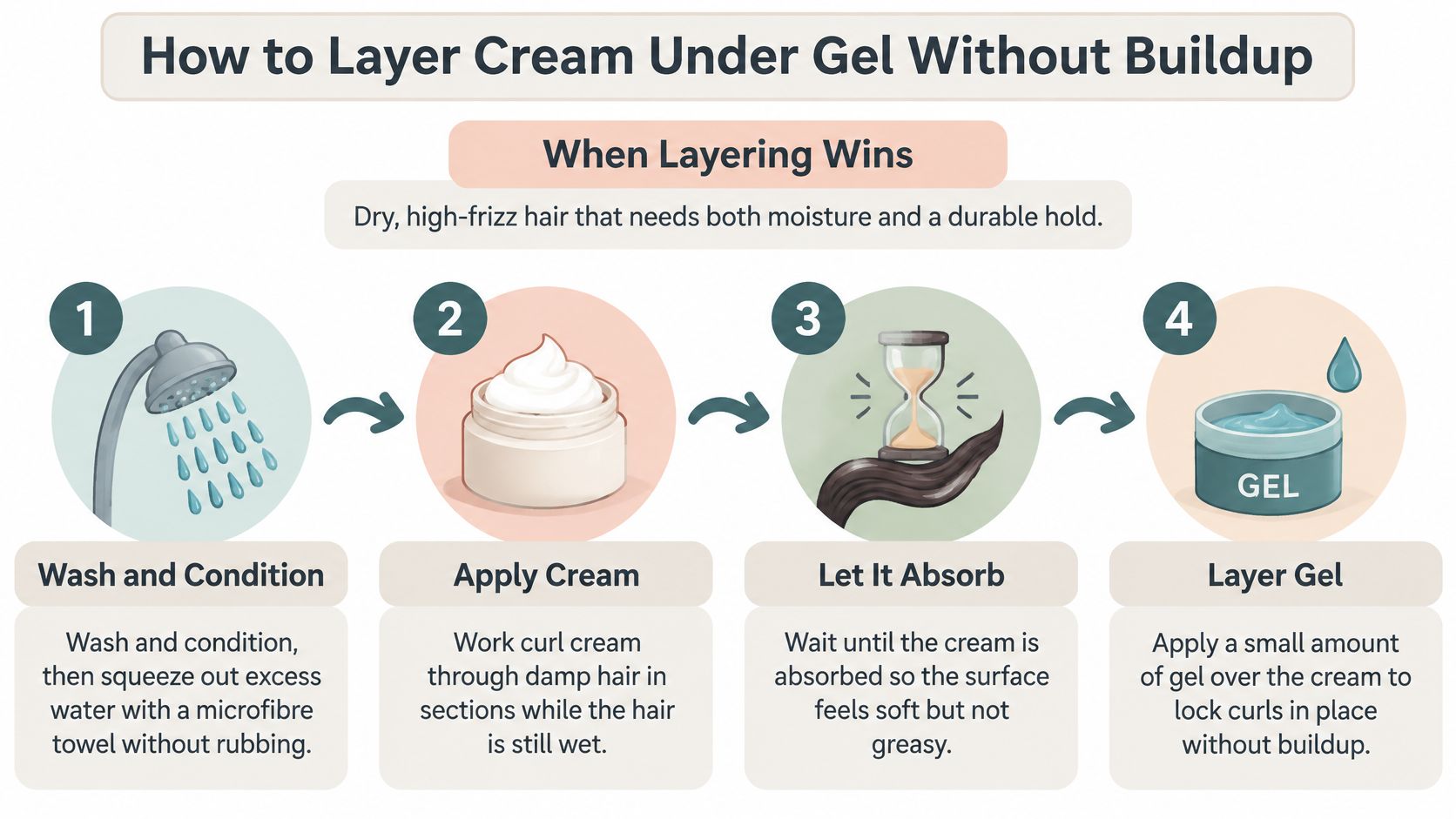
Use this sequence as an application guide, keeping enough water in the hair for easy distribution.
Apply in thin, controlled layers
- Wash and condition. Squeeze away freely dripping water with a microfibre towel without rubbing. Keep the hair wet and easy to separate, not towel-dried until fluffy.
- Spread a little cream through each section. Start with a pea-sized dab for a manageable section, adjusting for length and concentration. Rake through for coverage or smooth between your palms before scrunching.
- Check distribution rather than watching a timer. The section should feel slippery enough to style, not greasy or pasted together. There's no universal waiting period that proves cream has absorbed.
- Apply gel while the hair is still wet. Add water with a spray bottle if the section has started drying. Spread a thin layer evenly, using fingers or a wide-tooth comb before reforming curl groups.
- Scrunch and dry with minimal handling. Air-dry or diffuse without repeatedly squeezing the developing cast.
- Assess only when fully dry. Gently soften a section and check its movement before scrunching the rest.
Diagnose the result before adding more
Too much cream commonly leaves soft but limp curls. Uneven gel application can leave rigid patches beside under-styled sections, while applying a thick gel to dry hair can create visible, uneven residue.
A successful layered result should have movement and definition without a greasy root area. Dullness, coating and persistent flatness suggest you should reduce the load, not add another finishing product.
The demonstration below provides another way to follow the application sequence.
Fine, low-density or easily coated hair needs the lightest version of this routine. Apply cream only where softness is missing, rather than automatically covering every section from roots to ends.
Clear Buildup and Read Labels
A styler that worked well on wash day can become less useful when you keep adding it without removing the previous applications. Before replacing a product because your curls look dull or flat, check whether you're styling over residue.
Use a clarifying shampoo when ordinary cleansing no longer removes the coated feeling, then condition according to how your hair feels. There isn't a universal clarifying calendar: washing frequency, application amounts and the cleanser you already use all affect what's needed.
Read ingredient families, not isolated warnings
A label helps identify the formula's likely priorities. It doesn't reveal exact ingredient concentrations or guarantee compatibility with your hair.
Ingredient families and what they do
| Ingredient family | Typical product | Effect on curls | Watch for |
|---|---|---|---|
| Film-forming polymers, including PVP, VP copolymers, polyquaterniums and acrylates | Gels and cream-gel hybrids | Provide hold and can form a cast | Stiffness or flaking with excessive application |
| Oils, esters and fatty materials | Creams and hybrids | Add lubrication, gloss and softness | Weight and limp roots on fine or low-density hair |
| Silicones and waxes | Some gels and creams | Add smoothing, shine or structure | Persistent coating when your cleansing routine doesn't remove it |
| Drying alcohols | Some alcohol-containing gels | Help a formula set quickly | An uncomfortable, dry-feeling finish on susceptible hair |
Don't treat every alcohol as a drying alcohol. Fatty alcohols such as cetyl alcohol and cetearyl alcohol are used differently, commonly supporting conditioning and cream texture. Likewise, the presence of a silicone doesn't automatically make a product unsuitable.
Match cleansing to the residue
If your hair feels coated after washing, reassess the cleanser and the amount you're applying. If it feels rough immediately after clarifying, avoid responding with an oversized dose of styling cream; adjust conditioning first.
- For flat roots: Reduce product near the scalp and check whether refreshing is adding unnecessary layers.
- For patchy flakes: Simplify to a single styler before testing a new combination.
- For persistent scalp discomfort: Stop the suspected product rather than trying to cleanse through the reaction.
An ingredient-checking app for curly-hair products can make label comparison easier. Use that information to shortlist products, then judge the actual result rather than treating an ingredient flag as a verdict.
Which Product Fits Your Situation
For a humid commute, start with gel, not an extra-rich cream. Your priority is preserving the style through exposure, while conditioning should be adjusted separately to avoid unnecessary weight.
For other situations, choose according to what the style needs to survive. A quiet indoor day, an outdoor event and a swim aren't equivalent tests of a product.
Verdict by everyday situation
| Situation | Pick | Reason | Caveat |
|---|---|---|---|
| Humid commute or summer outdoors | Humidity-resistant gel | Prioritizes retention of styled curl groups | A thick application can feel unnecessarily rigid |
| Desk job or dry climate, soft look | Cream alone | Provides a touchable finish when strong hold isn't essential | Loose curls may still drop during the day |
| Gym, swimming or sleeping on curls | Gel-based styling routine | Gives shape more support than conditioning alone | Sweat and immersion can disrupt the style; gel isn't waterproof protection |
| Short curls, fades or men's grow-outs | Light gel | Gives controlled shape without requiring a rich conditioning layer | Longer, dry grow-outs may benefit more from cream |
| Next-day refresh | Water-based mist, then reshape | Reactivates styling without immediately adding weight | Add a trace of cream only if softness is missing |
| Photo day or event needing strong hold | Strong-hold gel | Prioritizes deliberate definition and shape retention | Test beforehand to avoid flakes or an unwanted finish |
Separate styling needs from protection
For swimming, a cast won't reliably preserve a wash-and-go through immersion. Treat the gel choice as a styling preference, not protection against pool water, and plan to cleanse and condition afterward.
For sleep, reducing friction matters as well as choosing a styler. A satin bonnet or pillowcase can support the routine without adding another layer of product.
Choose for the disruption: Humidity calls for humidity resistance; friction calls for gentler handling; dryness calls for conditioning.
Short hair also doesn't require a separate product category based on gender. Apply a small amount evenly and judge whether you want a sculpted finish or a softer, less controlled shape.
If the table doesn't match your experience, don't keep escalating product strength. Check the formula for heavy conditioning ingredients, silicones or waxes that may change the finish, then compare it under your own conditions. A consistent home test is more informative than choosing by someone else's curl photograph.
Confirm Your Pick With a Three-Week Test
Treat a three-week comparison as a practical experiment, not a clinical study. You're trying to identify a useful routine under ordinary conditions, not prove that a product category is universally superior.
Keep your cleanser, conditioner, sectioning and drying method as consistent as possible. Measure the amount of each product you use, but don't force identical quantities of cream and gel when their concentrations and jobs differ.
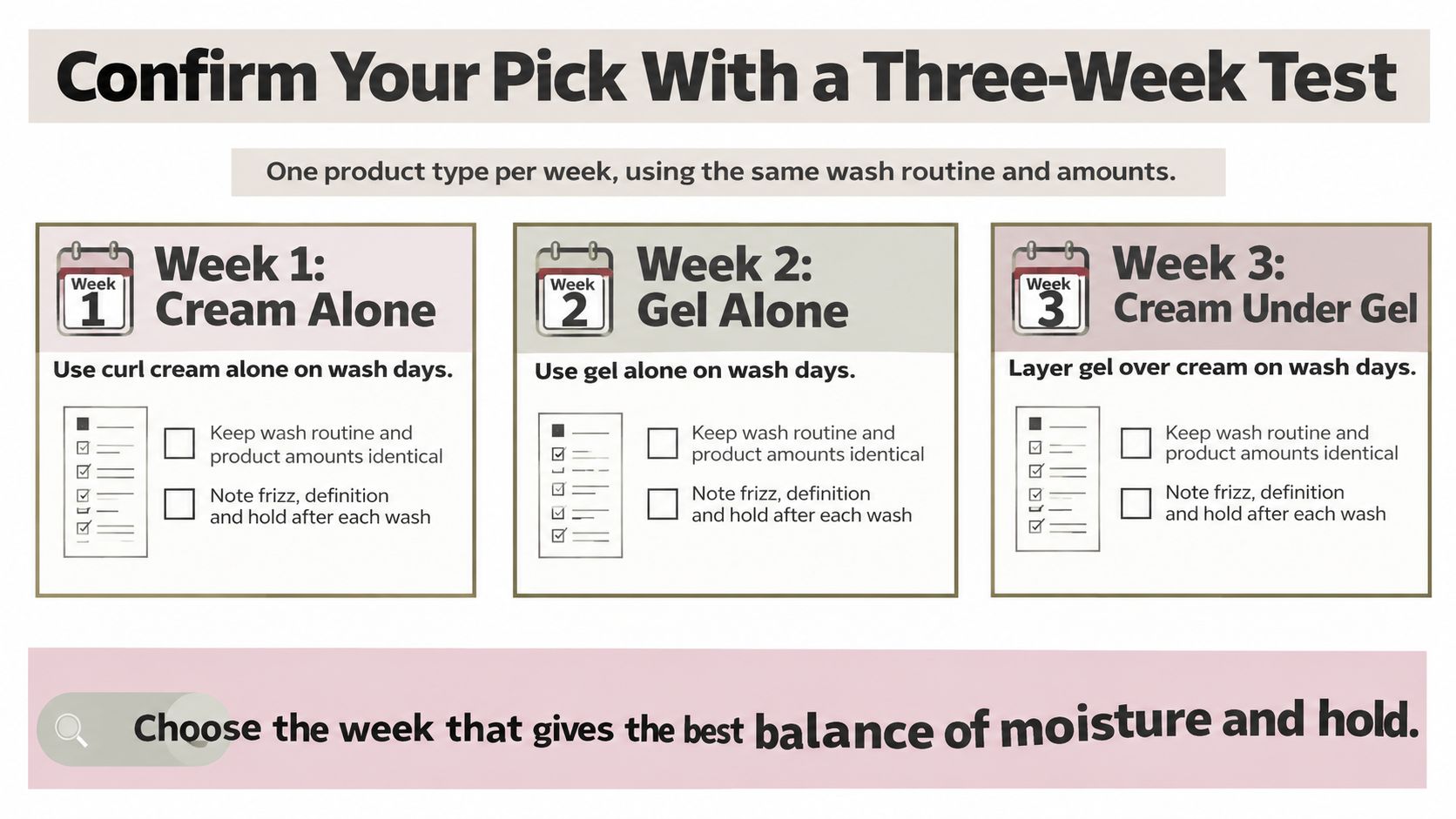
The testing schedule below separates the options so you can compare them deliberately.
Keep a repeatable record
- Week one, cream alone: Use cream on wash days and record whether softness comes at the expense of definition.
- Week two, gel alone: Assess whether the finish stays comfortable after the cast softens.
- Week three, cream under gel: Check whether conditioning improves the gel result enough to justify the extra layer.
After each wash, record initial definition, frizz after normal activity, cast hardness, root residue, next-day recovery and scalp comfort. Add the date, amounts, weather and any unusual activity so an exceptionally humid day doesn't distort your conclusion.
A notebook works. In Coil, product scoring tallies how your curls performed on the days each product was used, and we line your curl score up against products and habits to sharpen the routine. Photographing an ingredient label also lets us flag sulfates, drying alcohols, silicones and waxes.
Keep the simplest successful option
Choose the routine that gives the definition and frizz control you want without persistent coating or discomfort. If cream alone and layering perform similarly, keep cream alone. If gel alone feels comfortable and lasts, there's no need to add cream out of habit.
If the weather changes substantially between test periods, repeat the closest contenders before deciding. For your next wash, choose the first product, check its ingredient families and write down the amount before applying it.
Coil builds a routine around your curl type, porosity, density and scalp, then helps you compare products against your results over time. Visit Coil to track your cream, gel and layered wash days with ingredient checks and a photo timeline, so you can keep the routine that actually suits your hair.