Low Porosity Hair Routine That Actually Works
Build a low porosity hair routine that beats buildup, boosts curl definition, and makes products finally absorb. Real techniques, not generic tips.

Most low porosity advice starts in the wrong place. It tells you to pile on heavier creams, richer butters, and more oils as if your hair is starving for moisture, when the actual issue is usually that water isn't getting in cleanly, or product is already sitting on the strand and blocking the next layer.
Treat low porosity as a working hypothesis, not a permanent identity. Hair is naturally porous because keratin fibers contain voids at different scales, and the cuticle plus internal lipid layers control how quickly water moves in and out, so the job is controlled hydration, not product volume MDPI moisture-sorption study.
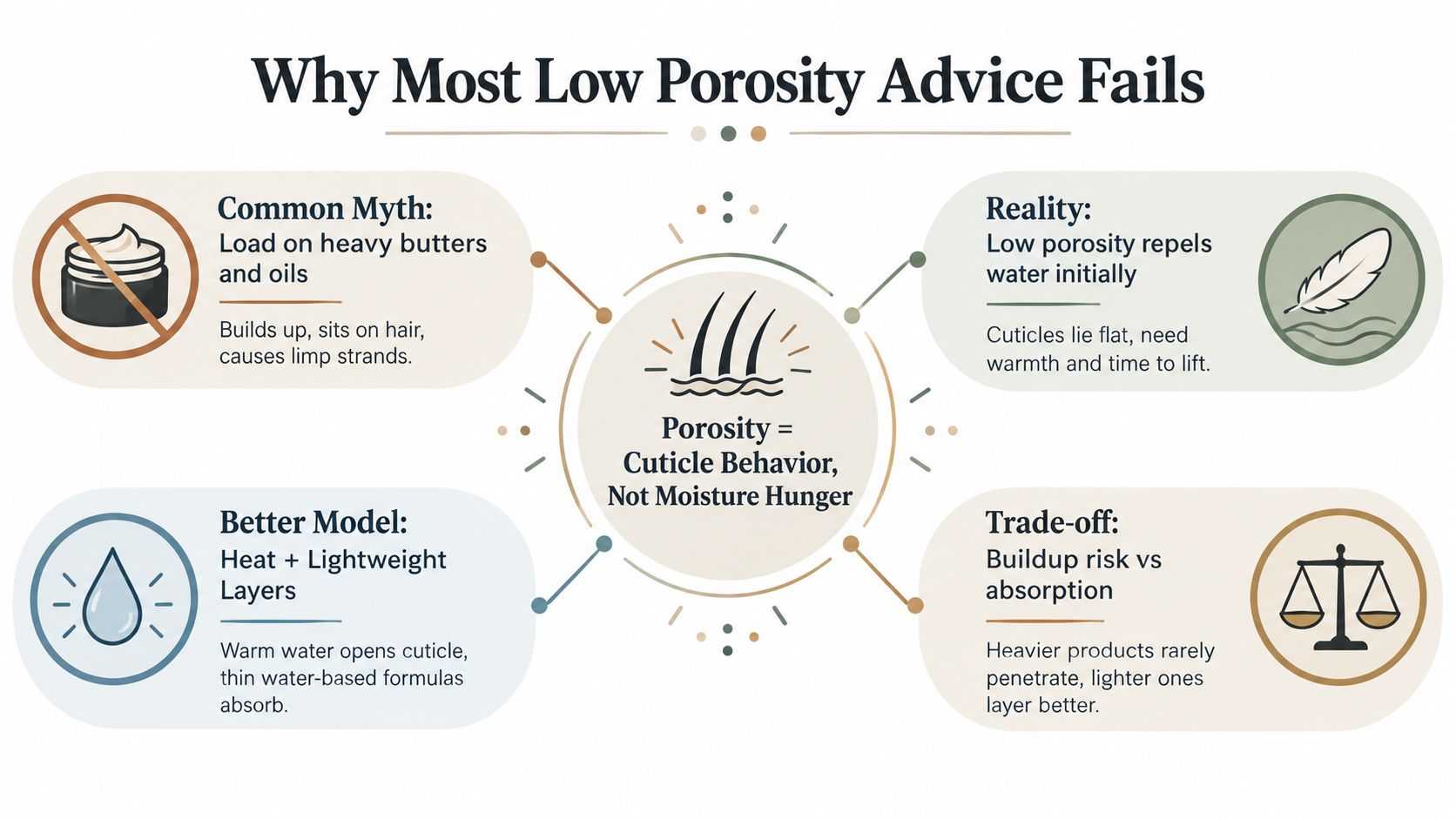
Table of Contents
- Why Most Low Porosity Advice Fails
- Running a One-Day Porosity Diagnostic
- The Wash Day Routine Step by Step
- Reading Ingredient Labels for Low Porosity Hair
- The Heat Question and When It Actually Helps
- Tracking Four Outcomes Across Wash Cycles
- Your 30-Day Low Porosity Plan
Why Most Low Porosity Advice Fails
Most guides confuse resistance to wetting with a need for richer products. That's a bad read. Tight cuticles slow water entry, so if you keep layering butters, oils, heavy leave-ins, and protein on hair that's already slow to absorb, you often get coated curls that dry flat, feel dull, and still don't feel adequately hydrated.
Porosity Is a transport problem, not a hunger problem
The useful mental model is simple. Porosity is about how water moves through the fiber, not whether the hair “wants moisture.” Research has identified distinct moisture-sorption behavior in the cuticle and cortex, and the cuticle's role becomes more obvious as humidity rises MDPI moisture-sorption study. A 2025 moisture-sorption study also found a transition at about 30% relative humidity, linked to opening of the hair's inner structure and the accommodation of extra water molecules MDPI moisture-sorption study.
That matters because it changes the order of operations. Start with water access, product spread, and residue control. Don't start with heavier layers and hope the strand magically cooperates.
Practical rule: if hair gets limp before it gets soft, you're probably overloading it, not underfeeding it.
The float test tells you less than people think
The float test is popular because it's easy, not because it's reliable. Strand condition, product buildup, oils, waxes, and mineral residue can all change whether hair floats or sinks, which means the result often says more about coating than about true structure. Hair-science methods measure swelling, water uptake, microscopy, or gas-sorption properties, not a glass-of-water guess frizz, humidity, and porosity testing.
If your hair seems low porosity, assume nothing yet. Check how fast it becomes fully wet, how long it takes to dry, whether it feels waxy or flat, and what changes after a strong cleanse. That's a far better read than curling up one shed strand in a cup and pretending you've solved the case.
Running a One-Day Porosity Diagnostic
Start wash day by asking one blunt question, is this hair actually resistant, or is it coated? Warm water should tell you a lot in the first minute. If the strands take a long time to saturate, bead visibly, or still feel slick after rinsing, you're probably dealing with slow wetting, residue, or both.
Use one strong cleanse as the test
Clarify once with a stronger cleanser than usual. Don't add five new products after that and confuse the result. If hair suddenly feels lighter, dries faster, and gains better definition after clarification, the problem wasn't some fixed “low porosity” destiny. It was buildup.
Hair that behaves differently after a clarify is giving you a message. Listen to the wash day, not the label.
After that cleanse, record four things in plain language, not vague impressions. Note how quickly hair gets fully wet, how long it takes to dry, whether curls look more defined or more coated, and whether the scalp feels comfortable. If your ends still repel water after a reset, then you've got a real routine challenge. If they improve fast, then your routine was the problem.
Watch for the coating pattern
The coating pattern is obvious once you know it. Hair looks soft at first glance but feels heavy, dries slowly, and goes limp when you add more leave-in or oil. That's not a moisture shortage. That's product sitting where water should be entering.
Use the diagnostic on clean hair, then keep notes over the next few wash days. One wash day can lie because humidity changes, styling changes, and product amounts all blur the picture. Repeated observation tells you whether the hair itself is resistant or whether the routine is creating the resistance.
The Wash Day Routine Step by Step
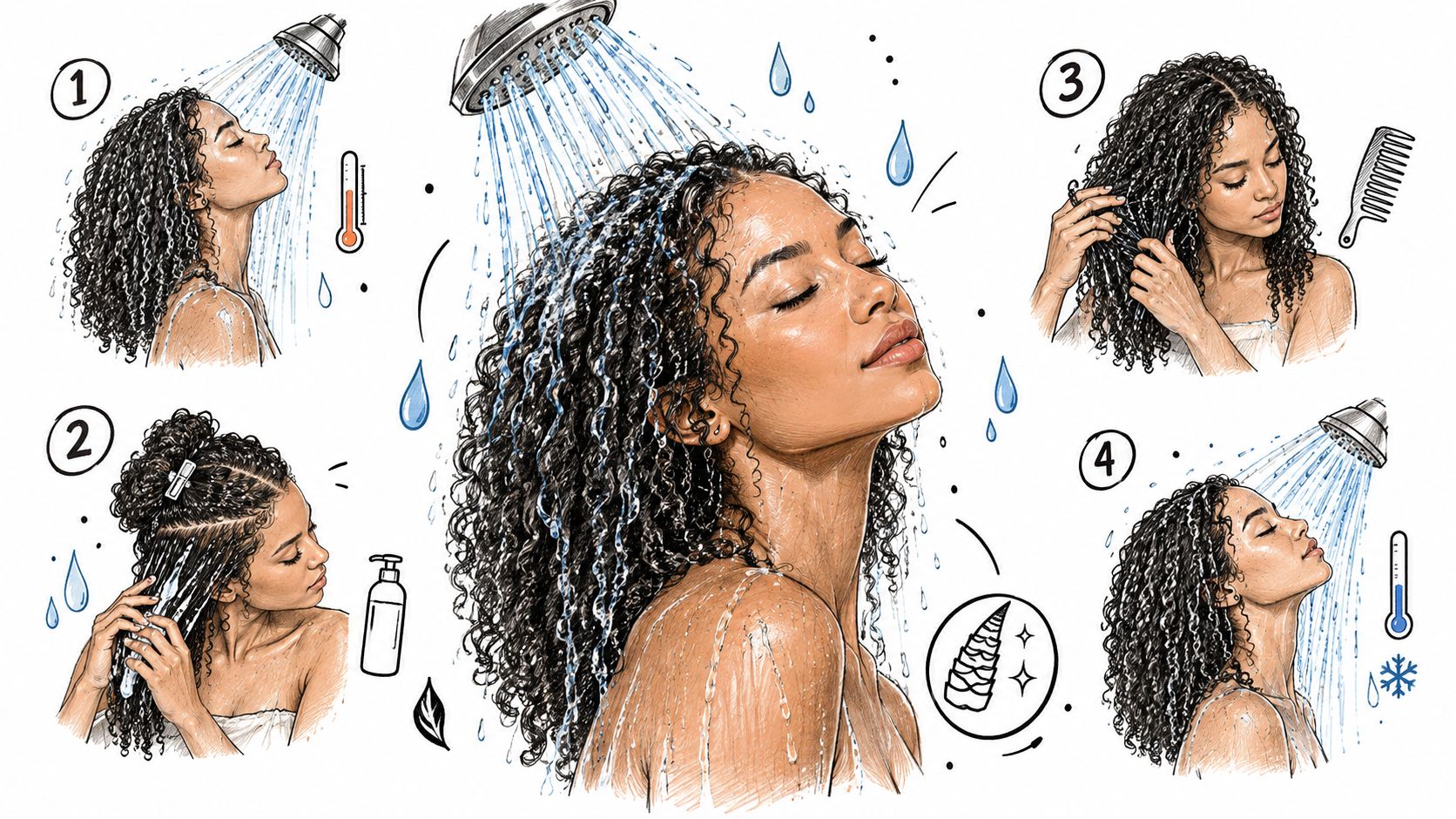
I'd run this routine on a day when your hair feels stubborn, not on a day when you're trying to rescue it with more and more product. Start with a full warm-water soak. A little surface wetness isn't enough for tightly packed cuticles.
Cleanse small, then condition smaller
Use a lightweight cleanser on the scalp, and keep the amount modest. The point is to remove oil and residue without re-coating the fiber. After rinsing, apply a lightweight rinse-out conditioner to soaking-wet hair in sections, not in one big glob on damp curls. Small amounts spread better, and sectioning keeps you from missing the lower layers.
Finger-detangle while the conditioner is in, then rinse thoroughly. If you're tempted to leave extra conditioner in because the hair still feels rough, stop. Roughness at this stage can mean slow wetting, not a need for more residue.
Add warmth only if it earns its place
A brief warm-water, steamer, or hooded-dryer phase can help conditioner work better on tightly packed cuticles, but only if the heat is comfortable and controlled. Use it after the conditioner is on, not before you've even saturated the hair. Then rinse cool enough to finish the wash with less surface swell and less frizz.
Direct rule: if your hair gets softer with brief heat and cleaner without getting heavy, keep it. If it gets limp, drop it.
Finish with a light leave-in or styler, again on wet hair and in small sections. If strands look coated, don't stack more products. Use less, not more. A low-porosity routine works when every step makes it easier for water to enter and easier for the hair to stay clean enough to accept the next step.
Reading Ingredient Labels for Low Porosity Hair
Label reading gets easier when you stop chasing “good” and “bad” lists and start looking for weight, film, and rinse behavior. Water-based products usually win because they spread more evenly on slow-absorbing hair. Lightweight conditioners, aloe-based sprays, and humectant-forward formulas are usually safer starting points than dense creams that sit on top.
What usually behaves well
Look first for formulas that feel thin, rinse clean, and don't need a lot of force to spread. Humectants such as glycerin and panthenol can make sense when the rest of the formula isn't overloaded, and light conditioners are easier to distribute on thoroughly wet hair. You're trying to feed the strand a manageable layer, not trap it under a film.
What usually causes trouble
Be skeptical of formulas that lean hard on dimethicone-heavy silicones, heavy butters like shea or cocoa, dense mineral oils, or multiple film-forming polymers. Those aren't automatically evil ingredients, but on slow-absorbing hair they often build up faster than they improve softness. If your curls go limp, dull, or waxy, the label is probably part of the story.
| Ingredient Type | Often Well Tolerated | Use with Caution |
|---|---|---|
| Water-based leave-ins | Thin sprays, milks, lightweight creams | Dense creams applied in large amounts |
| Humectants | Glycerin, panthenol, aloe-based formulas | Heavy formulas stacked with multiple humectants |
| Silicones | Light, rinseable formulas | Dimethicone-heavy products that coat easily |
| Oils and butters | Small amounts on very dry ends | Shea, cocoa, mineral oil, frequent sealing |
| Protein | Symptom-led, occasional use | Automatic use based only on “low porosity” |
Protein deserves restraint. Porosity alone does not mean you need it, and too much can leave hair stiff or brittle. Use protein only when the hair is signaling that it wants it, after heat, coloring, or repeated stress, not because a quiz told you to.
The Heat Question and When It Actually Helps
I'm pro-heat, but only when heat has a job. Warm water, a steamer, or a hooded dryer can improve conditioner spread and help tightly packed cuticles cooperate. The second it becomes a standing rule instead of a tool, people start overconditioning hair that didn't need the extra help.
Heat is useful when softness improves and residue doesn't
Use brief heat after the conditioner is already on saturated hair. That's the point where it can help the product interact with the strand more effectively. On fine, dense, or scalp-sensitive hair, though, the trade-off is real. Too much warmth, too often, can make the routine feel fussy, and frequent leave-in layering in humid conditions can leave curls limp instead of defined.
If you live in a dry climate, you may tolerate a slightly longer warm-water phase. If you live somewhere humid, the same amount of heat and product can go too far. The decision should come from your hair, not from a universal rule.
Test one no-heat wash against one gentle-heat wash back to back. Keep the version that gives you softer hair without extra residue.
I'd keep the comparison simple. If gentle heat improves softness, definition, and next-wash cleanliness, it earns a place in your routine. If it adds time and leaves the hair coated, skip it. Good curl care is selective, not ceremonial.
Tracking Four Outcomes Across Wash Cycles
Stop judging the routine by one bad day. Track wetting speed, drying duration, curl definition, and residue over several wash cycles. Those four signals tell you much more than a single compliment in the mirror or a random frizzy day after bad weather.
Use a one-variable rule
Change only one thing at a time. If you clarify, don't also switch stylers, masks, and leave-ins in the same wash. If you try heat, keep the conditioner amount stable. That's how you learn what moved the result.
Here's the only kind of note-taking you need:
- Wetting speed: does water soak in faster after clarification or after changing products?
- Drying duration: does hair dry in a reasonable time, or does it stay damp and coated?
- Curl definition: do strands clump cleanly, or do they collapse under product?
- Residue: does hair feel clean, soft, and touchable, or waxy and dull?
Reassess after chemical or heat stress
Bleaching and repeated heat can change how hair behaves, sometimes making it more permeable and more vulnerable at the same time controlled absorption testing. That means the routine that worked on virgin roots may fail on colored ends. Don't keep the same routine forever and call that consistency. Recheck the lengths after any color service or long stretch of heat styling.
Your 30-Day Low Porosity Plan
Week 1, diagnose
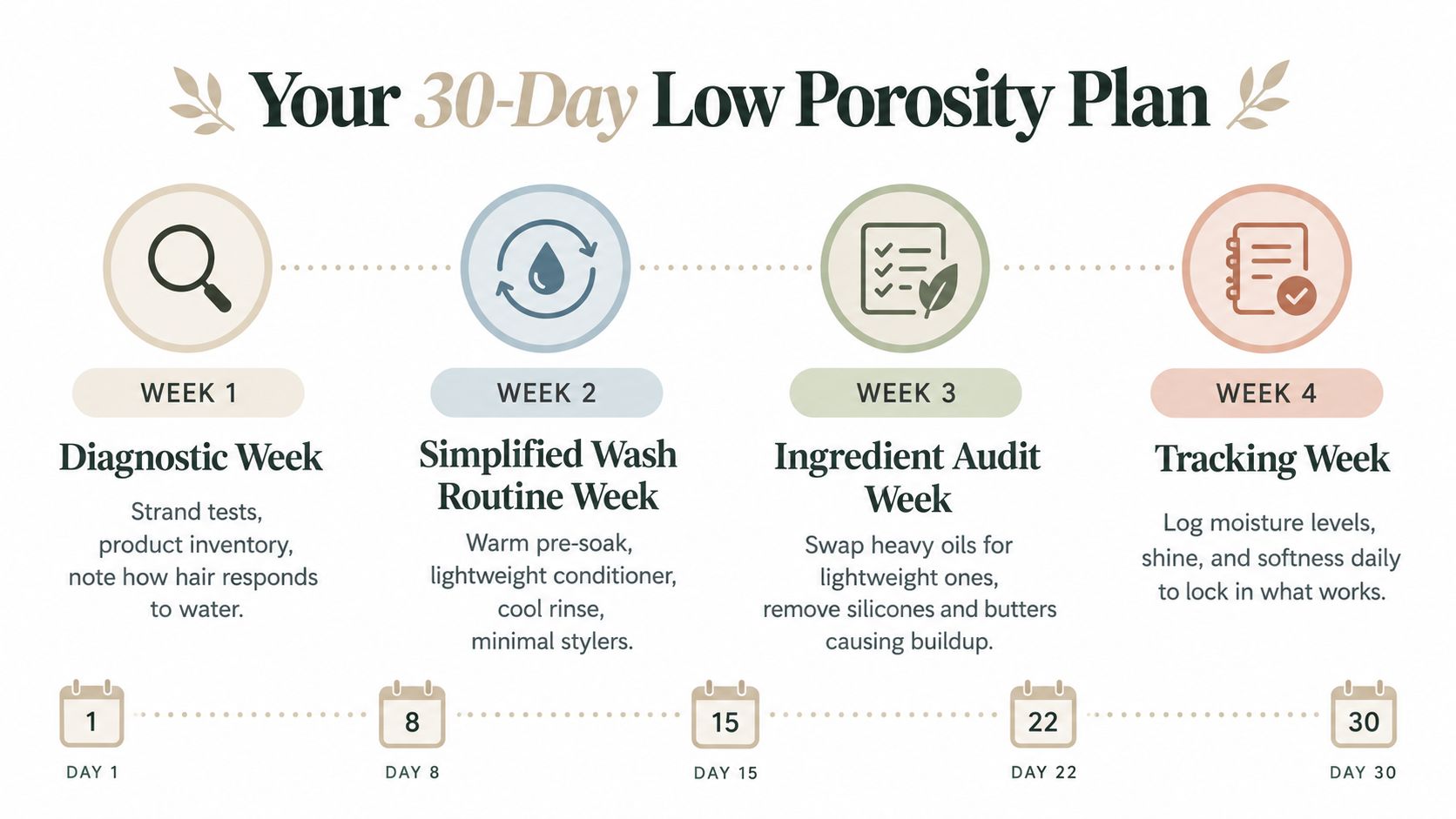
Clarify once, then watch what happens to wetting, drying, and softness. Inventory the products already in rotation and note which ones leave the hair coated. If the hair changes sharply after the cleanse, you've found buildup, not a mystical porosity curse.
Week 2, simplify
Run one wash day with a warm pre-soak, a lightweight conditioner, and minimal styler. Keep every amount small. If the hair looks better, don't celebrate by adding more products next time. Keep the routine lean.
Week 3, audit ingredients
Drop the thickest oils, butters, and heavy coatings first. Keep an eye on silicones and film-formers if the hair still feels dull or flat. The goal is not purity, it's cleaner water access and less surface drag.
Week 4, lock the pattern in
Track moisture feel, shine, softness, and residue through the week. If one version clearly wins, repeat it. If the hair stops matching the routine after color, seasons shift, or heat exposure increases, go back to diagnosis instead of forcing the old plan.
If you're done guessing, use a routine that adapts to what your hair does, not what a label says it should do. Coil builds curl routines around porosity, density, scalp condition, and daily check-ins, so you can stop overloading coated hair and start adjusting with evidence.
Crafted with Outrank tool