How to Define Curls: Wash-Day Steps for Wavy to Coily Hair
How to define curls step by step: a wash-day routine, humidity fixes and product tips for wavy, curly and coily hair.
You did the wash. You scrunched. By lunch the clumps have opened, the crown looks fuzzy, and you're not sure whether the gel failed or the weather did. The wash-day steps below stay the same from wavy through coily hair. What changes is one variable at a time, judged over three weeks, so you can see which single change holds when the air shifts.
Read Your Curl Pattern, Porosity and Density
The letter on your bottle rarely matches the hair in the mirror. Wet, it reads loose. Dry, it springs tighter. Stretch it and the pattern almost disappears.
The label many people already use is the André Walker Hair Typing System, developed by hairstylist André Walker in the 1990s and set out in his 1997 book Andre Talks Hair. As Allure's curly-hair care guide lays out, the system sorts hair into four families: Type 1 straight, Type 2 wavy, Type 3 curly, and Type 4 coily or kinky. Letters A, B, and C mark increasing tightness. 2A is a loose wave, 2B a clearer S, 2C a strong wave on the edge of a curl. 3A–3C get progressively tighter. 4A–4C are coils, and 4C often shows the least consistent pattern. It is a consumer vocabulary, not a clinical measurement. The same head can carry more than one pattern, and wetness, styling, damage, humidity, and shrinkage all change what you see. The original system didn't fully lock in the 4C wording. Natural-hair communities online later widened the scale for tighter coils.
| Curl label | Typical pattern | Common definition challenge |
|---|---|---|
| 2A | Loose wave | Waves flatten quickly and need light hold |
| 2B | More defined S-shaped wave | Frizz appears when the wave is not clumped |
| 2C | Strong wave bordering on curls | Weight can pull the wave out if product is too heavy |
| 3A | Loose, well-defined curl | Clumps fall apart if handled during drying |
| 3B | Tighter, springy curl | Shrinkage and frizz rise in humidity |
| 3C | Tight, dense curl | Needs more water and more hold to clump |
| 4A | Tight coil with visible pattern | Pattern can blur without moisture and a firm hold |
| 4B | Very tight coil with a zigzag shape | Shrinkage is high and definition needs sealing |
| 4C | Tightest coil, least consistently visible pattern | Definition is hard to judge until fully dry |
Two checks matter more than the letter.
Porosity is how fast a fibre drinks water and lets it go. Drop a clean strand into a glass of room-temperature water. Fast sink means high porosity, a long float means low porosity, and a strand that hangs midway is medium.
Density is how many strands sit in one section. Part the hair and look at the scalp. A lot of visible scalp means low density, and that hair can't carry a heavy coat. Write down pattern, porosity, and density before the first wash day. If a styler leaves hair feeling coated, sort whether silicones belong on your curls before you add another layer.
How to Define Curls on Wash Day
How to define curls comes down to water first and hold second. A film-forming gel can't clump fibres that were never fully wet.
A Society of Cosmetic Chemists preprint on curly hair structure and care treats full hydration and clumping as the prerequisites for hold. Curly fibres are more elliptical than straight ones and take more energy to comb wet or dry, so brushing, towel rubbing, and fiddling split clumps into frizz. The same testing found that fixative gels and curl creams reduced measured shrinkage by up to 65% in type 3 hair and 69% in type 4 hair, though heavy formulas can flatten fine, low-density hair. Judge dry hair, not wet hair: at 60% relative humidity, type 3 hair can take about 6 hours to reach drying equilibrium, and type 4 hair about 8 hours.
Six moves, in order
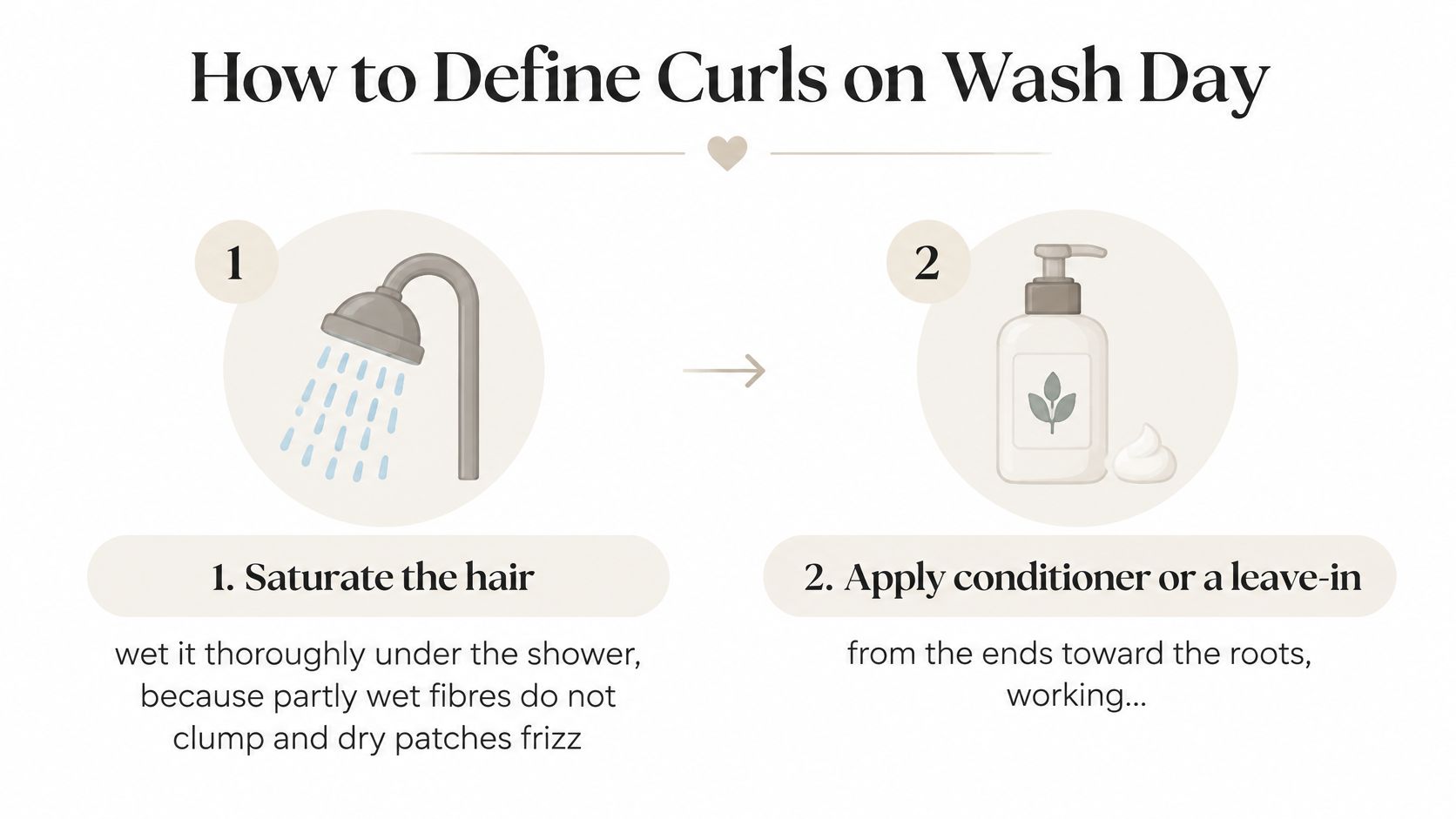
- Saturate the hair. Stand under the shower until every section is dripping, roots included. Partly wet fibres don't clump, and dry patches frizz as they set. The usual slip is misting the outside and calling it wet.
- Apply conditioner or a leave-in from the ends toward the roots. Work it through each section, not across the surface. Surface-only product leaves the inside of the curl fuzzy while the outside looks slick.
- Section, then add a film-forming styler while the hair is still wet. Four to six sections is enough for most shoulder-length hair. A gel or curl cream goes on dripping hair. If you wait until it's damp, the film grabs frizz instead of clumps.
- Smooth with praying-hands passes. Sandwich a section between flat palms and glide down to line the strands up. Skip the brush and the comb here. Dragging a tool through wet curls pulls clumps apart.
- Scrunch upward. Cup the ends and press toward the scalp so strands compress into bundles. One firm pass per section is plenty. Scrunching again and again just opens what you closed.
- Leave it alone until it's fully dry. No twisting, no "just checking," no diffuser hovering that keeps moving the hair. Touching during the set is the slip that undoes steps 4 and 5. Air-dry, or diffuse on low with the bowl still and the hair undisturbed.
When the cast comes off
Once the hair is completely dry, scrunch the cast out with your fingers or a soft cotton T-shirt. A brush will shred the clumps you waited hours for. Photograph the result in the same light, after equilibrium, not while it's still cool and wet. Wet curls always look more defined than the set you'll wear.
Practical rule: If the clumps look sharp at minute ten and fuzzy at hour six, you judged too early, not too harshly.
Heavier stylers can buy that shrinkage reduction and still kill volume on fine hair. If the dry result is defined but flat, the next wash day cuts the styler dose, not the water.
Choosing Products That Hold Without Weighing Down
Start with density, not the curl letter. Fine or low-density hair collapses under thick creams, butters, and two hold products stacked together. Use less, and use one hold product.
Gels lay down the firmest film. They suit frizz-prone hair on humid days. Overloaded, they dry crunchy and dull, and the crunch isn't definition if the hair feels like plastic.
Curl creams give softer hold plus moisture. They suit looser patterns and hair that feels dry in mild weather. On fine waves they often pull the S-shape straight by afternoon. A side-by-side look at curl cream versus gel is worth it before you buy both.
Leave-ins are the moisture base under the styler, applied to wet hair. They are not hold. Used alone, they soften and then let clumps drift.
Mousse and foam give light hold and lift. They're the better first styler when low-density hair goes flat under gel. They fail when you need a hard film against heavy humidity.
I would start with a pea to a nickel of styler per section on shoulder-length hair, then add only if the dry clumps stay loose. Shoulder-length 3B hair in four sections might take four nickels of gel total. The same length in fine 2C hair often needs half of that, or a foam instead.
Read the label when hair feels coated or weighed down. Heavy butters and some silicones sit on low-porosity or fine hair and stop the next wash from wetting evenly. Change one product per wash day. Two swaps at once make the result impossible to trace.
Soft hold on dry hair beats a crunchy cast you have to break apart with a brush.
Why Curls Lose Definition in Humidity
Monday's routine looked sharp. Thursday, same products, same scrunch, and the clumps have opened by noon. The steps didn't change. The air did.
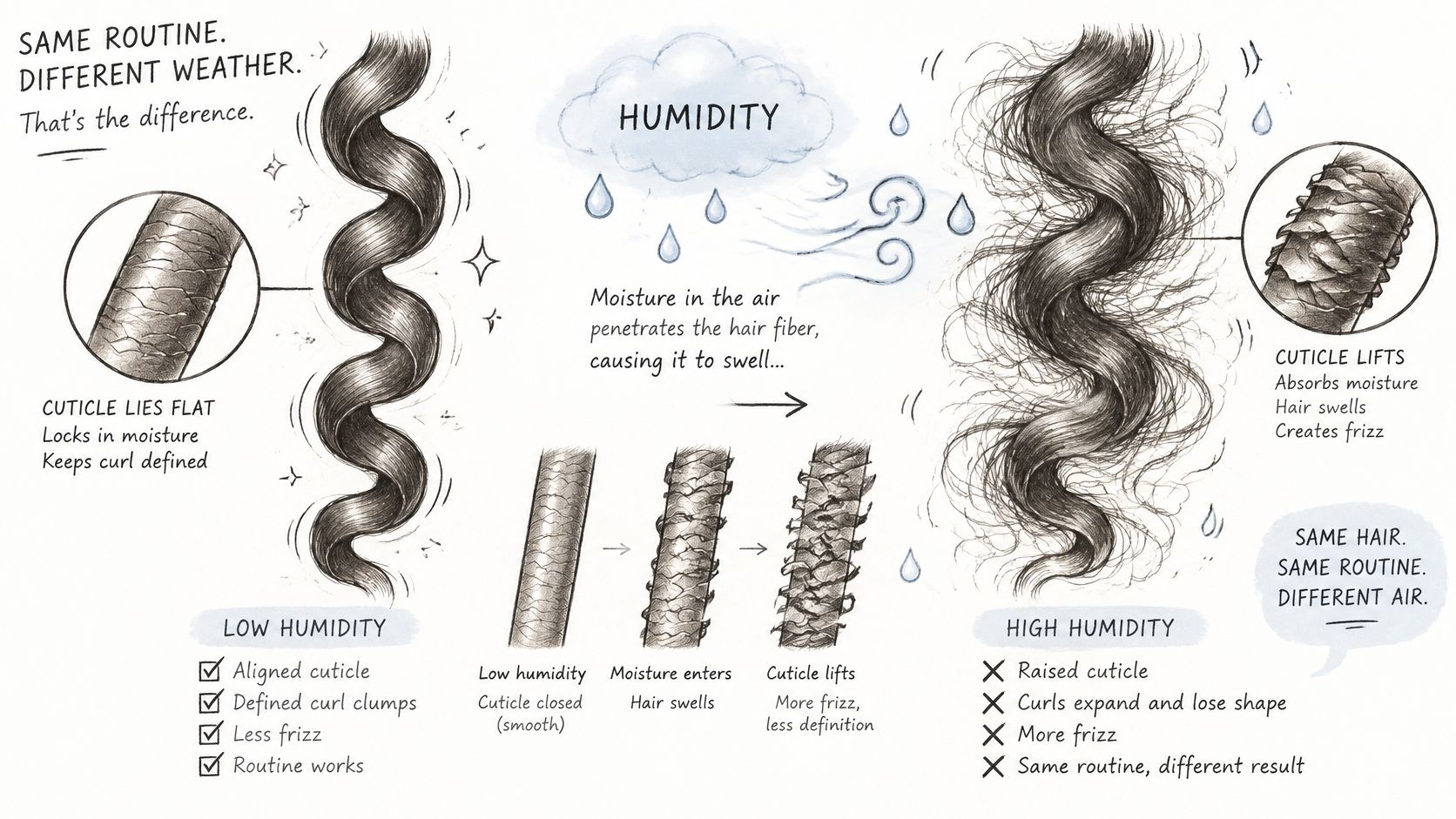
Curl definition follows the fibre, not only the pattern you can see. Curlier hair tends toward a more elliptical cross-section, uneven cuticle cells, and differences between the two sides of the cortex, which tracks with greater fragility and different moisture behavior. A professional cosmetic-science review, covered in the International Journal of Cosmetic Science, reports that Type 1 fibres are roughly cylindrical, with ellipticity around 1.0–1.40, while Type 3 and Type 4 fibres are more oval, with ellipticity extending to about 3.0. Porosity rises as the curl tightens, and Type 1 fibres hold more moisture than Type 3 and Type 4 fibres in both dry and humid air.
Hair takes water from damp air and gives it back when the air dries out. In humidity the fibre swells, clumps drift, and frizz shows. In very dry air the same hair can turn brittle, and split ends follow. Extra water isn't always the fix. On a muggy day, more humectant can pull more water in and swell the fibre until the shape softens. On a dry day, skipping a seal leaves the lengths unprotected. That's the practical split between humectants for curly hair and a plain film-forming styler.
A 2024 taxonomy study in that same review found that all participants discussed humidity in relation to rising frizz over time or curl shrinkage. In the sample, 47.6% identified as 3A, 20.3% as 3B, and 10.85% as 4C. Visual definition and tactile frizz are not the same thing. Humidity can change surface friction so hair feels rough even when the clumps still look tidy.
This short clip shows the same swelling in plain view, which is easier to trust than a mirror check at hour one.
When the hair has actually finished drying
Don't score the style while it's still cooling. Use equilibrium with the room.
| Hair type | Time to dry to equilibrium at 60% humidity | Shrinkage reduction with gel or curl cream (up to) |
|---|---|---|
| Type 3 (3A to 3C) | About 6 hours | 65% |
| Type 4 (4A to 4C) | About 8 hours | 69% |
If you live somewhere that sits well above or below that humidity, the clock shifts, but the rule doesn't. Photograph after the hair matches the room, then decide whether hold failed or you looked too soon.
Fix Frizz, Stiffness and Collapse Without Damage
Frizz by midweek is the complaint that sends people shopping. The product usually isn't the first problem. The symptom is.
Don't rebuild the whole routine. Match one row, change that one thing, and run it on the next comparable wash day.
| Symptom | Likely cause | Fix to try first |
|---|---|---|
| Soft hair with no visible curl | Hold too light or too much handling | Use a firmer film-forming styler and stop touching the hair during the set |
| Stiff, dull or flat hair | Too much product or too little water | Saturate the hair fully and cut the styler amount by half |
| Frizz within hours in humidity | Moisture swings and weak hold | Switch to a lightweight high-hold styler and style on a drier day if possible |
| Persistent roughness | Inadequate conditioning or over-cleansing | Condition more and cleanse less often |
| Breakage at knots and tangles | Dry detangling and mechanical force | Detangle wet with conditioner in small sections |
| Scalp pain, tightness, flaking or hair loss | Tight styles or scalp condition | Loosen the style and see a professional if symptoms persist |
A Physics Magazine brief on curly hair makes the same split. Undefined but soft hair usually needs stronger hold or less handling. Stiff, dull, or flat hair points to excess product or not enough water. Persistent roughness points to weak conditioning or cleansing too often. Curly and kinky hair can be harder to saturate because cuticle layers sit close together, yet hydrated fibres bundle, and as water leaves, strands separate and frizz shows. When humidity knocks definition out, a lightweight, high-hold film former beats another heavy cream. Record humidity, drying time, amounts, and the result, because tactile frizz can jump with humidity through surface friction even when the photo still looks fine.
A refresh that doesn't restart wash day
On day two or three, mist the lengths until they're evenly damp, not dripping. Add a few drops of leave-in to the ends only. Scrunch upward once and let the hair dry without touching. Don't pile on a fresh gel coat over yesterday's film or you'll get stiffness without new clumps.
Detangle wet, with conditioner, in small sections. Dry detangling breaks the bundles you aligned, and knots add bending stress along the shaft. For coily hair, keep tension low. Regular conditioning and a seal from a leave-in, oil, or emollient protect the length better than a tighter style.
Scalp pain, a style that pulls, flaking, or shedding outranks a sharper curl. Loosen the style, and get a professional look if those signs don't settle.
Best definition for one photo isn't the same as the best outcome over a month. If breakage is rising, drop the technique intensity before you chase a crisper cast.
Run a Three-Week Test and Keep What Holds
Keep the six wash-day steps fixed for three weeks. Pick one variable to move: water level, styler amount, drying method, or the refresh. The cleanser and the rest of the order stay put, because two changes make the result unreadable.
What to write down
After the hair is fully dry, log four lines.
- Humidity that day: a weather-app reading is enough. Note morning and afternoon if they differ.
- Drying time: from styler-on until the roots are dry, not until the hair "looks mostly dry."
- Product amount: nickels, pumps, or grams. "Some gel" won't compare next week.
- The result: one concrete line, such as "clumps held overnight" or "frizz by 3 p.m."
A notebook or notes app is enough; the value is in using the same units every wash. Run several wash days across the three weeks so the log catches both damp and dry weather. Skip new products during the test, even if a bottle is almost finished.
Read the log by humidity first, then by result. The keeper is the setting that held clumps on a wet afternoon and still looked calm on a dry day; a single lucky photo does not count. If the cast was stiff, I would move styler dose next. If clumps never formed, move water. If frizz showed only late, move the refresh before you touch the styler.
If you want the routine itself built from your curl type, porosity, density and scalp, take Coil's 13-question quiz in the iPhone app, which takes about two minutes, and use the 20-second daily check-in to tick off what you did, rate how your curls feel and optionally add a selfie.