Are Silicones Bad for Curly Hair? What the Research Shows
Are silicones bad for curly hair? Learn which silicones help curls, when buildup happens, and how to choose products by porosity and density.

Silicones are not bad for curly hair by nature. Their effect depends on the silicone type, the formula, and how you cleanse, and some shampoos use them at about 0.5 percent.
The most popular curl advice still treats every silicone like a stain you can never wash out. That rule grew out of co-wash routines, where conditioner is the only cleanser and a water-insoluble film has nothing strong enough to lift it. Outside that routine, the same film can cut snags, add slip, and shield a rough cuticle. Banning the whole family because one member clings is like throwing out every jacket because a raincoat holds water if you never take it off.
The useful test is narrower. Which silicone is in the bottle, does water or a surfactant remove it, and does your wash day do that job? Fine waves and dense coils do not fail the same way, and a weekly shampoo is a different system from conditioner-only washing.
The Short Answer on Silicones and Curly Hair
Silicones are functional conditioning agents, not a universal toxin for curls. What changes the result is the specific silicone, how water-soluble it is, the rest of the formula, and the cleanser you use afterward.
A 2023 dermatology review places silicones among the most active conditioning ingredients because their film lowers friction between hair fibers, which shows up as more shine, slip, smoothness, and less frizz. The same review describes dimethicone as a protective coating that reduces abrasive forces on the shaft, and notes that silicones are commonly used at approximately 0.5 percent in some shampoo formulations. That is a thin coat, not a shellac.
Think of the film as a thin rain jacket on each strand. It keeps fibers from rubbing each other raw while you detangle, and it can slow the way humidity roughs up the surface. Leave the jacket on through wash after wash that cannot unzip it, and water plus conditioner sit on the outside. The hair feels coated because the film was never meant to be permanent. It was meant to be renewed.
The working rule is simple. Do not ask only whether a silicone is on the label. Ask whether the slip you gain is worth the residue your wash can clear. That answer changes with density, porosity, how often you style with heat, and whether a surfactant touches your scalp on a schedule you can keep.
The rest of this guide sorts silicones by how they leave the hair, what the film does on bends and coils, how buildup shows up, which curl profiles handle which type, and a four-week check you can run on one product.
Silicones are functional conditioning agents, and the routine decides whether they help or weigh curls down.
Silicone Types Compared for Curly Hair
| Silicone type | Water solubility | Effect on curls | Buildup risk |
|---|---|---|---|
| Dimethicone | Insoluble | Reduces friction and detangling force; film accumulates | High with co-washing or infrequent shampooing |
| Amodimethicone | Insoluble | Targets damaged, porous areas; strong slip | Moderate to high |
| Cyclopentasiloxane | Volatile (evaporates) | Light slip, little lasting film | Low |
| Dimethicone copolyol | Water-soluble | Conditioning without heavy residue | Low |
| Silicone quaternium types | Water-dispersible | Conditioning and detangling | Moderate |
Read the table from solubility outward, not from the brand name. Insoluble means a water rinse will not finish the job. Volatile means most of the material leaves as it evaporates. Water-soluble and water-dispersible mean a normal rinse, sometimes with a mild shampoo, is enough for many routines.
Dimethicone is the name people picture when they say silicones ruined their curls. It lays down a hydrophobic coat that makes wet detangling easier, then stays if you only co-wash or shampoo rarely. On thick, frizz-prone coils that get a real shampoo, that same coat can be the reason the comb stops snagging. On fine waves washed with conditioner alone, it is the reason roots go flat.
Amodimethicone is also insoluble, but it is built to stick where the cuticle is already rough or negatively charged. Damaged, high-porosity lengths often get the slip. Healthier roots get less. The trade-off is still residue. If several leave-ins stack this polymer, even porous hair can feel wrapped rather than conditioned.
Cyclopentasiloxane behaves more like a carrier than a coat. It gives slip while the product is wet, then evaporates, so the lasting film is small. People who hate weight and still want a serum to spread often do better here than with a heavy dimethicone cream.
Dimethicone copolyol rinses with water. Conditioning is lighter, which suits fine curls that lose bounce the moment something films the strand. You give up some of the long-wear shield. You also skip the slow pileup that makes people clarify every other week.
Silicone quaternium types disperse in water and add a detangling charge. Buildup risk sits in the middle. A rinse-out conditioner with one of these is a different bet from a butter that lists dimethicone near the top.
On an ingredient list, scan for endings -cone, -siloxane, and -methicone. "Silicone-free" on the front of the bottle is a marketing line. The list is the record. Match solubility to your wash habit before you match the product to your curl pattern. An insoluble silicone plus a weekly surfactant shampoo is a controlled system. The same silicone plus co-washing is a buildup system.
What Silicones Do for Curls and Coils
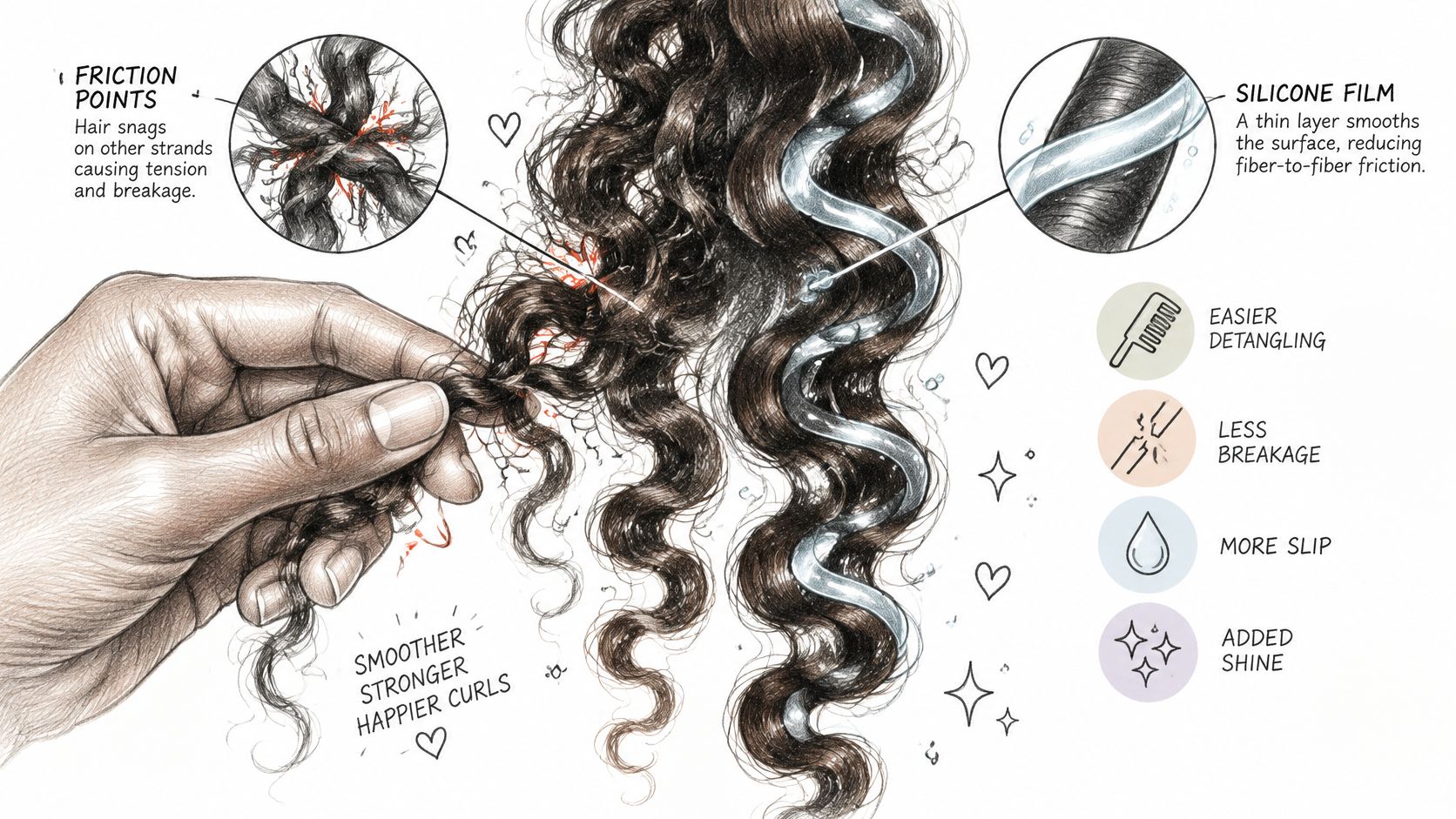
Curls tangle because the fiber is not a straight rod. Each bend is a place where one strand can hook another, and lifted cuticle edges add drag. Detangling then becomes a friction problem, not a moisture slogan. A silicone film lubricates that surface so fibers slide instead of sawing.
The gains you can feel line up with that physics.
- Slip and fewer snaps: Combing force drops, so you break fewer strands while working from ends to roots.
- A smoother look: The coat fills rough spots, so light reflects and the hair reads shinier.
- Frizz control in humidity: A hydrophobic surface slows uneven water uptake that swells the fiber and kicks pieces out.
- A buffer against heat and weather: The film takes some of the abrasive hit before the cuticle does.
Dimethicone is the coating most often credited with cutting those abrasive forces on the shaft. Separate medical writing describes silicone oils as thin, spreadable films that can guard hair from chemical and environmental damage, add body, raise water repellency, and boost shine. A pretreatment study, using microscopy and combing-force tests, found protection against bleaching and oxidative dye damage. Deposition can be protective. It is not automatically damage.
One experimental two-in-one shampoo study measured approximately 400–650 µg of silicone per gram of hair on tested swatches and reported better visual damage scores after amodimethicone or silicone polyquaternium systems, as described in a review of silicone deposition. Deposition itself shifts with polymer type, molecular weight, how damaged the hair is, formula pH, temperature, and cationic bridging agents. "Silicone" is a family, not one switch.
Where the payoff is largest
Porous, weathered, or hard-to-detangle hair usually notices the benefit first. Say you have coily hair, you detangle soaking wet, and your rinse-out conditioner lists dimethicone. Knots that used to lock at the mid-lengths start to release, and fewer pieces snap at the comb. That is the film doing its job, not a sign you must avoid the ingredient forever.
Watch two signals over several days. Detangling should feel easier while the hair is wet and slippery. Frizz should stay quieter after the hair dries, not only in the shower. If slip improves and definition holds, the silicone is earning its place. If the hair only feels slick for an hour and then dull, you are looking at weight, not protection.
When Silicone Buildup Weighs Curls Down
Buildup is a stack, not a curse. It follows a short chain.
- Water-insoluble silicones such as dimethicone deposit along the fiber and beneath cuticle scales, where they improve manageability and lower detangling force.
- Each wash that cannot remove them adds another layer. Conditioner-only washing is the classic case.
- The film gets thick enough that the hair behaves differently. Water beads, products sit on top, and curls lose spring.
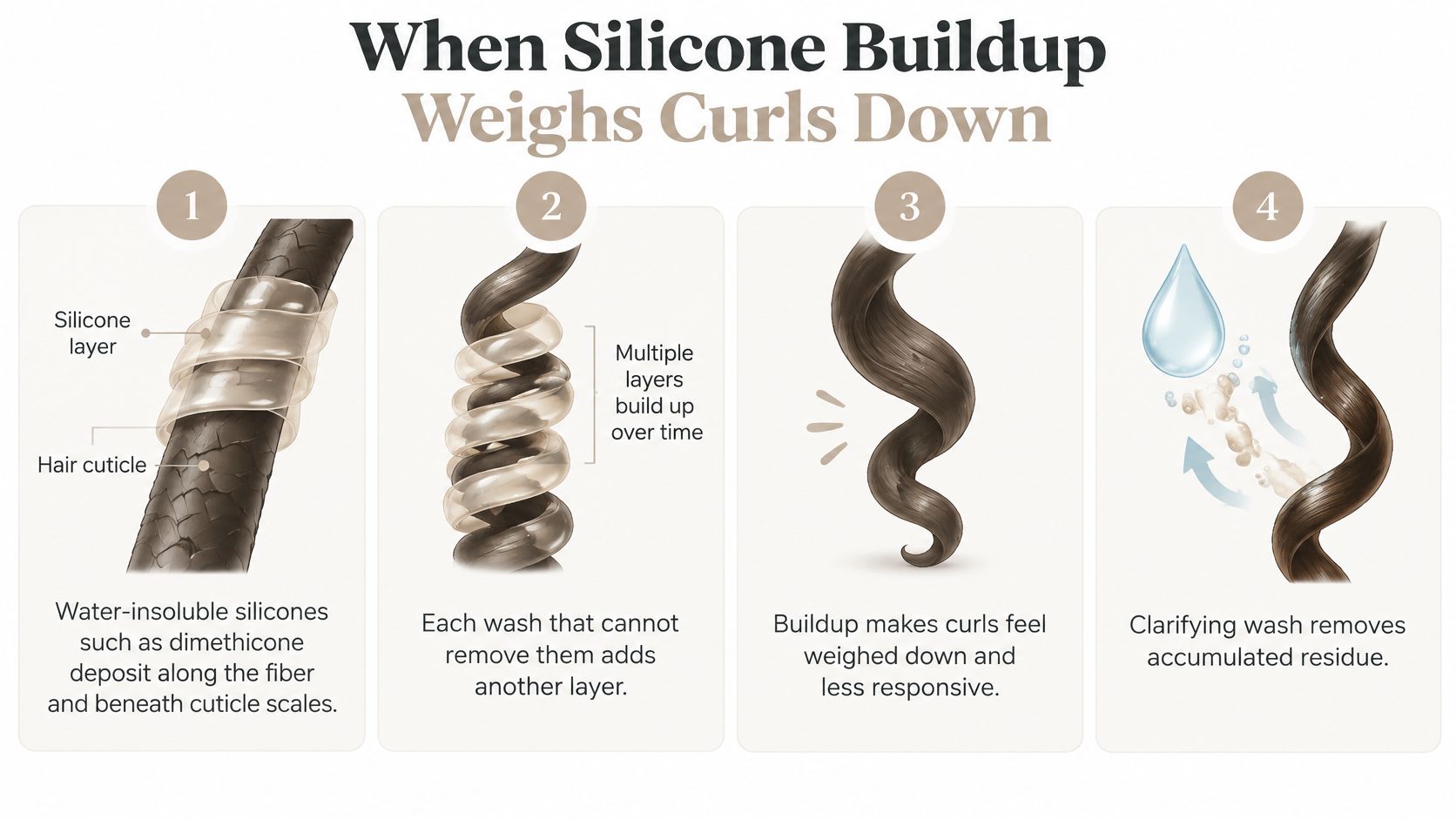
An NIH review of hair cosmetics states that nonsoluble silicones should be avoided with co-washing because buildup may occur. A later literature review adds that accumulated insoluble silicone may need stronger surfactants to come off, while excessive clarifying can dry the hair and stress the cuticle. Product-science testing has found that one clarifying shampoo can remove roughly 90 percent of silicone in tested systems, while ordinary shampoo may be enough for lighter deposits, according to a 2025 review of silicone accumulation.
What raises the odds
- Co-washing only: Conditioner cleans oil and light dirt. It does not reliably strip an insoluble silicone film.
- Infrequent shampooing: Weeks between surfactant washes let each application stack.
- Heavy leave-ins: A rich cream used daily lays more film than a rinse-out used once a week. If you are unsure what that step is doing, a plain guide to what a leave-in conditioner is helps you separate moisture from coating.
- Layering several silicone products: Shampoo, conditioner, cream, and serum can all carry insoluble types. Four light coats still add up.
Signs to check on your own head
- Limp roots that lose lift by the afternoon.
- Reduced definition and bounce, with clumps looking smeared rather than spiraled.
- A waxy or coated feel even after rinsing.
- Slower wetting, so water runs off instead of soaking in.
- Products sitting on top instead of disappearing into the lengths.
- Stiff, dull curls after a few weeks of the same lineup.
The trap is blaming roughness on silicone after you have clarified harshly three washes in a row. Aggressive surfactant use can lift the film and also leave the cuticle feeling straw-like. That dryness is a cleansing injury, not proof the ingredient family is poison. If the checklist above matches your hair, treat buildup as a routine mismatch. Clarify once, condition, and change either the silicone type or the wash that is supposed to remove it.
Matching Silicones to Your Curl Type and Porosity
| Hair profile | Silicone use | Wash approach |
|---|---|---|
| Fine, low-density, low-porosity curls | Water-soluble or volatile silicones only | Clarify every two to three weeks |
| Medium curls, normal porosity | Insoluble silicones in small amounts | Shampoo weekly |
| High-porosity or heat-styled coils | Insoluble silicones for friction and protection | Shampoo weekly with a gentle surfactant |
| Co-wash-only routine | Avoid insoluble silicones | Clarify about every four weeks |
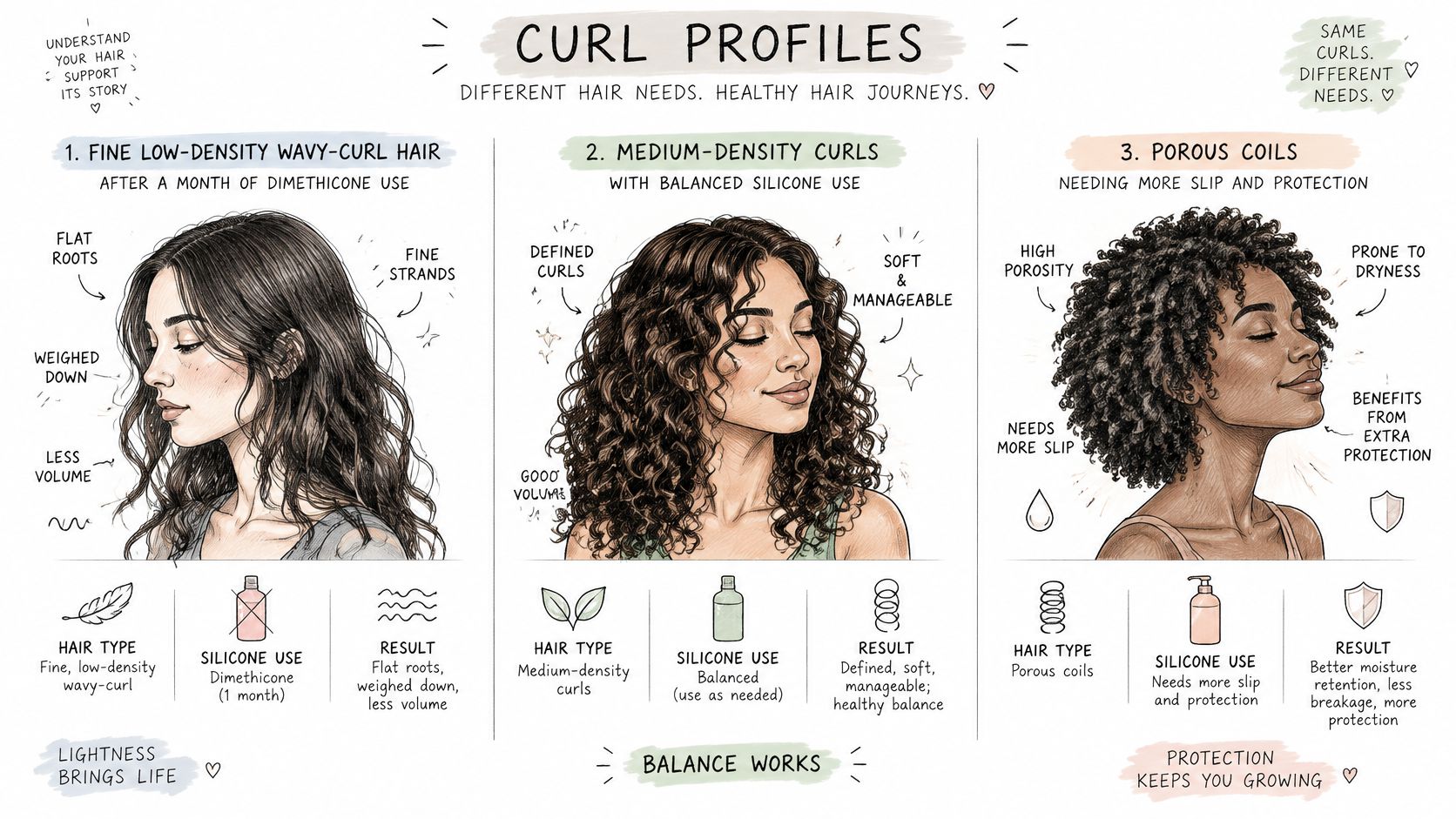
Pattern names (2A through 4C) describe shape. They do not tell you whether a film will sink in or sit on top. Porosity and density do more of that work, along with whether shampoo is in the week at all.
Porosity is how easily water gets through the cuticle. High-porosity hair, often from bleach, color, or years of heat, drinks product and also loses it fast. A film-forming silicone can slow that loss and cut friction on rough spots. Low-porosity hair has a tighter cuticle. The same film coats the outside, blocks water, and makes roots look greasy while the ends still feel dry. A low-porosity hair routine is built around that tight cuticle, not around chasing heavier seals.
Density is how many strands share the scalp. Dense, thick hair can carry a richer conditioner without collapsing. Fine, low-density hair shows residue early because each strand has less bulk to hide the coat.
Three routines, three fixes
A fine, low-density wavy-curl user loved a dimethicone leave-in for the first two weeks. By week four the roots were flat and water beaded on the crown. Switching to a water-soluble or volatile silicone, and clarifying every two to three weeks, brought the lift back without giving up all slip.
A 4C coily user who flat-irons the ends and has high-porosity lengths was snapping hair every detangle. Insoluble silicones in the rinse-out, plus a gentle surfactant shampoo once a week, cut the knots. The weekly wash kept the film from becoming a second cuticle.
A co-wash-only user with 3B curls kept a dimethicone cream because shampoo felt stripping. Definition faded and the hair felt waxy. The adjustment was either to drop insoluble silicones or to clarify about every four weeks, then return to conditioner washing. Both can work. Pretending co-washing removes dimethicone does not.
Curl pattern alone never picks the silicone. Two people with 3C hair can need opposite formulas if one shampoos weekly and the other does not, or if one has fine strands and the other has a dense, color-treated crown.
Check Products and Clear Buildup in Four Weeks
Run one change at a time. A cupboard purge feels decisive and teaches you nothing, because five products moved at once.
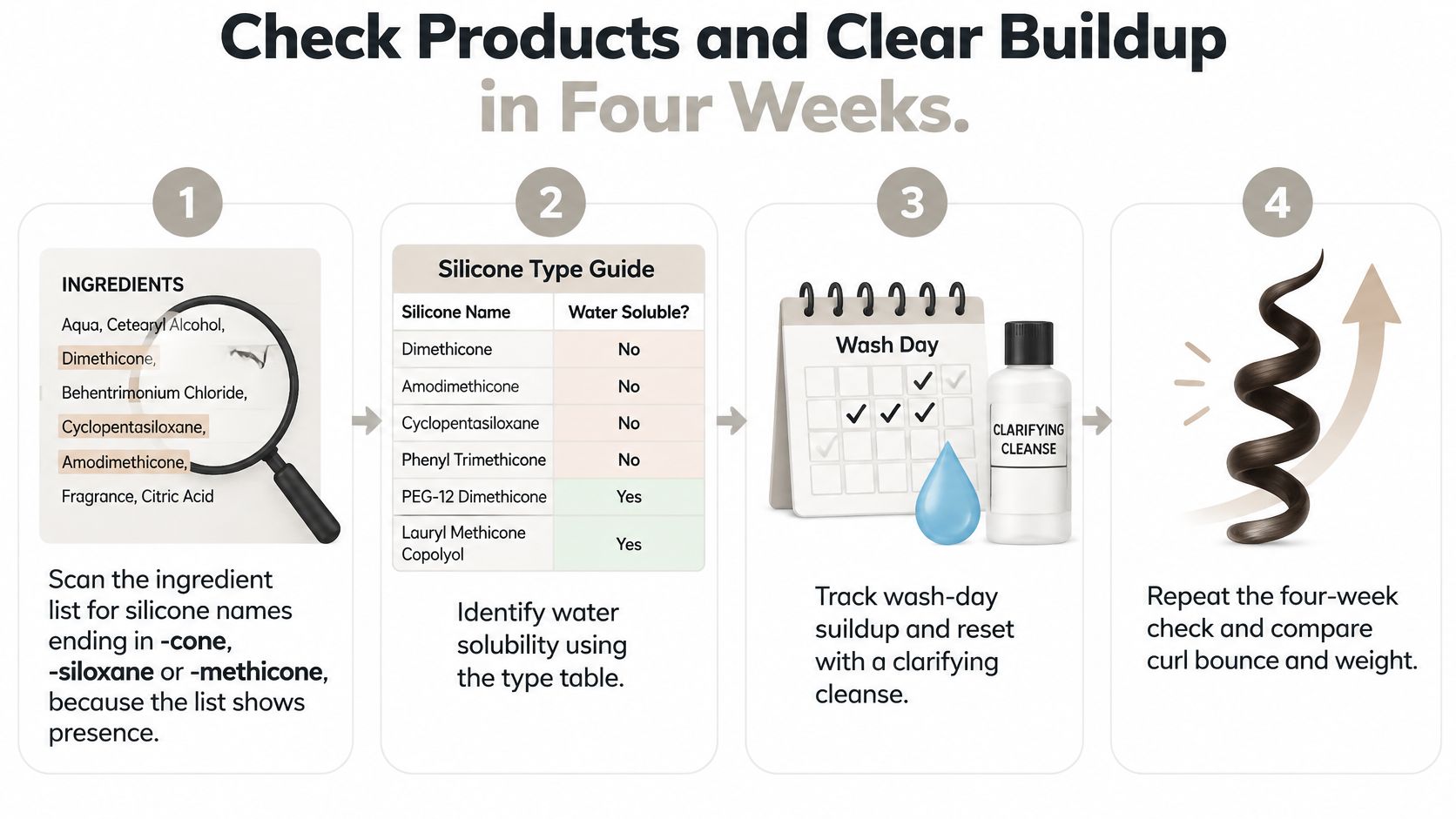
Read the label before you trust the claim
- Scan for silicone names. Look for endings in -cone, -siloxane, or -methicone. The list shows presence. The front label shows marketing. In 2024, 38 percent of newly tracked hair-styling product stock-keeping units carried a no-silicone or vegan claim, according to MarketLens IQ's shelf-monitoring data. A no-silicone badge does not replace reading. Vegan and silicone-free are not the same test, and waxes or heavy oils can coat hair too.
- Sort the name by solubility. Use the type table. Dimethicone and amodimethicone need a surfactant shampoo if you want them off. Cyclopentasiloxane and dimethicone copolyol ask less of your wash day. If you cannot tell which group a long chemical name sits in, treat it as insoluble until you confirm otherwise.
- Match the product to your washing routine. Co-wash users should not rely on insoluble silicones. Weekly shampoo users can. If your "clarifying" step is a sulfate-free co-wash, it is not clarifying insoluble film.
One product, four weeks
- Test a single silicone product for four weeks on a fixed wash schedule. Keep every other product the same. Log definition, frizz, weight, moisture, and roots once a week. One variable is the only way to know what changed. A notes app works. If you want the log tied to your own hair, we build a routine from curl type, porosity, density, and scalp, and product scoring works by photographing a label so silicones, sulfates, drying alcohols, and waxes get flagged. That is an optional aid next to the manual read, not a substitute for it. People comparing several bottles sometimes start with a roundup of apps that check curly-hair ingredients.
- If limpness or a coated feel shows up, clarify once. Use a surfactant-based clarifying shampoo, rinse fully, then condition. Do not clarify three days in a row to "reset harder." After that single reset, repeat the four-week test with a more soluble silicone or with fewer layers.
- Cut the pileup. Use less leave-in, and stop stacking a silicone serum on a silicone cream on a silicone gel. One filmed product is easier to judge than four.
What to write down each week
- Definition: Do clumps hold after drying, or do they droop by day two?
- Frizz: Is the halo smaller on humid days, or only slick while wet?
- Weight: Do roots lift when you flip your head, or stay stuck to the scalp?
- Moisture: Does water soak in on wash day, or bead for several seconds?
- Feel: Smooth, or waxy once the hair is fully dry?
Judge the dry hair, not the mid-rinse slip. Silicone feels amazing while it is wet. The question is whether curls still move two days later.
This is general hair information, not medical advice. Persistent scalp irritation, sudden shedding, or patchy hair loss should be checked by a dermatologist. A film on the cuticle does not explain every scalp problem, and clarifying will not fix one that needs a clinician.
This week, pull your current shampoo and conditioner and mark which one lists an insoluble silicone. That single note tells you whether your wash can remove what you are applying. If it cannot, change the silicone or change the wash, then give the new pair four quiet weeks before you judge whether silicones and your curls can share a routine.
Coil builds a wash plan from your curl type, porosity, density, and scalp, then scores a product from a photo of its ingredient label so silicones and other coating ingredients are flagged before they stack on your hair. If you want that check beside the four-week log, visit Coil.