Curly Hair Routine for Beginners: Wash Day First
Learn a curly hair routine for beginners: wash-day steps, a four-product kit, daily refresh habits, and fixes for frizz and buildup.
You bought the cream, the gel, the oil, and two things you can't quite explain. Your curls looked promising in the shower, then lost their shape by lunch. That's where many begin, and it's rarely a product problem. A workable curly hair routine for beginners starts with two unglamorous habits, full saturation and one change at a time. Get hair completely wet before you style it, run the same simple week twice, and you'll know what to adjust instead of guessing in the aisle.
Your First Week of Curl Care
Say it's Monday morning and you're staring at five open bottles. Yesterday's wash looked defined while it was wet, puffed up by noon, and feels rough today. The instinct is to add a sixth product. Don't. Your first week isn't a shopping exercise, it's a repeatable schedule that lets you see what water, conditioner, and hands off drying already do.
Here's the shape of the week before any detail.
| When | Focus | What to do | Time | Goal |
|---|---|---|---|---|
| Wash day | Scalp and lengths | Fully wet, shampoo the scalp, condition, detangle wet, leave-in, style soaking wet | 25 to 40 minutes | Clean scalp and defined clumps |
| Day after wash | Set and dry | Hands off while drying, scrunch only if a gel cast is fully dry | About 5 minutes of checking | Hold the wash day shape |
| Refresh days | Moisture and shape | Mist or smooth water or leave-in on dry sections, add a little gel, do not brush | 5 to 10 minutes | Revive frizz without a full wash |
| Clarify week | Buildup reset | One clarifying wash if gels, oils, creams, or pomades are used often, then return to a mild shampoo | Extra 10 minutes | Remove residue that blocks water |
| Scalp check | Whether to wash | Wash for sweat, odor, flakes, or heavy product, thick or tight curls at least every 2 to 3 weeks | As needed | Scalp comfort without over-drying |
Why Water Comes First
Moisture leads because curl shape is tied to water inside the fiber. A 2023 report from the American Physical Society describes the hair shaft as a keratin based fiber protected by overlapping cuticle cells, similar to roof shingles. Curlier and kinkier hair has those cuticle layers positioned closer together, which makes the fiber harder to saturate with water.
That one fact explains a lot of beginner frustration. Hydrated strands maintain their natural curl pattern, while moisture loss causes hair to seek water from the surrounding environment, contributing to frizz and loss of definition. If you style hair that's only half wet, you're asking a cream to do water's job. It can't.
Score for week one: After hair dries fully, is it soft and defined, rough and frizzy, or heavy and coated? That answer picks your next edit.
One template can't fit 2A through 4C equally well. Water uptake varies with curl tightness, cuticle condition, and porosity, so a loose wave and a tight coil won't need the same amount of leave-in or the same drying time. Treat that as normal, not failure.
Wash timing follows the scalp, not a daily default. Wash sooner for sweat, odor, flakes, or heavy product. For thick or tightly curled hair, don't stretch past 2 to 3 weeks just because a routine online told you to avoid shampoo.
At the end of your first dry down, write down one of those three results. Soft and defined means repeat it. Rough and frizzy points to water and handling. Heavy and coated points to amount. You don't need a new bottle to act on any of them.
Read Your Curls Before You Buy
Before you spend money, take five quick notes on your own hair. They'll tell you how much conditioner, leave-in, and styler to use far better than someone else's shelf photo will.
Five Notes on One Card
- Pattern: Look at a dry strand in daylight and place it roughly in the 2A to 4C range. You don't need precision. Waves flatten easily under heavy product, coils usually need more conditioner and more sectioning, and that difference matters more than an exact letter.
- Density: Part your hair in three places and check how much scalp shows. Visible scalp at each part usually means lower density, so use less leave-in and less oil than a dense head of hair would tolerate.
- Porosity: Drop a clean, product free strand into a glass of room temperature water and watch it. Slow sinking hints at low porosity, where products sit on top. Quick sinking hints at high porosity, which dries and frizzes fast. Treat this as a rough clue, not a lab result.
- Scalp: Note whether your scalp feels oily, flaky, or itchy by day three after a wash. That note sets your wash timing more reliably than your curl label does.
- History: List color, relaxers, heat styling, or protein treatments. Each one changes how a strand takes in and loses water, which changes how it responds to the same product.
Write all five on one card and keep it with your wash day steps. When later advice says reduce, clarify, or add water, check the card first. Fine, low density, low porosity hair that's gone limp needs less product, not a stronger one.
Your card is a starting dose, not a diagnosis. What hair does after two washes matters more than any single test.
How to Wash, Style, and Dry on Wash Day
Wash day works best as a fixed order you don't renegotiate in the shower. This overview shows the flow before the detailed steps.
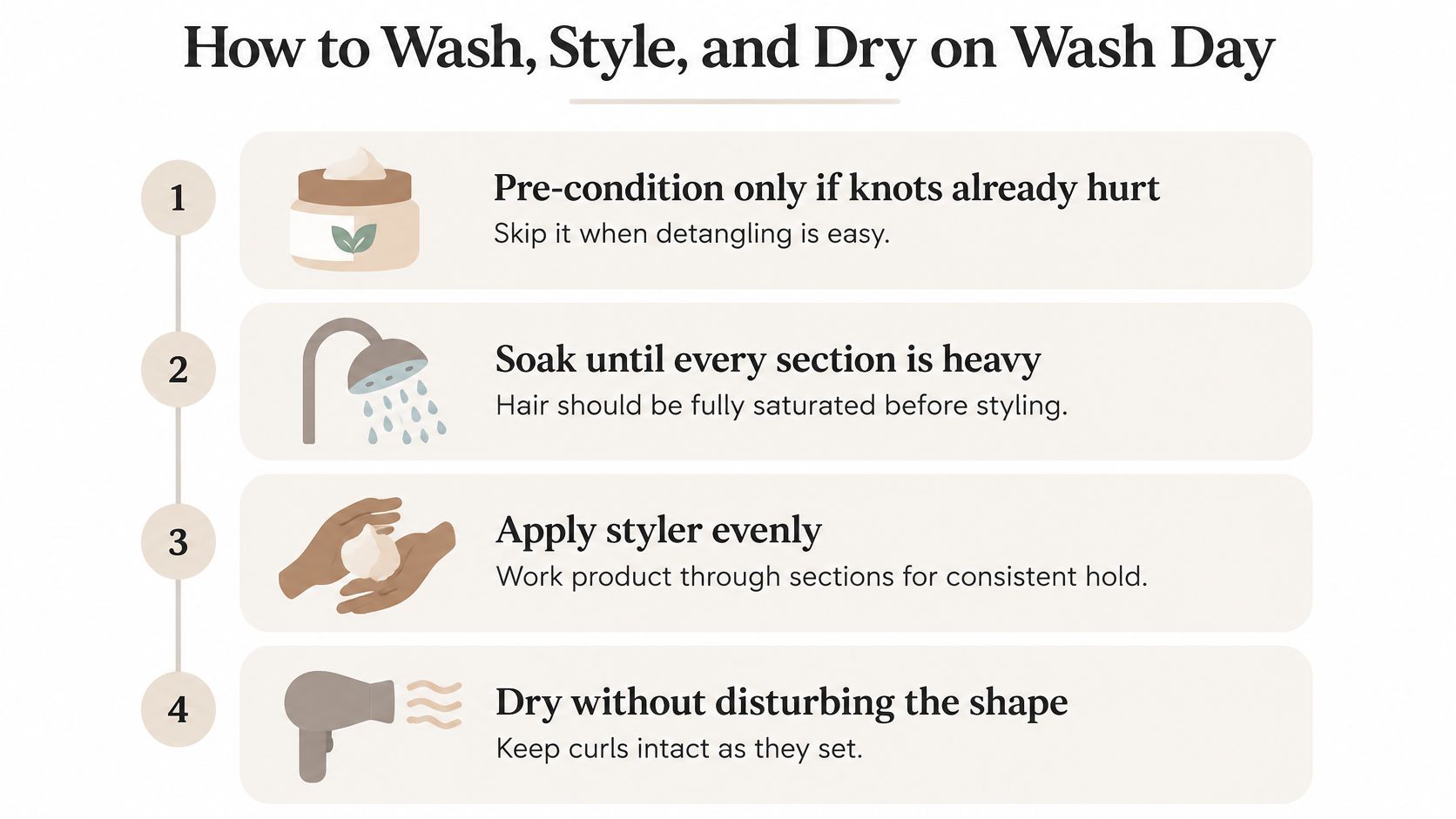
Follow these ten steps exactly for your first two washes. Changing the order mid shower is how steps get skipped and results get muddy.
The Ten Steps in Order
- Pre-condition only if knots already hurt. A little conditioner on dry tangles can make detangling gentler. If your hair isn't badly knotted, skip it, because extra steps add buildup without helping.
- Soak until every section is heavy. Hair should feel fully saturated, not just damp on top. Half wet styling is the main reason clumps never form.
- Massage mild moisturizing shampoo into the scalp with fingertips, not nails. The scalp is where sebum, sweat, and flakes collect. Scratching irritates skin and roughs up roots.
- Let the rinse carry cleanser through the lengths. Don't pile lengths on your head and scrub them like laundry. That creates tangles you'll pay for during detangling.
- Apply rinse out conditioner generously to all the hair. Conditioner gives you slip, and slip is what makes detangling safe. Skimping here causes snapped hairs later.
- Detangle in four to six sections, ends toward roots. Use fingers or a wide tooth comb while hair is wet and slippery. Starting at the roots drags knots tighter and hurts.
- Rinse fully if hair is fine or goes limp, leave a little if ends feel rough. This is your first weight adjustment. Fine waves often do better with a full rinse.
- On still soaking hair, apply leave-in, then one styler. Choose gel for hold or a lighter cream for softer shape, and scrunch upward. If you're unsure which fits you, our guide to curl cream versus gel for hold and softness breaks down the trade off. Don't use both on day one.
- Blot with a cotton T-shirt or microfiber cloth. Don't rub with a terry towel and don't dry brush. Rubbing lifts frizz before hair has even set.
- Air dry or diffuse on low heat and low speed, hands off until dry. Touching wet clumps breaks them into frizz. If a stiff gel cast forms, scrunch it out only after it's completely dry.
The logic is separation of jobs. The American Academy of Dermatology guide to curly hair care recommends washing curly hair when needed rather than automatically daily, and notes thick or tightly curled hair should generally be cleansed at least every 2 to 3 weeks for scalp health. Wash earlier for sweat, sebum, flakes, odor, or styling buildup.
Watching the order once can make the shower sequence easier to copy.
Finished looks specific. You should see elongated wet clumps, a scalp that feels clean but not squeaky, and only a few snapped hairs in the comb. If hair feels squeaky and rough, you likely cleansed the lengths too hard. If it separates into single fuzzy strands, it probably wasn't wet enough at styling.
The Four Products Worth Buying First
A curly-hair aisle can make a beginner feel as if every concern needs its own bottle. Textured-hair shoppers will find plenty of products marketed for their hair, while dryness and frizz are common reasons to seek them out. Start with one concern and a small cart. Keep each choice unchanged for two wash cycles so you can tell what helped.
For a simple first routine, buy a cleanser, conditioner, leave-in, and one styler. The right choices depend on your hair: a product that feels light on dense coils may weigh down fine waves. Add or swap one product at a time.
Starter Products and When to Skip Them
| Product | Job | How to use it | Skip or delay when |
|---|---|---|---|
| Mild moisturizing shampoo | Clean the scalp without stripping lengths | Apply with fingertips to the scalp; let the rinse water carry it down | Your scalp feels comfortable, with no sweat, odor, or flakes |
| Rinse-out conditioner | Add slip for detangling and condition the lengths | Apply generously each wash, then detangle in sections | Keep it in the routine on wash day |
| Leave-in conditioner | Condition hair after rinsing | Apply to soaking hair; use less on fine hair. Learn what a leave-in conditioner does | Hair feels heavy or coated after drying |
| Gel or curl cream, choose one | Help curls clump and manage frizz | Apply one styler to soaking hair. Gel usually gives firmer hold; cream gives a softer shape | Your clumps already hold their shape |
| Clarifying shampoo | Remove product buildup | Use for an occasional cleanse, then return to the mild shampoo | You use no styling products and see no residue |
| Oil | Coat the outside of the strand | If needed, smooth a tiny amount over dry ends | Hair is fine, low-density, or gets greasy easily |
The table includes two optional extras, but the first cart stays at four: shampoo, rinse-out conditioner, leave-in, and one styler. Clarifying shampoo and oil can wait until you have a reason to add them.
For example, if dryness and frizz are your main concerns, start with those four products and choose a light gel. Leave the deep treatment and second styler on the shelf. After two washes, consider what changed before adjusting: did the hair feel dry, look fuzzy, or lose its shape? Change one thing, such as the amount of leave-in, and keep the rest of the routine steady.
Oil coats the strand; it does not add water. If you use it, keep the amount tiny and apply it last, especially on hair that gets greasy easily.
Refresh Days and Habits That Keep Definition
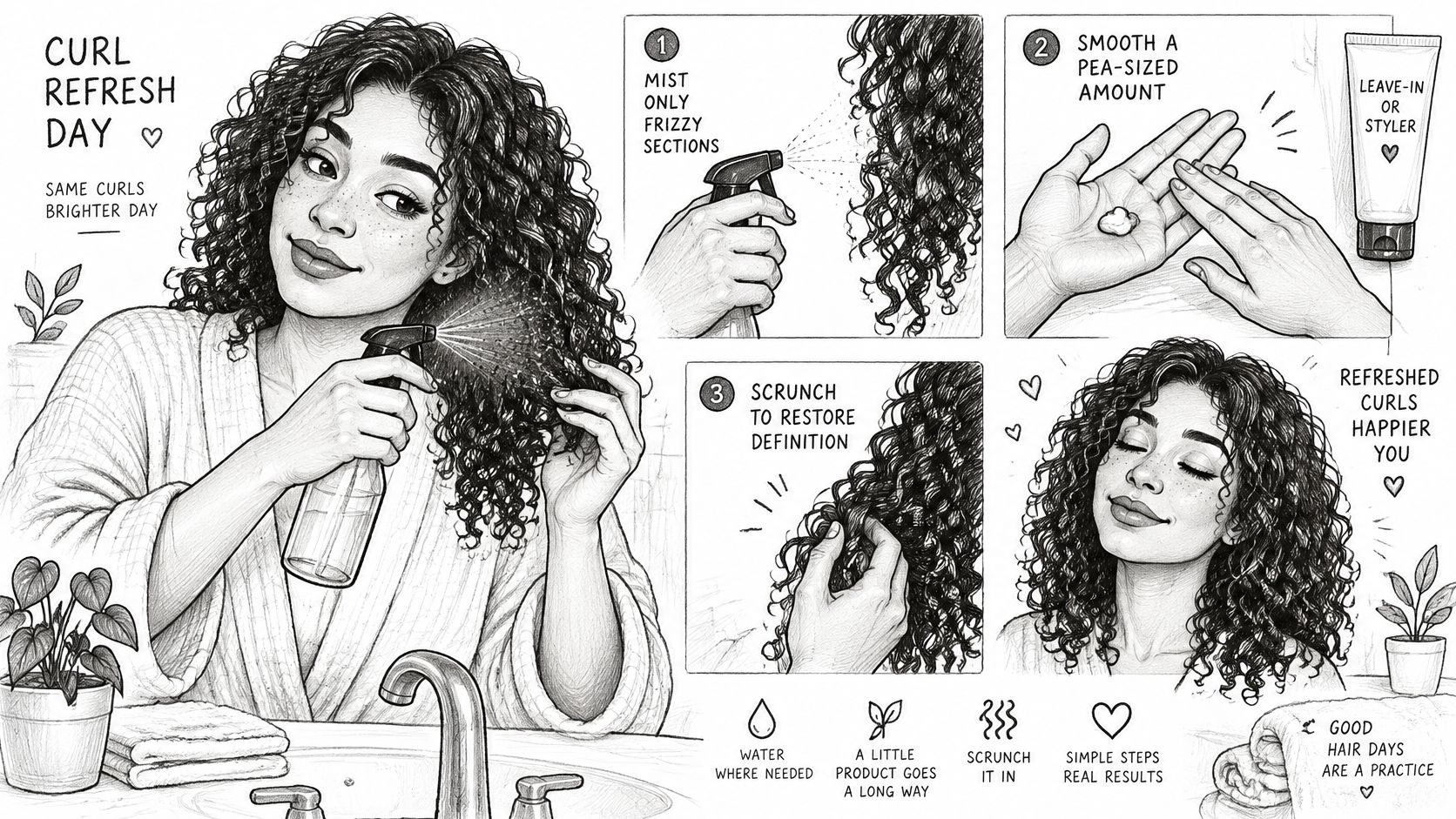
Most of your week happens outside the shower. A refresh should take minutes and target only what's frizzy, not restart wash day because the front section misbehaved overnight.
This simple sequence shows the refresh order.
The Five Minute Refresh
Wet only the frizzy sections with water or watered down leave-in from a spray bottle. Smooth or scrunch with wet palms, then add a pea size amount of the same styler you used on wash day if shape needs hold. Stop there.
Don't rewash a clean scalp just to fix dry ends. That's how lengths get drier while the scalp gets no benefit. And keep the day after rule firm, if a gel cast is still damp, leave it alone. Scrunch out the crunch only when it's fully dry, or you'll break the set you waited for.
- At night: Use a silk or satin pillowcase, a loose pineapple, or a bonnet to cut friction. Cotton rubbing overnight undoes careful styling.
- With styles: Take tight styles down before they ache. Pain is information, not a sign a style is secure.
- With brushes: Keep dry brushing off the list. It separates clumps, raises frizz, and snaps strands that would have detangled safely when wet.
The Coily Moisture Constraint
Tightly curled and coily hair plays by a harder rule. A review in PMC on care for tightly curled and coily hair explains that the curved fiber makes it harder for scalp sebum to travel along the shaft, increasing susceptibility to dryness, tangling, breakage, and damage. Your scalp can feel oily while your ends stay dry, and both can be true at once.
That means condition after every shampoo and use leave-in when lengths feel rough. Treat oil as an optional sealant, not the hydration step. Avoid painful tight styling, repeated high tension braiding or weaving, and aggressive towel rubbing, because each adds mechanical stress to fibers that are already vulnerable at every bend.
Length changes dose, not logic. Short hair or a fade needs less product and may need more frequent scalp washing if sweat builds. Long 4C hair needs more sectioning and more leave-in. Neither needs more steps.
There's no trustworthy success percentage for a beginner routine, so don't chase one. Judge a good week by easier detangling, fewer broken hairs, less visible residue, and definition that repeats. Those signs mean the habits are working even if day three hair isn't perfect.
What to Change When Curls Misbehave
Frizz by afternoon is the complaint that sends beginners back to the store. Usually the cause sits in technique or amount, both of which are free to change. Use the symptom, pick one cause, make one change.
Beginner Curl Problems and the One Change to Make
| Symptom | Likely cause | One change |
|---|---|---|
| Frizz within hours of drying | Hair styled half wet, or rubbed dry | Saturate fully and blot with a T-shirt or microfiber cloth |
| Stringy, greasy, or limp | Too much cream or oil for the hair's density | Clarify once, then use less and skip oil |
| Painful tangles and snapped hairs | Dry brushing or detangling from the roots | Conditioner plus sections, ends toward roots, fingers or a wide tooth comb |
| Flakes, itch, or odor | Scalp left too long between washes | Wash the scalp, don't wait past 2 to 3 weeks if thick or tightly curled |
| No curl groups | Styler on damp hair, or too much handling | Apply one styler on soaking hair and leave it alone while drying |
| Rough or brittle after a new product | Protein overload or several products changed at once | Return to the last routine that felt soft and test one product for two washes |
Read the table narrowly on purpose. Stringy hair on fine, lower porosity strands usually means the dose was wrong for that hair, not that cream is bad for everyone. Flakes and odor mean the scalp waited too long, not that your curl type forbids shampoo. If frizz is your recurring issue, why curly hair gets frizzy and what actually drives it goes deeper on causes.
Ingredient Fear Is Not a Diagnosis
Beginners often inherit blanket bans on sulfates, silicones, or alcohols without any mention of dose, density, or whether a product rinses out. Coverage from BASF Care 360 on curly hair ingredient labels notes only 17% of textured hair consumers reported not looking for any specific ingredients. People are reading labels. The labels just don't answer why a product worked for someone else and left your hair greasy.
Compatibility depends on porosity, strand thickness, density, buildup tolerance, protein sensitivity, application amount, and whether the product is rinsed out. A heavy butter that saves dense, high porosity coils can coat fine, low porosity waves in one use. That's a mismatch, not proof the ingredient is harmful.
Change one variable and give it two washes. A wholesale product purge destroys the information you need.
Separate real irritation from online absolutism. Burning, sores, or persistent itch deserve attention and a patch test mindset. Limp hair after a rich cream usually deserves a smaller amount and a clarifying wash. If itch, sores, or shedding persist, see a dermatologist before trying another product.
Choose the Next Wash From What You Saw
Run the same week twice before you judge it. One wash can be thrown off by weather, a rushed dry, or a heavy hand with gel. Two washes start to show a pattern you can act on.
After the second dry down, make one decision.
- Keep: Detangling hurt less, fewer hairs broke, your scalp stayed comfortable, and the shape lasted past the morning. Repeat the exact steps and products, because you've found a baseline worth protecting.
- Reduce: Hair was soft but flat. Cut leave-in or cream on the next wash only, and leave everything else untouched so you know the reduction caused the lift.
- Clarify: Hair felt heavy or coated. Clarify once, drop the oil seal, and return to your mild shampoo the following wash.
- Add water, not product: Hair was defined, then frizzy by evening. Style wetter next time and keep your hands off while it dries.
Write the one change on your card. That turns the next wash into a test instead of a restock, which is the whole point of a sustainable curly hair routine for beginners.
Once your starter week is steady but results still swing, personalization helps. Coil builds a hair routine from your curl type, porosity, density and scalp, starting with a thirteen question onboarding quiz covering curl pattern, porosity, density, scalp, chemical history, how you dry your hair and what you want, and it takes about two minutes. The routine is re-shaped around what you did, not what you intended to do, so a skipped refresh or a heavier gel day changes the next recommendation.
Keep the boundary clear, though. Persistent scalp pain, sores, or sudden shedding belong with a dermatologist, not an app or another product.
Run your two test washes, write down soft, rough, or heavy, and let that result choose your next step. When you're ready to turn those notes into a plan that adjusts with each wash, visit Coil and build a routine matched to your curl pattern, porosity, density, and scalp.