What Is a Leave in Conditioner and How to Use It
What is a leave in conditioner? Learn what it does, how it differs from rinse-out conditioner, and how to apply it on curls without buildup.
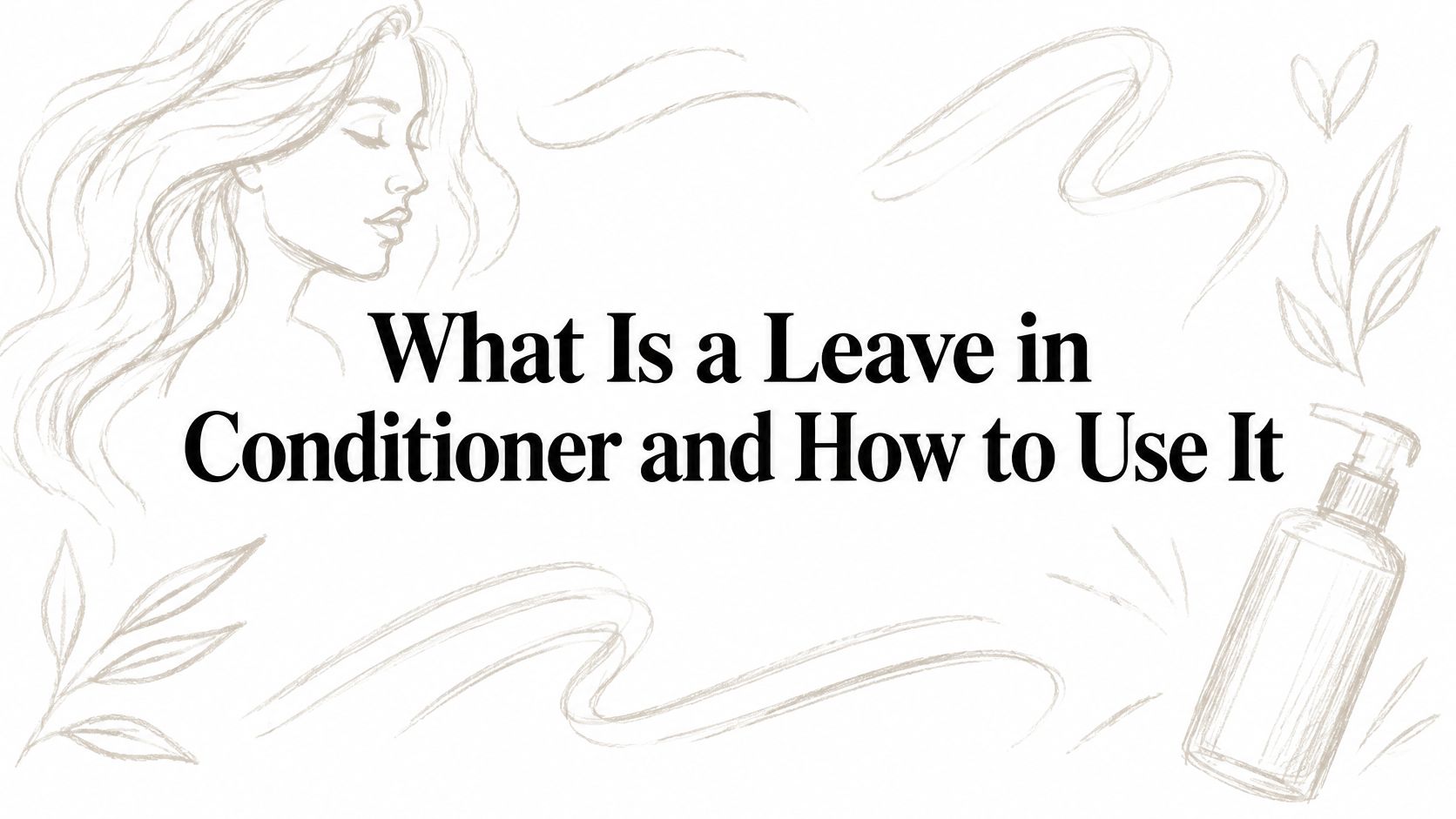
A leave in conditioner is a conditioning product applied after washing and deliberately left on the hair rather than rinsed out, designed to help with detangling, moisture, frizz and styling between washes.
You've washed your curls, rinsed carefully and started drying, yet the ends already feel rough. By afternoon, you're separating tangles and wondering whether you need another cream, more conditioner or a completely different routine. The useful question isn't just which bottle to buy. It's whether an extra conditioning layer helps your hair without leaving it heavy after repeated use.
What a Leave In Conditioner Actually Is
Freshly washed curls can feel slippery in the shower but become difficult to manage as they dry. A leave-in provides conditioning after the rinse step, when you're arranging your curls, drying them and handling them between washes.
Glamour's guide to leave-in conditioners describes products intended to stay on the hair, with lightweight and richer options for different hair needs. The important distinction is leave-on formulation, not a bigger dose of ordinary conditioner.
A typical formula combines water with ingredients that help retain moisture, soften the hair and make strands slide past each other. Humectants support moisture retention; emollients improve suppleness; fatty alcohols add softness and body to the formula. Positively charged conditioning agents help smooth the hair's surface.
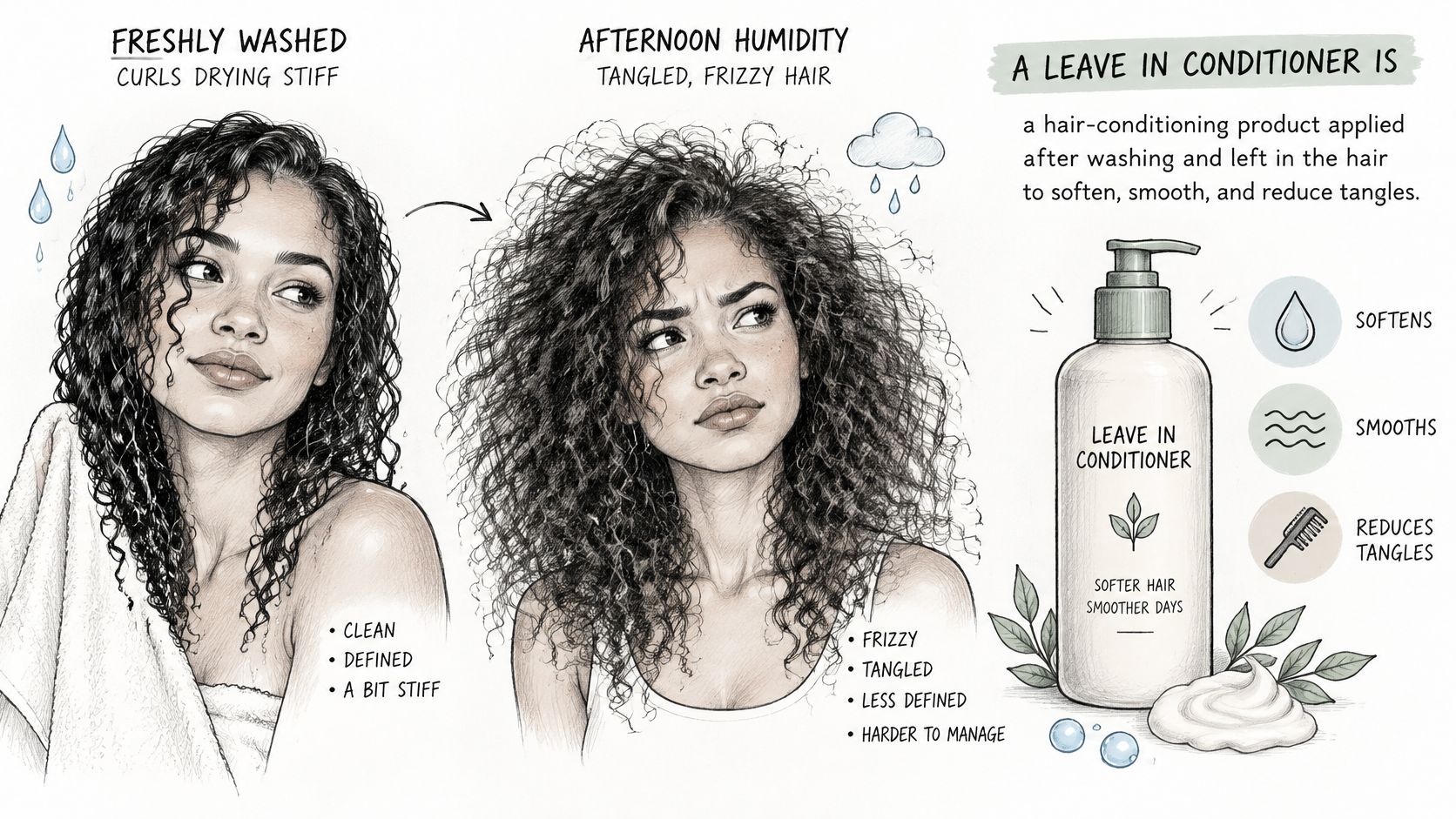
Say your ends catch against each other when you arrange your curls. A suitable leave-in gives them enough slip to separate without repeated pulling, while leaving the finished style comfortable to touch.
What the bottle's texture tells you
Sprays and light liquids usually spread easily through fine strands. Creams and lotions can offer more substantial conditioning for thicker or more porous hair.
A leave-in isn't simply extra conditioner. It's a product designed to remain useful after the wash.
Its label should tell you whether it's intended mainly for detangling, softness, frizz management or additional styling support. Those jobs overlap, but they aren't interchangeable.
How a Leave In Conditioner Works on Each Strand
Think of a leave-in as a thin raincoat around each strand. The comparison describes a surface coating, not a waterproof seal: neighboring hairs can slide past each other more easily instead of catching and pulling.
This illustration shows the surface effect.
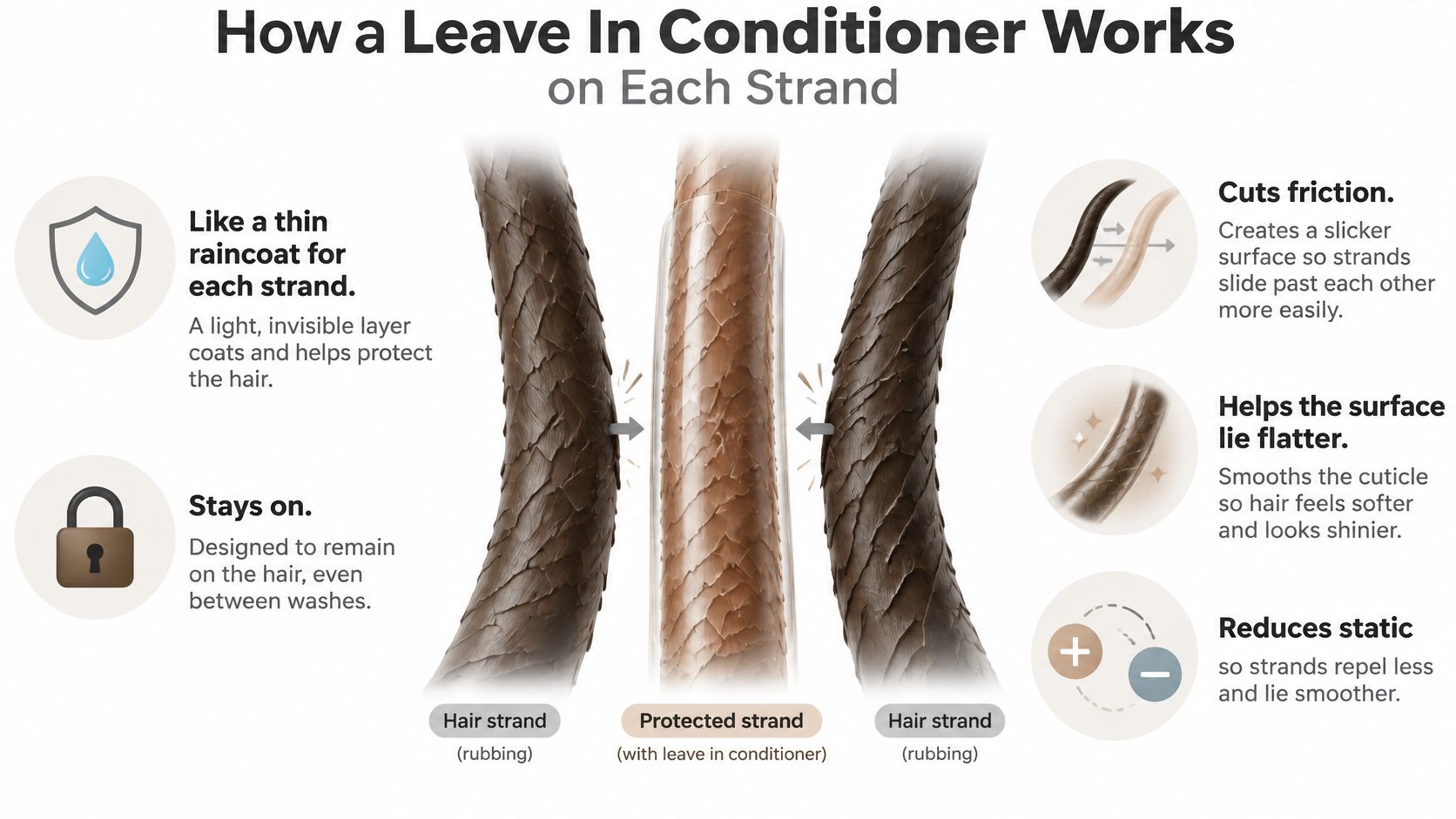
Weathered or damaged hair carries more negative charge. Positively charged conditioning molecules are attracted to those areas, so they deposit preferentially where the surface is worn. The hair-cosmetics review published in the International Journal of Trichology explains this conditioning mechanism and its role in reducing friction, static and combing resistance.
That's why detangling can feel easier even though the product hasn't permanently repaired the strand. You're reducing resistance between fibers rather than changing their underlying structure.
Common leave in ingredient families and what they do
| Ingredient family | Example | What it does on the strand |
|---|---|---|
| Cationic conditioning agents | Cetrimonium chloride, stearalkonium chloride | Deposit on damaged areas and reduce friction and static |
| Cationic polymers | Polyquaternium-10 | Improve detangling, slip and ease of combing |
| Fatty alcohols and lipids | Cetyl alcohol, lipid blends | Add softness and lubrication between fibers |
| Silicones | Dimethicone | Add slip, shine and a protective coating; can accumulate |
| Humectants and emollients | Glycerin-type humectants, plant oils | Support moisture retention and suppleness |
Fatty alcohols aren't the same as the drying alcohols readers often worry about. In conditioners, they help create a creamy texture and a softer feel.
Humectants also deserve more attention than a simple moisturizing claim allows. Our guide to humectants for curly hair explains how they fit into a complete formula.
For an accompanying explanation, watch the video below.
The main takeaway is temporary surface conditioning. Cleansing removes deposited ingredients to differing degrees, so a leave-in shouldn't be mistaken for permanent repair or a lasting change to your curl pattern.
Leave In Versus Rinse Out Conditioner Compared
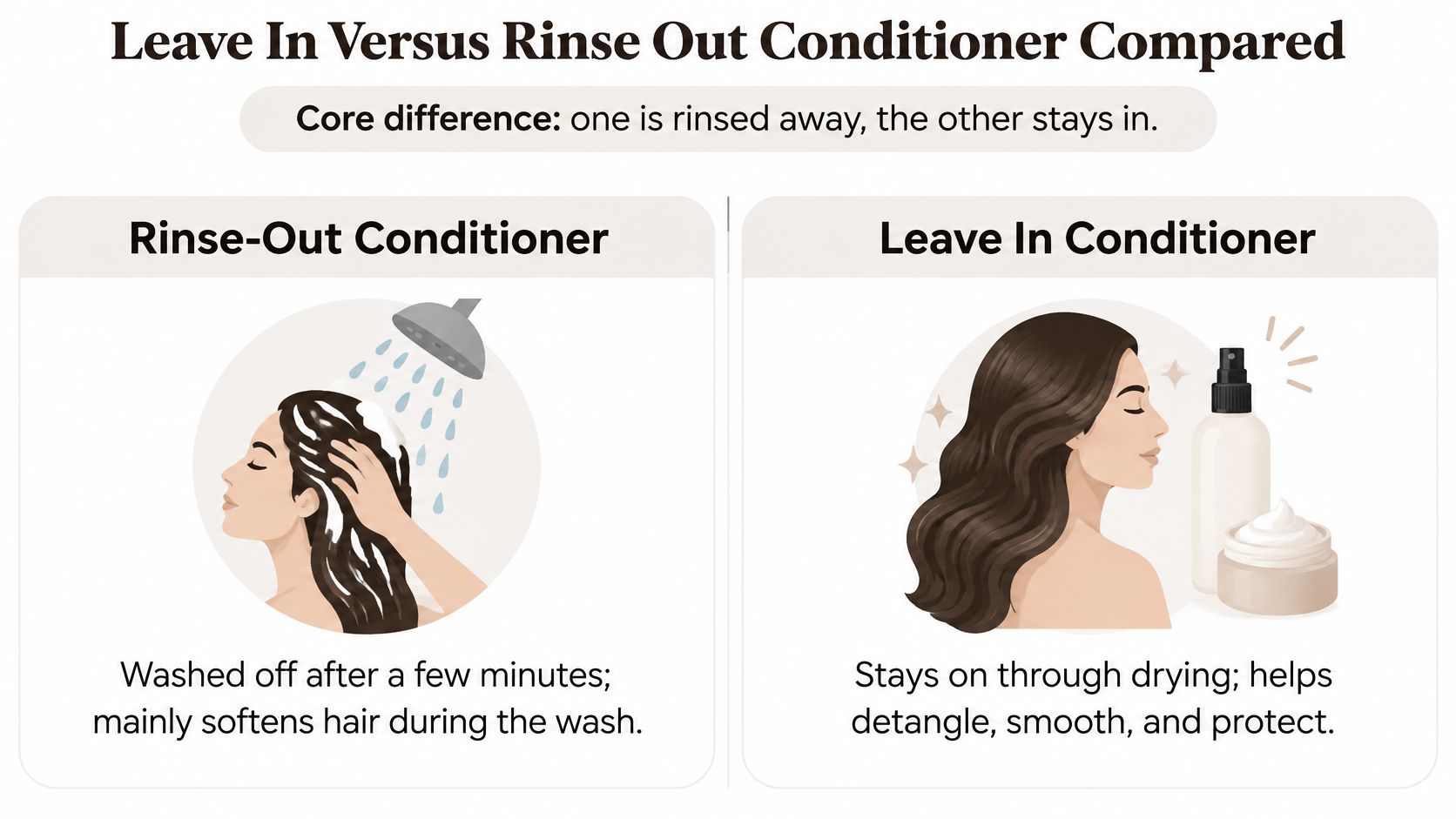
A rinse-out conditioner is removed during washing; a leave-in stays on through drying and styling. That difference in intended use matters more than whether both products look creamy.
The visual distinction is straightforward.
A 2026 formulation analysis published in Archives of Dermatological Research examined products marketed for textured hair; its ingredient findings appear below, with the numerical comparator specifically representing deep conditioners, not every rinse-out product.
Leave in versus rinse-out conditioner at a glance
| Feature | Leave-in conditioner | Rinse-out or deep conditioner |
|---|---|---|
| Main job | Surface management: slip, detangling and frizz control | Softening and conditioning during the wash |
| Time on hair | Remains after washing and through styling | Rinsed away after the product's treatment period |
| Quaternary conditioning agents | Present in 94.4% of formulations | Not reported in the available findings |
| Silicones | Present in 66.7% of formulations | Present in 53.8% of deep-conditioner formulations |
| Film-forming agents | Present in 27.8% of formulations | Present in 7.7% of deep-conditioner formulations |
| Hydrolyzed proteins | Uncommon | Uncommon |
| Typical texture | Spray, light liquid, cream or lotion | Commonly cream-based; texture wasn't reported in the analysis |
The formulation differences help explain why a leave-in can be useful even after you've conditioned in the shower. It provides a surface-management layer for handling and styling rather than merely repeating the wash step.
Protein isn't the defining feature of either category. Don't assume a leave-in is a protein treatment unless the particular formula supports that purpose.
Nor does everyone need both products. If rinse-out conditioner leaves your hair manageable and your styler already supplies enough softness, another conditioning layer may add weight without solving a problem. Don't substitute a rinse-out product for a leave-in unless its instructions explicitly allow that use.
Matching Leave In Texture to Your Curls
Choose by the problem you're trying to solve and the way your hair responds, not the category name alone. The Grand View Research U.S. hair-conditioner market report describes demand for conditioning alongside complementary styling products, but a larger routine isn't automatically a better one.
Curl pattern describes shape. Strand thickness, density and porosity help explain how much conditioning your hair can comfortably carry.
Leave in texture by hair profile
| Hair profile | Suggested texture | Why it fits | Watch for |
|---|---|---|---|
| Fine or easily weighed-down wavy hair | Light spray or light liquid | Adds slip with less coating | Excess product can flatten waves |
| Medium-density curly hair | Lotion or light cream | Balances softness with curl grouping | Several cream layers can coat the hair |
| Dense coily hair | Richer cream as a starting option | Helps distribute conditioning through a substantial amount of hair | Heavy films can reduce spring |
| Dry or highly porous hair | Richer cream or lotion | Supports hair that loses moisture readily | Frequent reapplication can leave residue |
| Low-porosity hair | Light spray or light liquid | Limits the amount deposited on the surface | Heavy creams may sit on top |
| Frequent high-heat styling | Dedicated heat protectant | Addresses thermal protection directly | Don't assume a leave-in provides adequate protection |
These are starting points, not rules attached to curl shape. Someone with tightly coiled but very fine strands may prefer a light lotion, while someone with looser, coarse, weathered curls may benefit from a cream.
Choose by response: More tightly curled hair doesn't automatically need a heavier product.
Check packaging for explicit claims about heat protection, hold, protein or UV protection. A conditioning cream doesn't necessarily replace gel, and a leave-in doesn't automatically replace a dedicated heat protectant.
Give the texture several wash days before deciding it's right. An appealing first application won't tell you whether repeated use leaves your curls buoyant or coated.
How to Apply a Leave In on Curly Hair
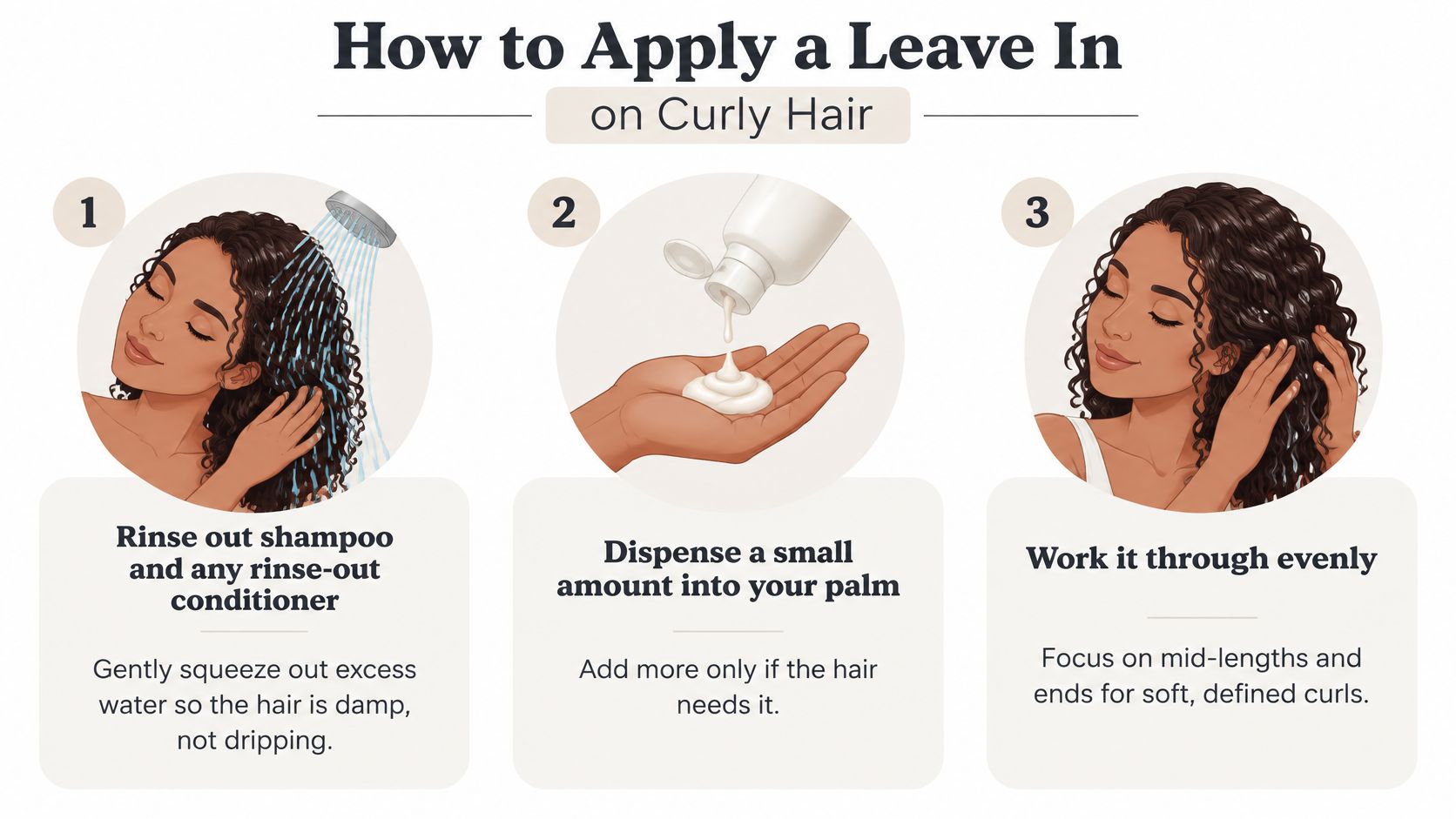
Even distribution matters more than a generous handful. Your aim is to condition the lengths evenly without saturating every section with product.
Use this visual as a reminder of the basic application sequence.
A practical wash-day routine
Finish rinsing, then squeeze gently. Remove your shampoo and rinse-out conditioner, then squeeze out excess water with your hands. Start with damp rather than dripping hair so the product spreads without immediately running off.
Spread a small amount between your palms. Begin with a thin coating rather than a full handful. You can add more to rough areas, but removing excess means another rinse.
Work through manageable sections. Divide your hair so you can reach the inner layers, then smooth the product from mid-lengths to ends. Use your fingers to distribute it rather than coating only the visible outer curls.
Check where your hands are placing it. Concentrate on the lengths rather than massaging it into your roots. Short hair may need a lighter touch and a smaller amount so you can control placement.
Detangle while the hair feels slippery. Use your fingers or a wide-tooth comb, starting at the ends and gradually moving upward. Pause at knots rather than forcing the comb through resistance.
Add a styler only if it serves another purpose. Apply gel for hold or a curl cream when you need its particular styling effect, keeping the hair damp. The distinction between curl cream and gel helps you avoid stacking products that do the same job.
Let the curls dry with minimal handling. Air-dry or diffuse gently, then assess the hair when it's completely dry. Constant rearranging during drying can separate curl groups and make the result harder to judge.
Decide whether to refresh
On a later day, reapply only to the mid-lengths and ends of a section that feels dry. Dampen that area lightly first so you can distribute a small amount evenly.
Skip the extra product when your hair still feels soft after drying. Finished curls should feel comfortable and springy, not waxy or overloaded; if you use gel, distinguish its temporary dry cast from a persistent coated feeling underneath.
Buildup, Dryness and Other Problems to Fix
Can a leave-in make hair feel dry or interfere with wetting? Sometimes, yes. Too much product, repeated reapplication or insufficient cleansing can leave a film that feels stiff, limp or oddly dry.
Apply leave-in to the hair rather than the scalp to reduce buildup and irritation; the American Academy of Dermatology's leave-in conditioner guidance also advises washing it out with shampoo and water after about a week when it has remained on the mid-lengths and ends.
A substantial coating can make water penetration more difficult, particularly when hair already resists wetting. That doesn't make silicones bad, and tightly coiled hair isn't automatically low-porosity. Watch your own hair's response instead of treating an ingredient name as a verdict.
Leave in symptoms, causes and fixes
| Symptom | Likely cause | Fix |
|---|---|---|
| Stiff or crunchy hair after several days | Accumulated film from conditioning or styling products | Shampoo thoroughly, then reduce the leave-in amount |
| Limp hair with no curl spring | Too much product per section | Use less and concentrate on the lengths and ends |
| Dry hair despite using a leave-in | Surface buildup, or insufficient conditioning | Cleanse first; consider a richer formula only if clean hair still feels rough |
| Flaky or itchy scalp | Product contact or another scalp problem | Stop scalp application, cleanse thoroughly and seek dermatology advice if symptoms persist |
| Frizz despite using a leave-in | Uneven coverage, insufficient conditioning or inadequate hold | Improve distribution; consider a richer texture or a styler on damp hair |
These are troubleshooting possibilities, not diagnoses. Flaking can also come from scalp conditions, while crunchiness immediately after styling may be gel hold.
Change the smallest useful thing
Don't respond to coated hair by adding oil and another cream. Cleanse, reassess the clean strands and change either the dose or the formula, rather than both at once.
For hair that resists wetting, a low-porosity hair routine can help you organize cleansing and lighter layers.
Judge the result by feel, movement and residue, not by how much product you applied.
Test One Leave In Over Three Wash Days
The useful test spans repeated wash cycles, not just the moment your hair dries beautifully. Treat this as a personal comparison, not a promise that every product reveals its full effects on a fixed schedule.
Keep the comparison simple
- Choose a baseline. Pick a texture that fits your strand thickness, porosity and styling goal. Keep your cleanser, rinse-out conditioner, styler and drying method as consistent as practical.
- Repeat before changing. Use the same leave-in over the wash days in your trial, with a similar amount and placement. If irritation develops, stop rather than completing the test.
- Record the full wear period. Note how your curls feel after drying, on subsequent days and before washing again. Track definition, frizz, softness, weight, residue and stiffness.
Keep the product if detangling becomes easier and curls remain comfortable without losing movement. Reduce the dose or drop it if you repeatedly notice residue, heaviness or stiffness.
A good result may also be realizing you don't need a leave-in. If your hair is already soft but loses its shape, a hold product may address the actual problem; if heat exposure is the concern, prioritize suitable thermal protection.
Make your next decision from notes
A paper log works well. If you prefer an app, our daily check-in at Coil lets you record what you did, rate how your curls feel and optionally add a selfie, giving you a record to compare with your product choices.
Today, choose a leave-in that fits your hair profile and begin the trial on your next wash day. Keep the routine simple enough that you can tell whether that layer helped.
We build your routine around curl type, porosity, density and scalp, so leave-in choices fit the rest of your care. Photograph a product's ingredient label to flag sulfates, drying alcohols, silicones and waxes, then judge the formula alongside your hair's response. Visit Coil to build a more personalized routine for your waves, curls or coils.