
Best Hair Journaling Apps for Tracking Curl Growth, Definition, and Hair Health
Best Hair Journaling Apps for Tracking Curl Growth, Definition, and Hair Health—compare features, measurement habits, privacy, and tracking methods.

How do you know your curls are healthier, not just better styled today? That question exposes the weakness in most advice about the best hair journaling apps for tracking curl growth, definition, and hair health. A sharper photo, a heavier gel, or drier indoor air can make hair look longer and more defined without any change underneath.
Useful journaling starts with measurement validity, not more selfies. You're looking for an app that helps you compare like with like, record the conditions behind a result, and protect the images you upload. Features matter only when they support those jobs.
Choosing a Hair Journaling App
Start by naming the decision you're trying to make. A beginner building wash-day consistency needs reminders, a short daily log, and a clear timeline. A product tester needs ingredient context and one-variable comparisons. Someone in a grow-out needs monthly length checks, trim dates, and breakage notes. One universal winner rarely serves all three well.
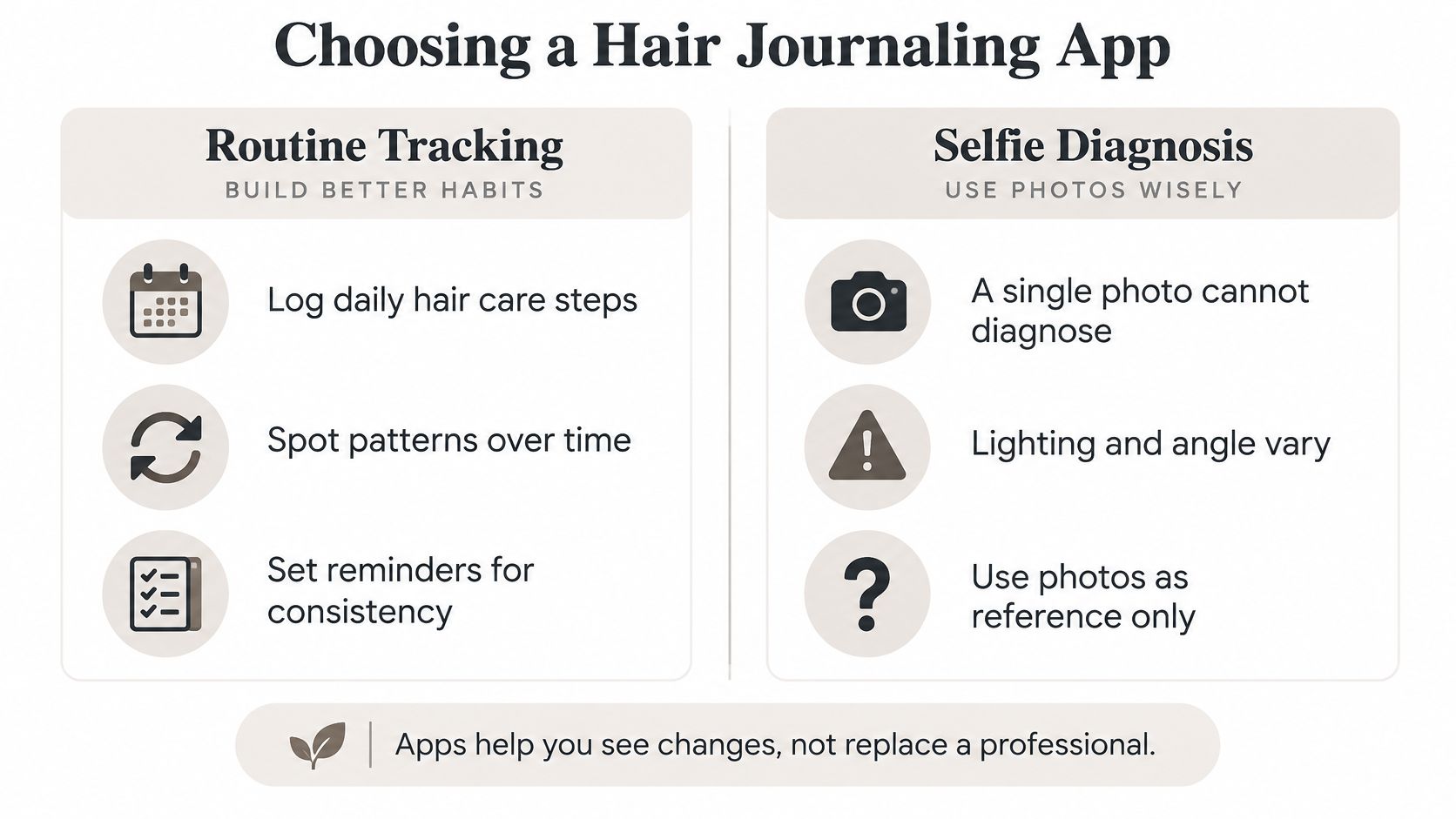
A notes app can store products and dates, but it won't prompt you to log the metadata that explains a photo. A stronger curl journal records wet or dry state, time since wash, drying method, styling technique, humidity, and whether hair was stretched. Without that context, you can't tell progress from styling luck.
What to Compare in a Curl Journaling App
| Tracking Need | Useful App Capability | Why It Matters |
|---|---|---|
| Length retention | Monthly stretched-length log and trim reminders | Separates slow growth from breakage at the ends |
| Definition and frizz | Standardized photo timeline with routine notes | Lets you compare matched wash and drying conditions |
| Product testing | Ingredient scanner and product history | Links build-up or dryness to a specific change |
| Scalp comfort | Daily check-in for itch, flakes, tightness, feel | Surfaces patterns a selfie can't show |
| Consistency | Quick check-in and adherence view | Shows whether the routine actually happened |
Ease of use decides whether you'll keep logging after week two. If an entry takes longer than your refresh routine, you'll skip it on busy days, and gaps will cluster around exactly the rushed routines you most need to understand. Look for fast check-ins, editable ratings, and exportable history.
The visual below shows the kind of structured timeline to look for, rather than a loose camera roll.
Privacy belongs in the first comparison, not the fine print. Before you commit, check retention, deletion, third-party sharing, and whether your photos train models. An app that can't answer those questions clearly hasn't earned your scalp close-ups, however polished its charts look.
Separating Growth, Condition, and Definition
Treat growth, fiber condition, and style performance as three separate signals. Growth is length over time. Condition covers breakage, split ends, moisture balance, and scalp symptoms. Definition describes how curls clump and hold shape after a particular wash, product load, and drying method. A single score that blends them hides which problem you're solving.
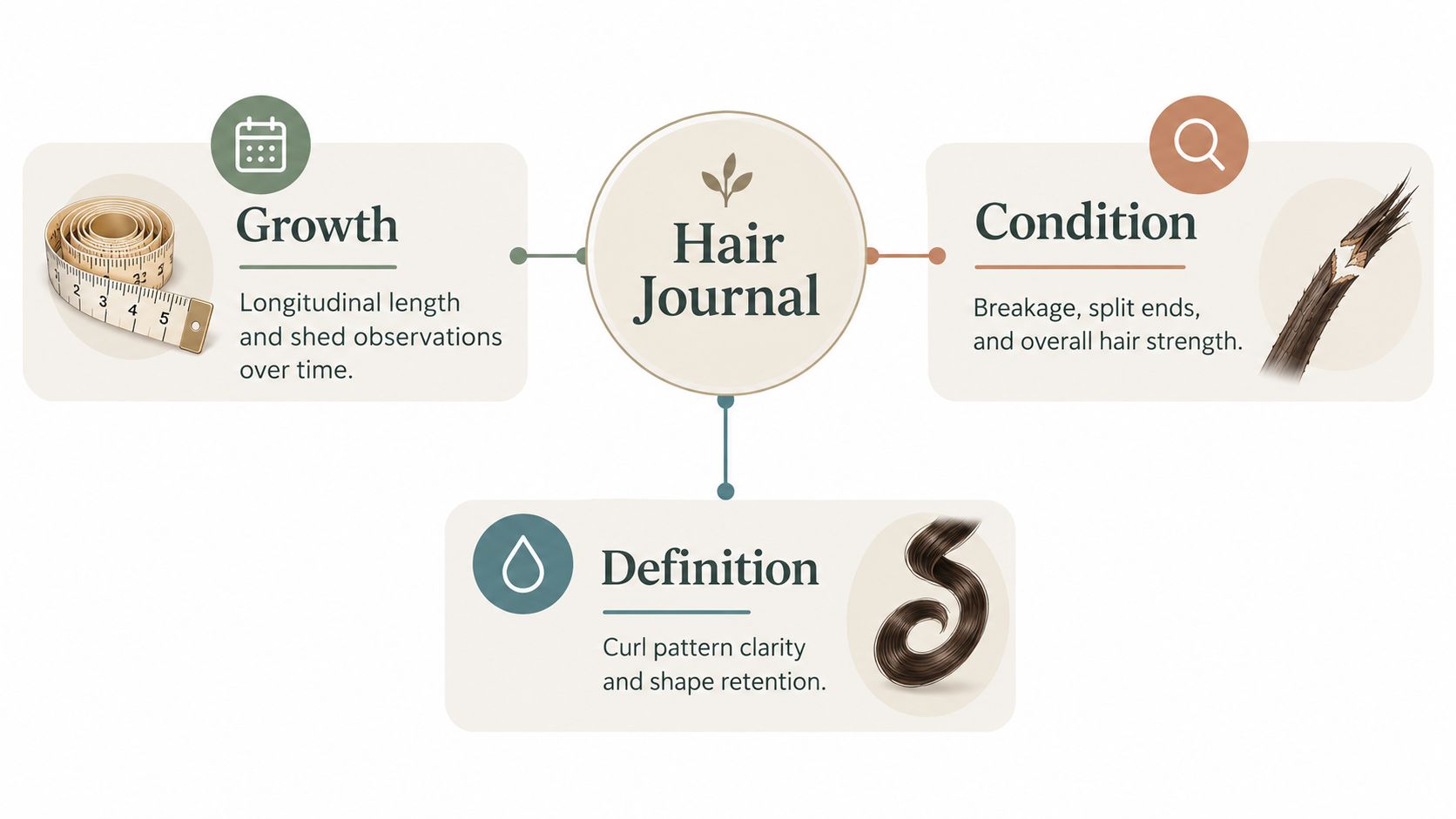
Growth is slow enough that weekly length judgments mislead. Clinical reference data place average scalp-hair growth at 0.34 to 0.36 millimeters per day, about 1 centimeter per month, with individual rates ranging from 0.6 to 3.36 centimeters per month, as summarized in clinical reference data on hair growth rates. That wide range means your baseline matters more than a universal target. Measure a repeatable stretched section monthly and log trims, so retention isn't confused with growth rate.
Why a Better Photo May Not Mean Healthier Hair
Definition can improve because you used more styler, diffused longer, or had less shrinkage that day. None of that proves stronger fibers. Curl behavior shifts with moisture balance, friction between hairs, and cuticle wear, so a looser or tighter wash-day pattern shouldn't be read as length change. Log the styling conditions and judge definition only across comparable routines.
Compare rolling averages across several wash cycles, not your best day against your worst day.
Condition needs its own evidence. Record breakage you see during detangling, how ends feel between washes, and scalp notes such as itching or flaking. If dryness at the scalp is part of your picture, background on dry scalp in curly hair can help you name symptoms more precisely in your log. Precise language beats a vague bad-hair-day rating when you review trends later.
Use a fixed protocol for every comparison photo. Keep the same area, lighting, camera distance, angle, and hair state, and note products, heat, manipulation, and humidity. Then compare rolling 4 to 8 week averages rather than isolated images. That cadence respects how slowly length changes while still catching breakage or scalp patterns early enough to act.
Don't treat porosity as a fixed diagnosis either. Chemical processing, heat, and UV exposure can change how hair behaves, so log those events beside porosity-related observations. When several variables move together, your journal becomes a diary. When they stay separated, it becomes evidence you can act on.
Assess Hair Density at Home
You can notice density changes at home without turning one harsh-lighting part into a diagnosis. Your goal is a repeatable view of visible density, meaning how much scalp shows in a defined area under defined conditions. You're tracking change against your own baseline, not counting follicles.
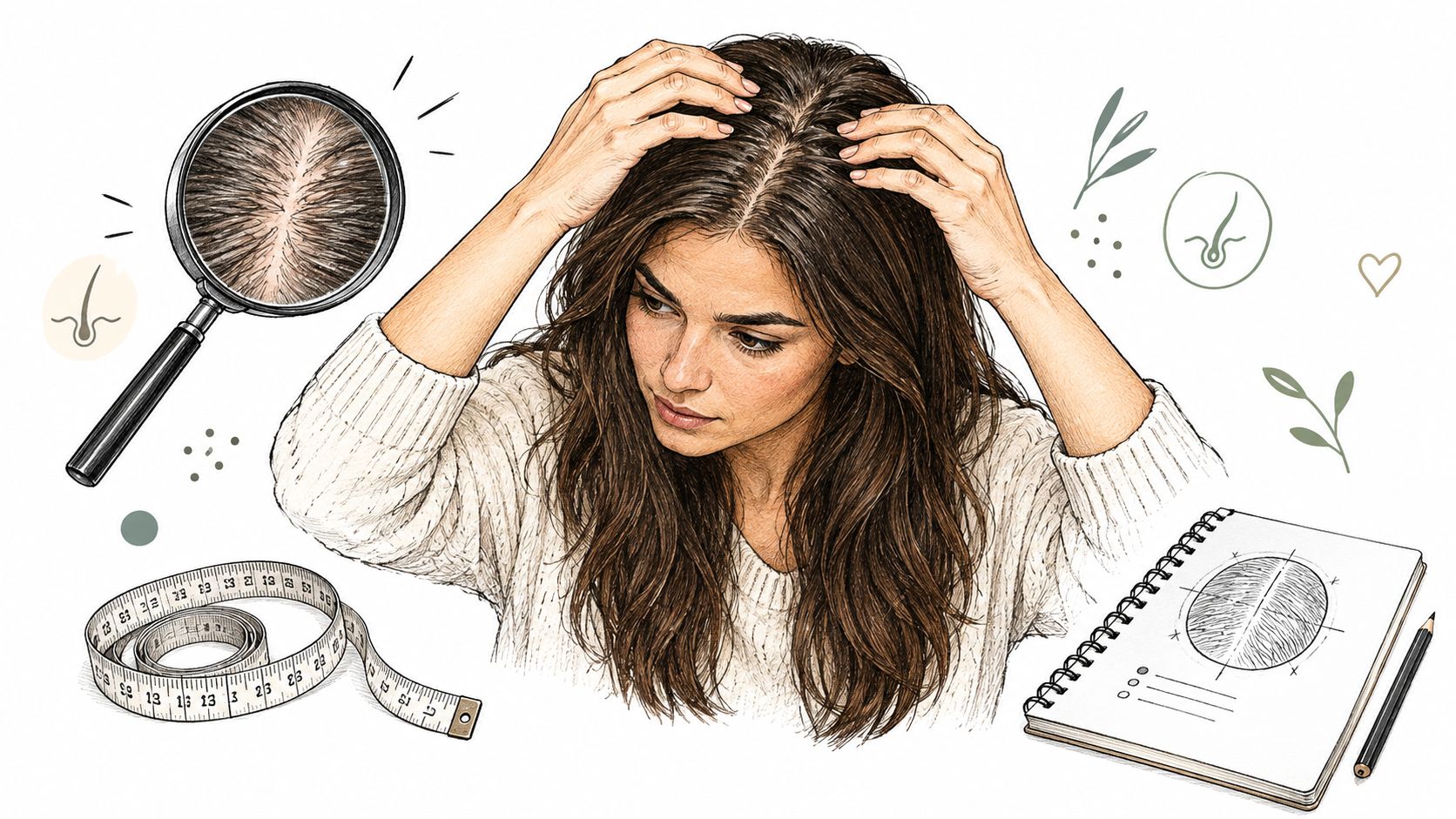
Pick two or three fixed checkpoints, such as your usual part, hairline, and crown. Photograph each one after a wash, fully dry, unstretched, and unstyled or styled exactly the same way each time. Use the same room and light source, and hold the phone at the same distance. A bathroom light at night and window light at noon will manufacture a difference that isn't on your head.
A Repeatable Parting Check
Create the part the same way each session, ideally with the same comb or fingertip placement. Note whether hair is wet or dry, stretched or shrunken, and freshly washed or several days old. Product build-up and flattened roots change how wide a part looks, so day-one hair is the cleanest comparison point.
- Same area: Photograph the identical part and crown position each month.
- Same state: Dry, unstretched hair removes shrinkage and water weight from the comparison.
- Same light: Overhead light widens a part visually, so don't alternate light sources.
- Separate notes: Log shed hair, short broken pieces, and definition as different observations.
Visual fullness isn't strand count. Consider someone whose curls clump tightly one wash day, so the part looks narrow and full. After the next wash, the pattern expands, clumps separate, and more scalp shows between them. Nothing about density changed in a week. Curl expansion redistributed the same hair over a wider shape, and the photo recorded styling geometry, not loss.
That distinction matters in research too. Work on visual shedding scales found that one scale couldn't assess all hair lengths accurately, requiring length-specific scales, as shown in validation work on a visual hair shedding scale. Your journal should apply the same lesson. Short coils, dense curls, and long waves shouldn't be judged by identical visual criteria.
Review density monthly, not after every wash. If matched photos show a widening part over several cycles, and you also notice changed shedding or scalp symptoms, that's a reason to seek professional input. Your baseline then becomes useful history to bring along, rather than a conclusion you reached alone.
Reviewing Coil for Curl Tracking
Coil is the featured option in this comparison because its workflow is built around structured journaling rather than photo storage. It starts with a 13-question setup covering curl pattern from 2A to 4C, porosity, density, scalp condition, length, wash schedule, habits, and goals. That intake gives later entries context, so a frizz rating is read against your hair profile instead of a generic standard.
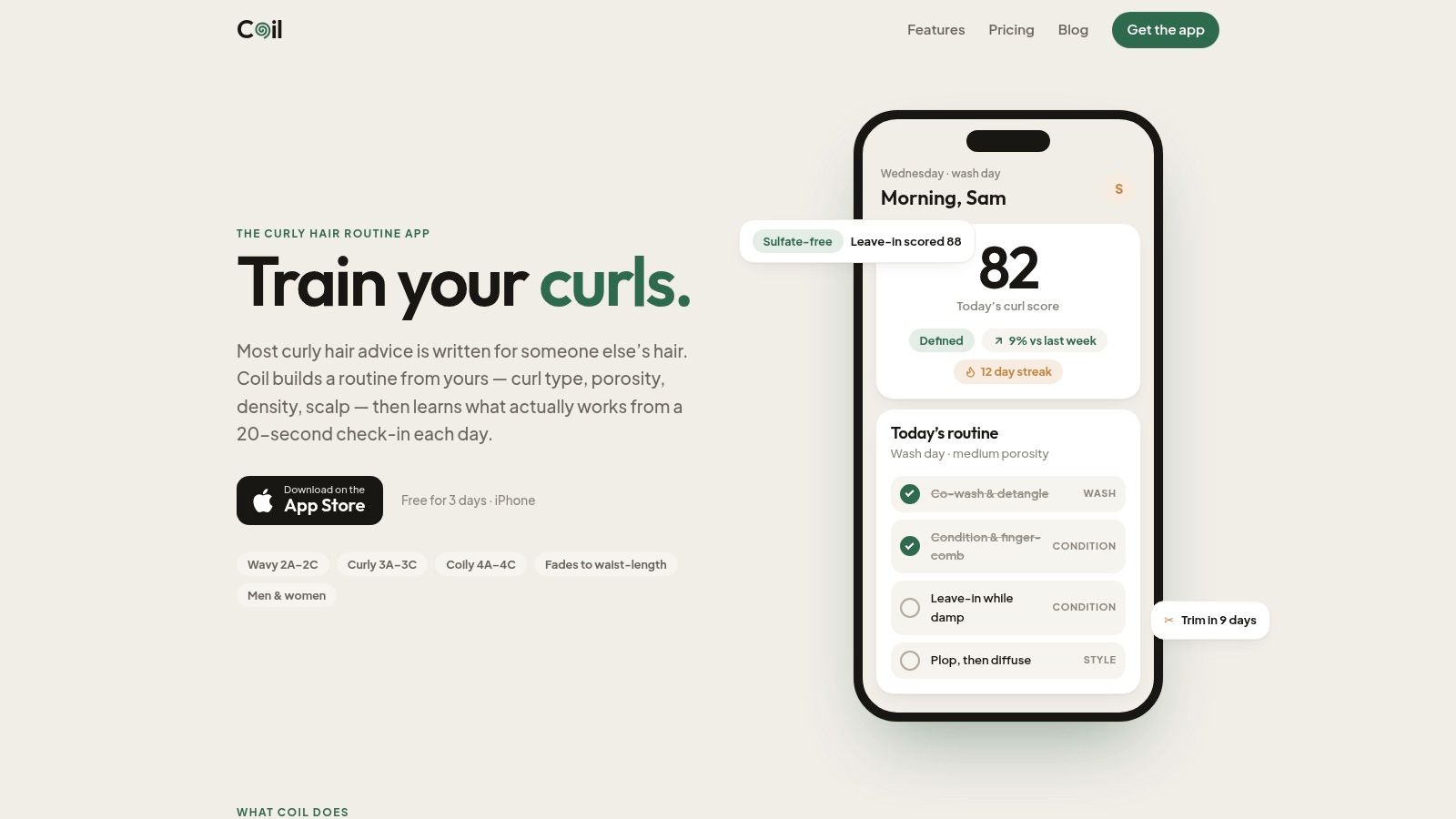
The routine adapts to what you did, not what the plan assumed. Steps vary by porosity and scalp needs, and the plan reshapes as your check-ins accumulate. That matters during a grow-out or a season change, when a static template keeps recommending steps your hair no longer responds to. Adaptation is only useful, though, if you log on skipped days.
What the Daily Workflow Captures
A 20-second daily check-in lets you tick off actions, rate how your curls feel, and add an optional selfie. Short entries protect adherence, and adherence is what makes trend charts interpretable. An AI hair scan reads definition, frizz, and moisture from selfies, and your corrections feed back into the metrics rather than being ignored.
That feedback loop is the right design choice, with a caveat. Corrected scores are still estimates from images taken under your lighting and styling conditions. They work best as trend indicators across matched photos, not as verdicts on a single wash day. Coil's photo timeline and trend charts support that longer view, and trim reminders help you separate retention problems from neglected ends.
- Curl score: Weighted across definition, frizz, and moisture, so ask which component moved before reacting.
- Ingredient scanner: Flags sulfates, drying alcohols, silicones, and waxes, and rates build-up risk and protein load for your profile.
- Curl guides: Cover curl type, porosity testing, frizz causes, and wash frequency for users building foundational knowledge.
- Length coverage: Supports short cuts and grow-outs, which many curl apps handle poorly.
Be candid about limits. These are tracking and decision-support features, not medical diagnostics, and no visual scan can confirm why hair is breaking or shedding. Coil suits iPhone users who want routine personalization tied to their own logged results, product testers who check ingredients before buying, and beginners who need structure. If you already keep a disciplined manual journal and rarely change products, the added value is mainly convenience and trend visualization.
Turn Tracking Into Styling and Product Decisions
A journal earns its place when it changes your next wash day. Start with the observation, then check the conditions behind it before touching a product. Less definition might trace to a smaller gel amount, air drying instead of diffusing, or skipping a leave-in. Your notes should tell you which lever moved.
Take a common scenario. Definition drops and frizz rises for two cycles, so you suspect your styler stopped working. Your log shows you also switched from diffusing to air drying and cut your gel amount while rushing. The cheaper conclusion is technique, not product failure. Restore the original drying method for one cycle and compare under matched conditions.
Change One Variable at a Time
Adjust a single element per wash cycle, then hold it long enough to read the result. If you swap cleanser, conditioner, and gel in the same week, attribution becomes impossible and you'll keep buying products to solve unknown problems. Product amount counts as a variable too, so log rough quantities, such as a coin-sized amount or number of pumps.
Practical rule: If you can't name the one thing you changed, don't judge the result yet.
Density observations guide amount and placement. Hair that looks fuller because clumps are tight may need product worked through in smaller sections to reach inner layers. Hair that reads as lower visible density often gets weighed down faster, so heavy creams can flatten roots and make the part look wider. Lighter layers, applied away from the scalp, usually preserve lift while still coating the lengths.
Ingredient checks add a second filter before you buy. A scanner can flag ingredients associated with build-up risk or a heavy feel for your profile, and your history shows whether similar formulas left your hair coated or dry. Weather belongs in that decision too, and reading about humectants for curly hair helps you interpret why a glycerin-heavy styler behaves differently on a humid day than a dry one. Log humidity beside frizz so you don't blame a product for the forecast.
Hair science testing defines frizz as reduced alignment among neighboring hairs and quantifies it through tress-width expansion after humidity exposure, as described in hair science methods for measuring frizz and curl retention. Your at-home version is simpler. Photograph at styling time and again a day or two later, note halo frizz and clumping, and compare only when wash and drying methods match.
End each cycle with one decision for the next wash. Keep, adjust, or drop. Write it down while the result is fresh, because memory rewrites wash days within a week.
Build a Reviewable Curl Journal Routine
Sustainable journaling is small on busy days and structured at review time. Set your baseline in the first week with standardized after-wash photos, a stretched-length check, density checkpoints, and honest ratings for definition, frizz, moisture feel, and scalp comfort. That baseline is your reference point, even if your hair isn't at its best.
During each week, log wash dates, products and amounts, routine completion, drying method, heat, and manipulation. Add how your curls feel, not only how they photograph. A pattern that looks defined but feels brittle tells a different story than soft hair with loose definition. Note treatments, coloring, and heavy sun exposure, since those events explain later shifts in behavior.
A Monthly Review Sequence
- Length and retention: Compare the same stretched section and check trim dates against breakage notes.
- Visible density: Review part and crown photos taken under matched lighting and hair state.
- Definition and frizz: Compare only cycles with the same wash and drying method, noting humidity.
- Condition signals: Scan breakage, shed observations, moisture feel, and scalp symptoms together.
- Adherence: Check whether poor results cluster around skipped steps or rushed routines.
Measurement discipline matters more than intensity. In one prospective study of 266 preschool children, growth was measured through weekly appointments over 7 to 21 days using serial measurements of three to five hairs, as reported in a clinical study of hair growth measurement methods. You don't need that rigor at home, but the principle transfers. Consistent intervals and positioning make small changes readable.
Look for patterns across cycles, such as definition improving whenever you diffuse, or breakage rising after a week of frequent restyling. If your hair drinks up product slowly and build-up shows up in your notes, a structured low porosity hair routine can give you a cleaner baseline to test against. Change the routine only after the review, then give the change several cycles before judging it.
Keep the daily habit on your phone lock screen or beside your products. Friction kills journals faster than bad design. Thirty seconds of logging after styling beats a detailed Sunday reconstruction you'll abandon by month two.
Use AI Scores and Hair Selfies Responsibly
An AI score is a decision aid, not a diagnosis. It estimates visible traits from an image, and images carry lighting, angle, camera processing, and styling with them. Comparing a wet photo to a dry one, or window light to bathroom light, manufactures progress or decline. If a composite score moves, ask which input moved and whether conditions matched.
Corroborate visual improvement with signals a camera can't fake. Credible benchmarks include reduced breakage during detangling, steadier definition under matched styling, retained length across trim cycles, and a comfortable scalp. Research on hair fiber behavior notes that assembly-level characteristics are difficult to infer from isolated measurements, as discussed in research on the physical behavior of hair assemblies. Your score should start a question, not settle one.
Privacy Questions to Ask Before Uploading
Hair selfies can reveal your face, location cues, and inferred attributes about your hair and scalp. European survey data found 72.34% of respondents viewed data misuse as a risk and 63.68% feared hacking, as reported in research on privacy attitudes toward personalized health apps. Treat that caution as rational, not paranoid.
- Retention: How long are selfies and inferred attributes stored after deletion?
- Model training: Can you use the app without consenting to training use?
- Sharing and export: Who else can access your data, and can you export your history?
Start with one repeatable observation rather than measuring everything at once. A monthly length check, matched wash-day photos, or a daily feel rating is enough to build the habit. Add metrics only when the first one runs on autopilot.
Ready to replace scattered selfies with a journal you can interpret? Coil combines an adaptive routine, a quick daily check-in, an ingredient scanner, and trend tracking for wavy, curly, and coily hair on iPhone. Start with your baseline this wash day and let matched comparisons, not single photos, guide your next routine change.