Best AI Apps to Analyze Your Curl Type and Create a Personalized Hair Care Plan
Explore the best AI apps to analyze your curl type and create a personalized hair care plan for curls, coils, moisture, products, and routines.

Take one selfie, get your curl type, follow the plan. That's the promise behind most lists of the best AI apps to analyze your curl type and create a personalized hair care plan, and it's the reason so many people end up disappointed.
A single photo can't tell you why your coils felt defined on Tuesday and dry by Friday. It can't know your heat history, your scalp, or whether yesterday's product is still sitting on your strands. The apps worth using don't pretend otherwise. They treat a scan as one input, then ask better questions, accept your corrections, and adjust when your hair responds differently than predicted.
Why Curl Type Is Not the Whole Picture
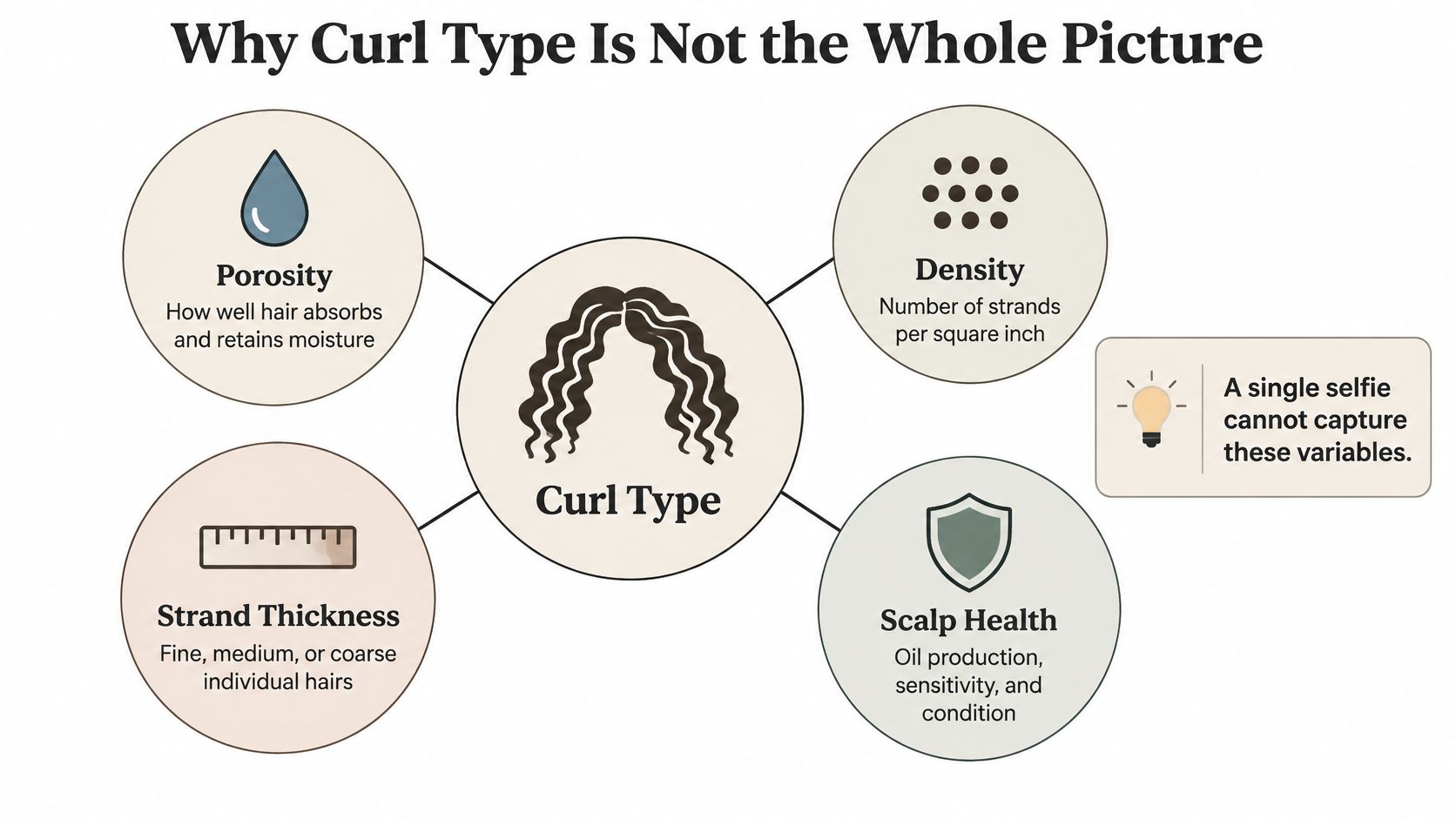
Two people can both look like 4A hair in a photo and need opposite wash days. One has fine, low density strands, a dry scalp, and no chemical history. The other has dense, coarse coils, bleached ends, and flat irons weekly. Give them the same heavy cream and the same schedule, and one gets definition while the other gets buildup, limp coils, or breakage.
That mismatch isn't a failure of effort. It's a failure of the label. Curl pattern describes visible shape. It doesn't describe how your hair absorbs water, how much product it can carry, or how your scalp behaves between washes.
Geography makes the same point at scale. A multinational study of 19,461 people across nine countries found curly hair prevalence ranged from 42.6% in Brazil to 5.5% in China. Curly hair isn't a niche category with one routine. It's a large, varied population shaped by climate, styling practices, and product access.
The Variables a Label Misses
A useful assessment separates at least these factors before it recommends anything.
- Porosity: How readily your hair absorbs and retains moisture, which changes with cuticle damage.
- Density and strand thickness: How much hair you have and how much product weight each strand tolerates.
- Scalp condition: Dryness, oiliness, sensitivity, or flaking that changes cleansing needs.
- Damage and habit history: Bleach, heat, protective styles, wash frequency, and your actual goals.
Practical rule: If an app gives you a routine from a photo alone, treat that routine as a draft, not a diagnosis.
Judge apps by whether they collect this context, explain uncertainty, and revise their advice. A confident label with no follow up questions should make you more skeptical, not less.
Compare the Best AI Curl Analysis Apps
Most comparisons rank apps by how dramatic the scan result looks. That rewards theater. A better test is whether the app keeps learning after day one.
Look for depth of intake, whether routines change when you skip steps, how ingredient advice is explained, and whether you can see progress over weeks. Check platform fit and subscription terms before you invest months of data. Price alone proves nothing about quality, but unclear billing is a reason to walk away.
AI Curl-Care App Decision Checklist
| Evaluation criterion | What to look for | Coil support |
|---|---|---|
| Assessment depth | More than a photo, including porosity, density, scalp, length, and habits | 13-question quiz covering pattern from 2A to 4C, porosity, density, scalp condition, length, wash schedule, habits, and goals |
| Adaptive routine | Plan changes based on what you actually did | Routine reshapes around completed actions, with steps varying by porosity and scalp needs |
| Photo analysis | Measurable signals, with a way to correct errors | Scan reads definition, frizz, and moisture, and incorporates user corrections |
| Ingredient review | Specific risks explained for your hair, not generic bans | Scanner flags sulfates, drying alcohols, silicones, and waxes, then scores buildup risk, protein load, and weight |
| Daily burden | Fast enough to sustain on busy days | 20-second check-in to log actions, rate how curls feel, and optionally add a selfie |
| Progress visibility | Trends you can review, not memory | Photo timeline, trend charts, trim reminders, and a unified curl score |
| Education | Guidance that explains the reasoning | Guides on curl type, porosity testing, frizz, men's routines, and wash frequency |
Coil is the detailed profile here because it's the app with verifiable product information to evaluate. That doesn't prove it's objectively superior to every competitor you might find. It means you can inspect what it does instead of trusting a ranking.
Where Coil Fits and Where It Doesn't
The strongest part of the design is the feedback loop. You don't just receive a static template. You log what happened, the score reflects definition, frizz, and moisture together, and later recommendations can respond to that record. For coily hair, where shrinkage and day to day moisture shifts make memory unreliable, that record matters more than a precise sounding label.
The fit is narrower in other ways. It's an iPhone app, so Android users need a different option. It's subscription based, with weekly and yearly plans, so you should use the trial period to test whether you'll complete check-ins. If you won't log anything, an adaptive system has little to adapt to.
Ask these questions of any app you trial, including this one.
- Correction path: Can you override a wrong reading easily?
- Reasoning: Does it say why it changed your routine?
- Exit clarity: Can you see renewal terms before you commit?
An app that answers those questions plainly is a safer bet than one that only shows before and after photos.
Understand What an AI Curl Scan Can Measure
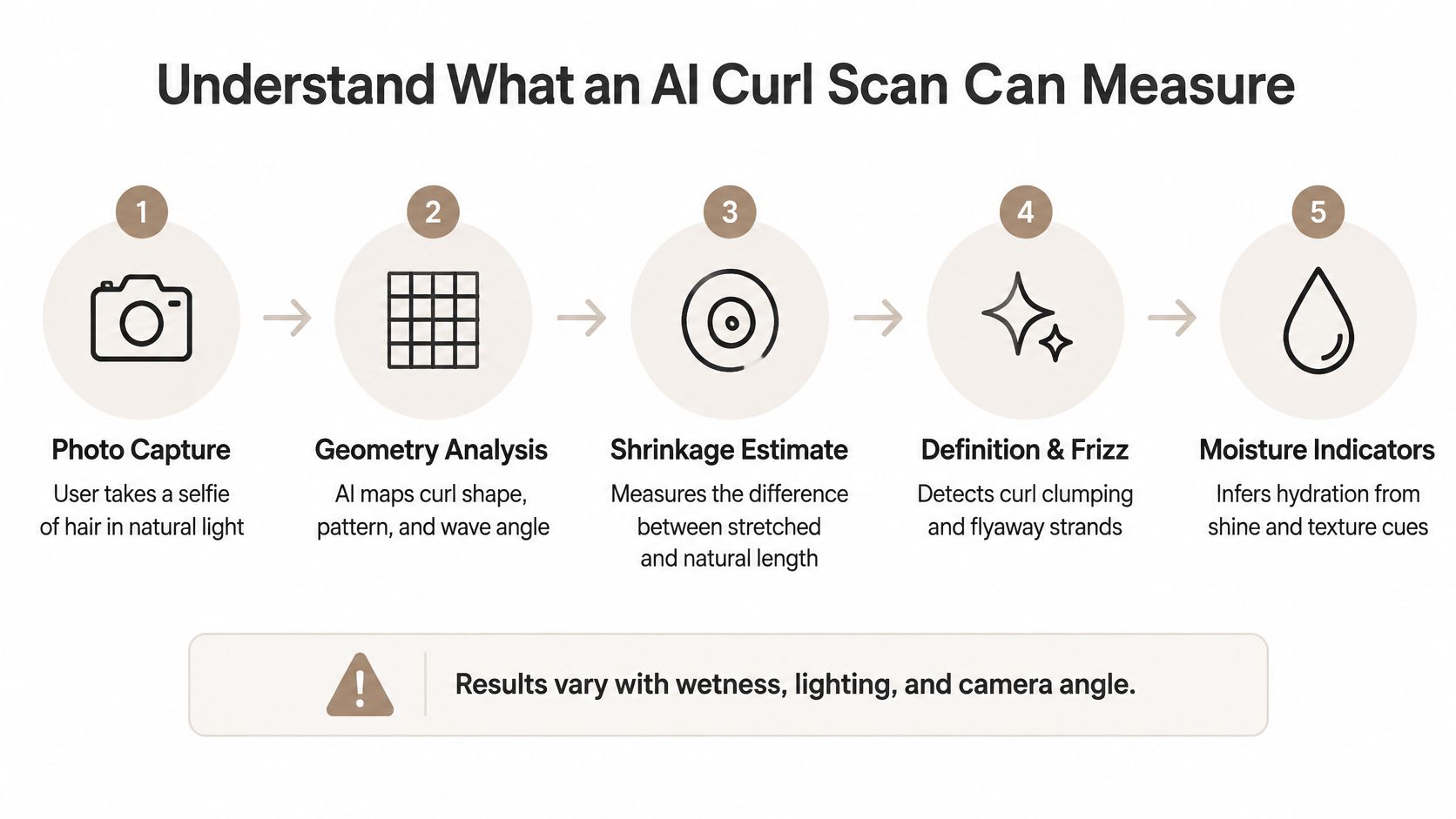
A scan can estimate visible geometry. It can map how curls curve, how tightly they coil, how much they shrink compared with stretched length, and whether strands clump into defined bundles or separate into frizz. Those are real signals, and they're useful for tracking change.
What a scan can't do reliably is separate your underlying pattern from today's conditions. Wet hair hangs differently. Product buildup dulls definition. Harsh lighting flattens texture, a low camera angle distorts volume, and a protective style hides your pattern entirely. Recent heat or chemical treatment changes how hair behaves in ways a surface image only partly reveals.
Research on fiber measurement supports a cautious approach. Established descriptors include curvature, curve radius, and curl index, while laboratory validation uses microscopy and related methods that a phone can't replicate, as described in research on quantifying curly fiber geometry. Cross-sectional measurements also overlap between curl groups, so a single deterministic label overstates what's knowable from a selfie.
How to Read a Scan Result
Prefer apps that give you a confidence range and invite correction when segmentation is uncertain. That's not weakness. It's honest calibration, and it gives you a role in improving later readings.
Validation is the wider gap. A systematic review of AI in trichology found the evidence dominated by retrospective, single-source datasets with limited external validation, with most studies not reporting skin tone or ethnicity diversity and none treating hair texture as a demographic variable. You should therefore ask whether accuracy is reported separately for wavy, curly, and coily hair, for treated and untreated hair, and across lighting conditions.
You can improve your own inputs regardless of the app. Use dry hair, consistent lighting, front and side views, and minimal occlusion. Retake blurry or heavily filtered photos instead of accepting the result. If you're also sorting out moisture behavior, a structured low porosity hair routine can help you separate porosity questions from pattern questions before you blame the scan.
A scan that can't distinguish a bad hair day from your actual curl pattern isn't measuring you. It's measuring the moment.
Build Your Personalized Plan in Coil
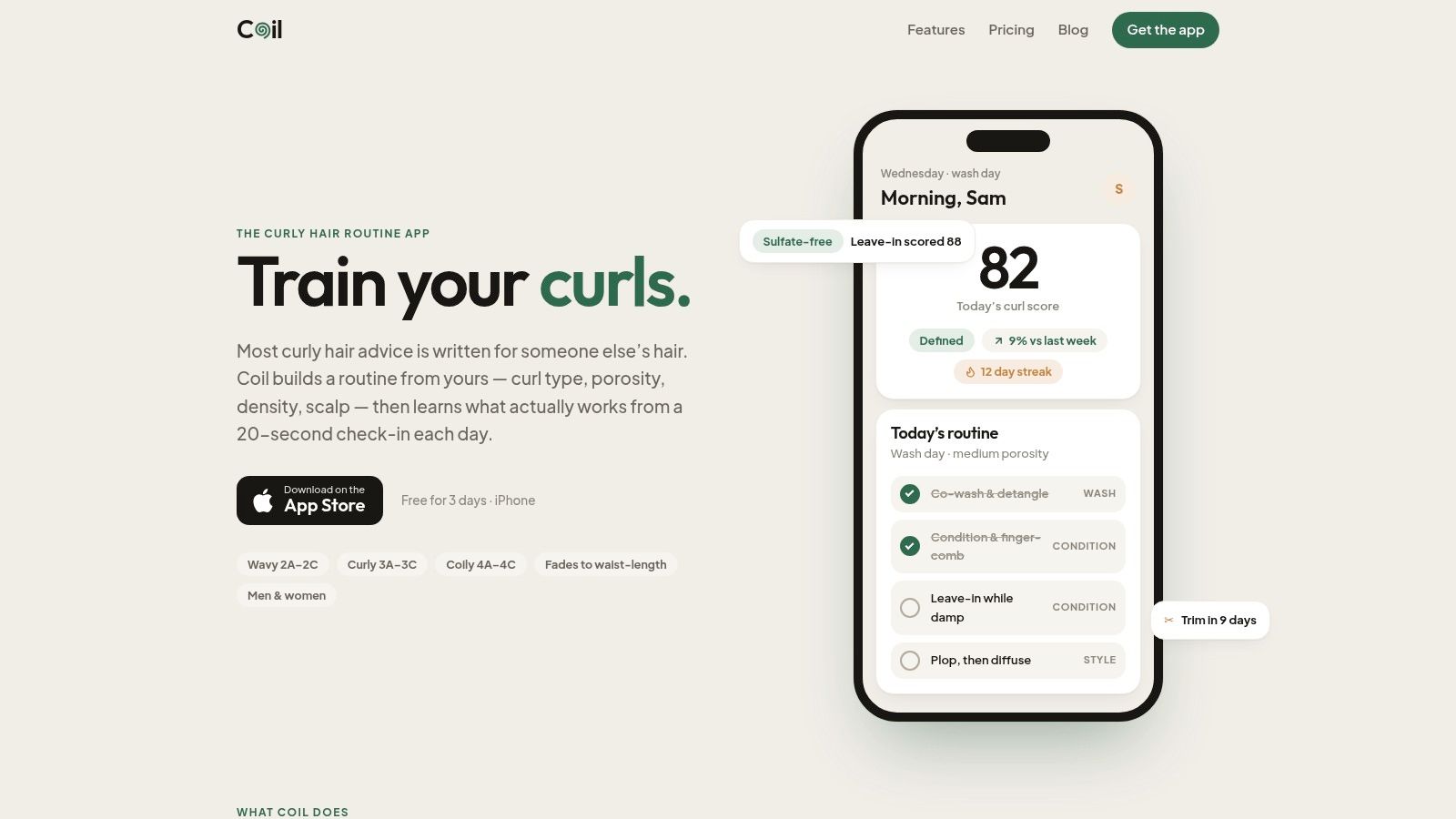
Start with the intake, not the camera. Coil opens with a 13-question quiz on curl pattern, porosity, density, scalp condition, length, wash schedule, habits, and goals. Answer based on your typical week, not your ideal one. If you wash every ten days and rarely deep condition, say so. A plan built on habits you don't have will collapse by the second wash day.
The screenshot below shows the app interface you'll use to review that starting plan.
From First Routine to Daily Feedback
Your initial routine reflects those answers. Steps vary by porosity and scalp needs, so a dry scalp may add an oil step that an oily scalp wouldn't get. Follow the first version closely enough to establish a baseline. You're not testing your discipline, you're collecting a comparison point.
Each day, the 20-second check-in asks you to tick off what you did, rate how your curls feel, and optionally add a selfie. Log skipped steps. The plan adapts to observed behavior, so pretending you completed a full routine teaches it the wrong lesson.
When you add a photo, the scan reads definition, frizz, and moisture. If the reading looks wrong because your hair is still damp or the light is poor, correct it. Those corrections feed into ongoing metrics instead of leaving a bad measurement to drive later advice.
The video below walks through how that cycle looks in practice.
Using the Curl Score Without Overreading It
Your curl score combines definition at 40%, frizz at 30%, and moisture at 30%. Treat it as a trend line for your own hair, not a grade and not a medical measure. A single low day after humidity or a rushed wash means little. Two weeks of decline after a product change means more.
Change one major variable at a time. If your coils feel dry by day three, adjust your leave-in amount or sealing step, then watch the trend across several check-ins. Don't also switch cleanser, add protein, and change drying method that same week. You won't know what helped, and neither will the app.
That restraint is backed by how variable fiber condition is. Porosity reflects moisture absorption and retention, and experimental work on true porosity measurement found oxidative bleaching nearly tripled hair surface area during the first minute through increased pore formation. Your history changes your hair's behavior, so your plan should change with evidence, not with every new product you see.
Create a Complete Routine for Coily Hair
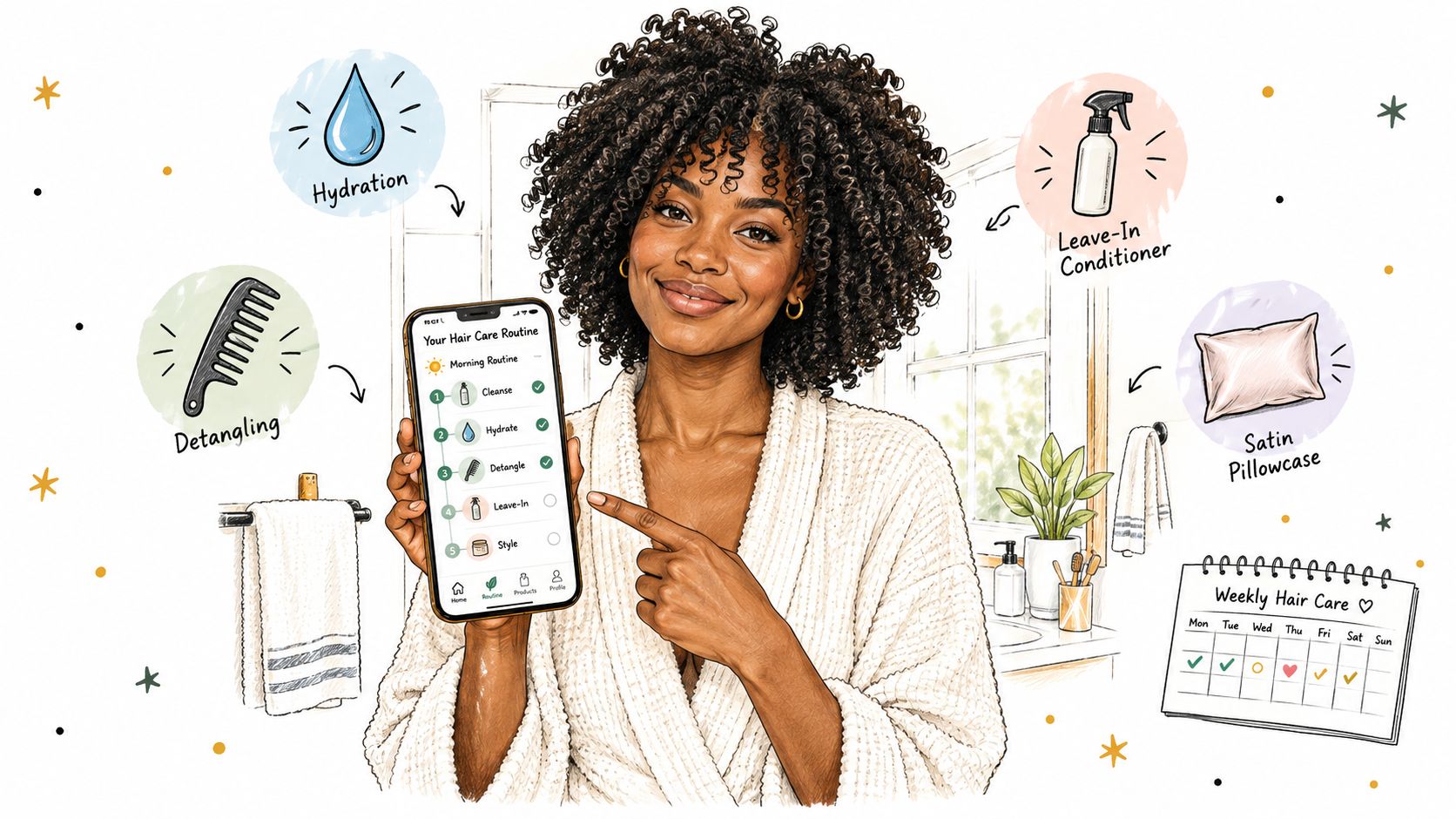
A coily routine doesn't need more steps. It needs the right steps in an order you can repeat, adjusted for length, density, scalp, and porosity. Use your app profile as the starting map, then refine by observation.
Wash Day Structure
Begin with cleansing matched to your scalp, not your curl pattern. An itchy, flaky, or oily scalp may need more thorough or more frequent cleansing than a dry scalp, even when both heads have 4C coils. If scalp oil is your recurring problem, an oily hair care routine gives you a useful contrast before you assume you need heavier moisture everywhere.
Follow with conditioning and detangling while hair is wet and slippery. Work in sections if your density makes a single pass unrealistic. Dense, shoulder length hair usually needs more product and more sectioning time than a short 4C cut, where smaller amounts and faster drying change what's practical. A grow-out sits between those cases, with ends that may behave differently from newer growth.
Then layer moisture and styling products based on how your hair responded last time. Fine coily hair can be weighed down quickly, so start lighter than you think you need. Coarser, denser hair may need richer coverage to reach the ends. Let next day definition and feel, logged in your check-in, settle the amount.
Drying, Protective Styles, and Heat
Air drying, diffusing, and stretching methods produce different definition and shrinkage. Pick one method for a few wash cycles so you can judge it fairly. Heat deserves particular caution. In a study summarized by Dyson and cited in the verified research, tightly curled hair exposed to 428°F for 50 straightening cycles left 37.5% of participants unable to regain their natural curl pattern after rewetting, while only 25% remained damage-free at that temperature. Lower heat at 365°F showed no overall change in curl recovery in that same summary.
Protective styles can reduce daily manipulation, but they don't pause scalp needs. Keep cleansing and moisture access in your plan while hair is braided or twisted, and note tension, itching, or dryness in your check-ins. When you take a style down, expect scans to read differently for a wash or two. Don't overhaul your routine based on that first photo.
- Short cut: Prioritize scalp cleansing, light moisture, and frequent small adjustments.
- Shoulder length coils: Section carefully, watch ends, and track trim timing.
- Grow-out: Compare new growth and older ends separately when you judge products.
Your Weekly Review
Once a week, open your photo timeline and trend charts and ask three questions. What changed this week? What improved or got worse? What's the single adjustment for next week? Trim reminders help here too, because ragged ends can mimic product failure through tangling and frizz.
Weekly test: If you can't name the one thing you changed, you didn't run an experiment. You just had a different wash day.
Use Ingredient Insights Without Oversimplifying Risk
Ingredient scanners are helpful when they explain trade-offs. They're misleading when they sort the world into good and bad chemicals.
Coil flags sulfates, drying alcohols, silicones, and waxes, then assesses compatibility through buildup risk, protein load, and potential weight. Read that as a hypothesis about your hair. A silicone that smooths one person's coils may contribute to buildup for someone who rarely clarifies. A sulfate cleanser may be too stripping for frequent use yet useful occasionally for heavy buildup. Context decides.
Label information itself is incomplete. Research on 150 textured-hair products cited in a study of textured-hair product labeling found 70% listed fragrance, only 41% appeared in the EWG Skin Deep catalog, 14.6% contained sulfates, and only 50.6% carried a formulated without sulfates badge. A scanner can't fully resolve inconsistent disclosure or marketing language, so you shouldn't treat its verdict as final.
A Sensible Product Trial
Compare two familiar products rather than rebuilding your shelf. Scan both, choose the one with the lower predicted buildup or weight risk for your profile, and change only that product. Record definition, moisture feel, weight, buildup, and scalp response over several uses. Rinse-off products expose you differently from leave-ins, and concentration matters, so a flagged ingredient in a shampoo isn't automatically equivalent to the same ingredient left on your scalp all week.
Porosity claims need the same restraint. Don't rely on a float test alone. Combine your bleach, heat, and chemical history with wetting, drying, frizz, and product response signals. Research in a study of textured hair permeability and porosity found bleaching increased water-related diameter variation by more than twofold versus virgin textured hair, which is a more grounded reason to track behavior over time than a strand in a glass. If you're weighing moisture ingredients specifically, guidance on humectants for curly hair can help you frame better trial questions.
Some symptoms aren't product problems. Persistent itching, scaling, pain, or shedding warrants a dermatologist, not another scan. Patch test new leave-ins when you have sensitive skin, and stop a product that repeatedly irritates you even if its compatibility score looks favorable. Cosmetic performance and medical risk aren't the same thing, and an app shouldn't blur that line.
Choose an App and Build a Lasting Routine
Choose based on the system, not the label it assigns you on day one. The best fit collects broad intake, accepts corrections, adapts routines, explains ingredient reasoning, tracks progress visibly, and states subscription terms clearly. It should also fit your phone and your tolerance for daily logging.
A 30-Day Adoption Plan
Use your first week to establish a baseline. Take standardized photos, complete check-ins, and resist product changes unless something irritates your scalp. In week two, change one major variable, such as cleanser frequency or leave-in amount. Hold that change through week three while you watch trends. In week four, review your timeline, keep what improved definition or moisture without new buildup, and revert what didn't.
Troubleshoot in a specific order when results stall.
- Inaccurate scan: Retake photos dry, in consistent light, and correct the reading.
- Conflicting advice: Return to your logged responses instead of following the newest suggestion.
- Buildup: Review product weight, frequency, and whether cleansing matches your styling load.
- Unexpected dryness: Check heat, weather, and recent chemical exposure before adding heavy oils.
- Low adherence: Shorten the routine until check-ins feel automatic again.
- Worsening scalp symptoms: Stop experimenting and seek qualified medical advice.
Coil costs $6.99 weekly or $99.99 yearly, with a three-day free trial, and App Store pricing may vary by country. Use that trial to test the quiz, scan correction, ingredient scanner, and check-in burden. Three days won't prove long term hair outcomes, but it's enough to learn whether the workflow fits your life.
The most useful app won't be the one that sounds most certain. It'll be the one that helps you make consistent, evidence-aware adjustments, recognize uncertainty, and notice when a problem falls outside cosmetic advice. For 4A to 4C hair especially, repeated measurement beats a single impressive scan.
If you want a routine that learns from your corrections, check-ins, scans, and ingredient choices instead of locking you into one selfie label, try Coil and use the trial to build your baseline. Start with the quiz, track your first wash cycles, and let the trends tell you what your coils need next.