Best Apps for Curly Hair Product Ingredients: Check if Products Suit Ur Hair
Best Apps for Curly Hair Product Ingredients: Check if products Suit ur hair. Best Apps for Curly Hair Product Ingredients: Check if products suit your hair
You're standing in the hair-care aisle with a curl cream in each hand. Both promise softness and definition, but the last “curl-loving” product left your roots flat, your ends rough, or your scalp uncomfortable. You'd like to check the ingredients before buying again, without needing a chemistry degree.
The best apps for curly hair product ingredients should help you check whether products suit your hair, not just sort ingredients into good and bad columns. A useful tool translates the label, considers your routine, and helps you compare its prediction with what happens on wash day.
Why Ingredient Apps Matter for Curly Hair
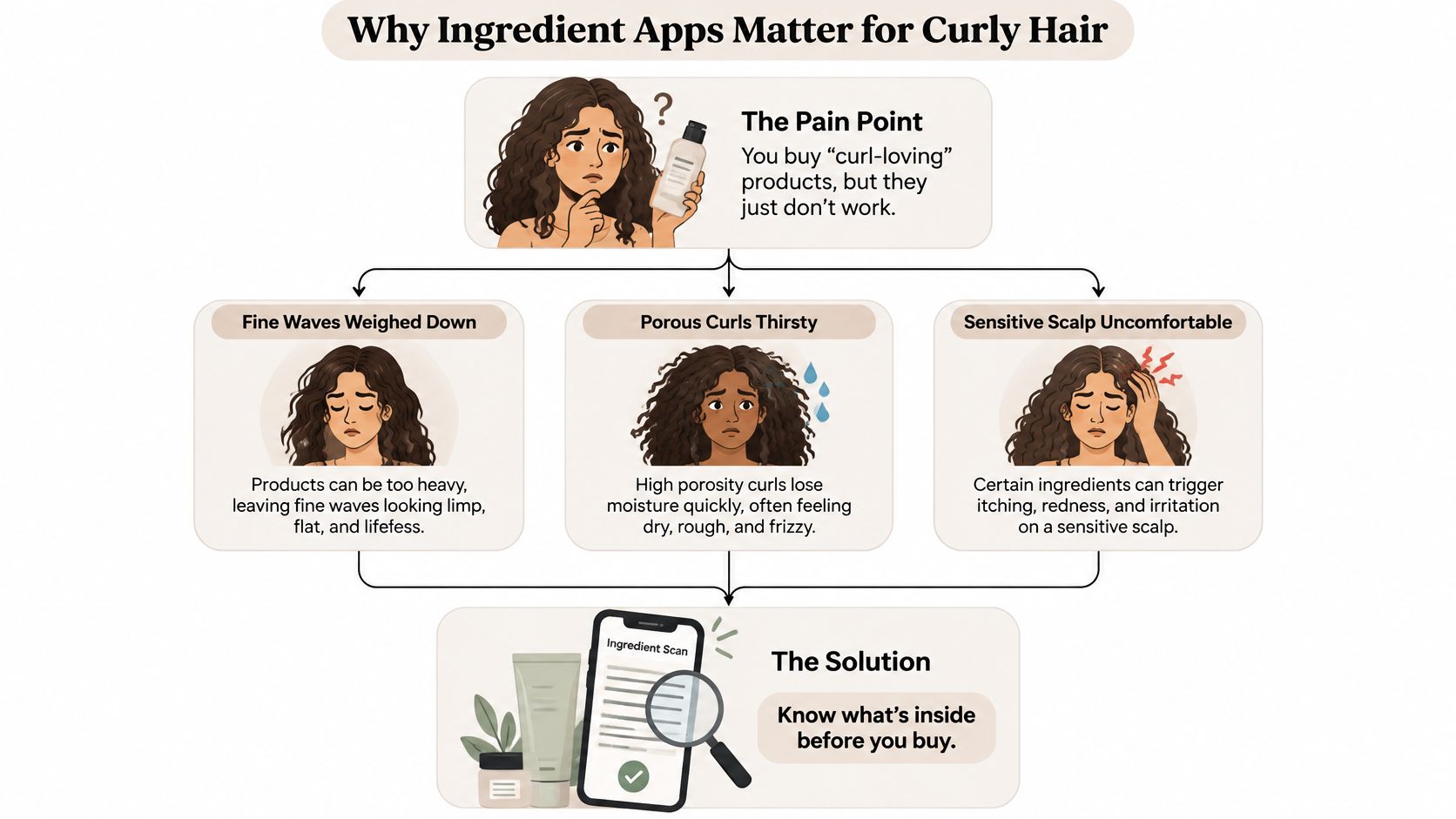
A product can sound perfect on the front of the bottle and still be a poor match for your routine. Consider these hypothetical shoppers: someone with fine waves wants movement without heaviness, someone with porous curls wants easier detangling, and someone with a sensitive scalp wants comfort above everything else. They're shopping in the same aisle, but they aren't solving the same problem.
Ingredient screening helps you ask more specific questions. Instead of choosing a conditioner because it says “intensive moisture,” you can investigate whether its likely conditioning and film-forming tendencies match what you need. The point isn't to predict every result before purchase. It's to make a more informed choice about what to try.
The diagram below connects common frustrations with the questions an ingredient app should help you investigate.
Look for explanations rather than verdicts
When comparing apps, inspect the reasoning behind a result. A useful explanation should connect the ingredient flag with a decision you can make.
- Product purpose: Does the app distinguish a rinse-out cleanser from a leave-in styling cream?
- Personal context: Can you account for porosity, density, scalp condition, and wash habits?
- Practical consequences: Does it explain what to monitor, such as residue, heaviness, or detangling comfort?
- Uncertainty: Can you tell what the app knows from the label and what remains unknown?
An app that explains a possible mismatch gives you something to test. An unexplained red warning leaves you wondering whether you should discard a product that has worked comfortably for you.
Practical rule: Choose the tool that helps you make a clearer decision, not the tool that produces the most alarming ingredient list.
Keep your own experience in the comparison. An app's recommendation is useful only when you can connect it with a product, a routine, and an observable result.
Understanding High Porosity Curly Hair
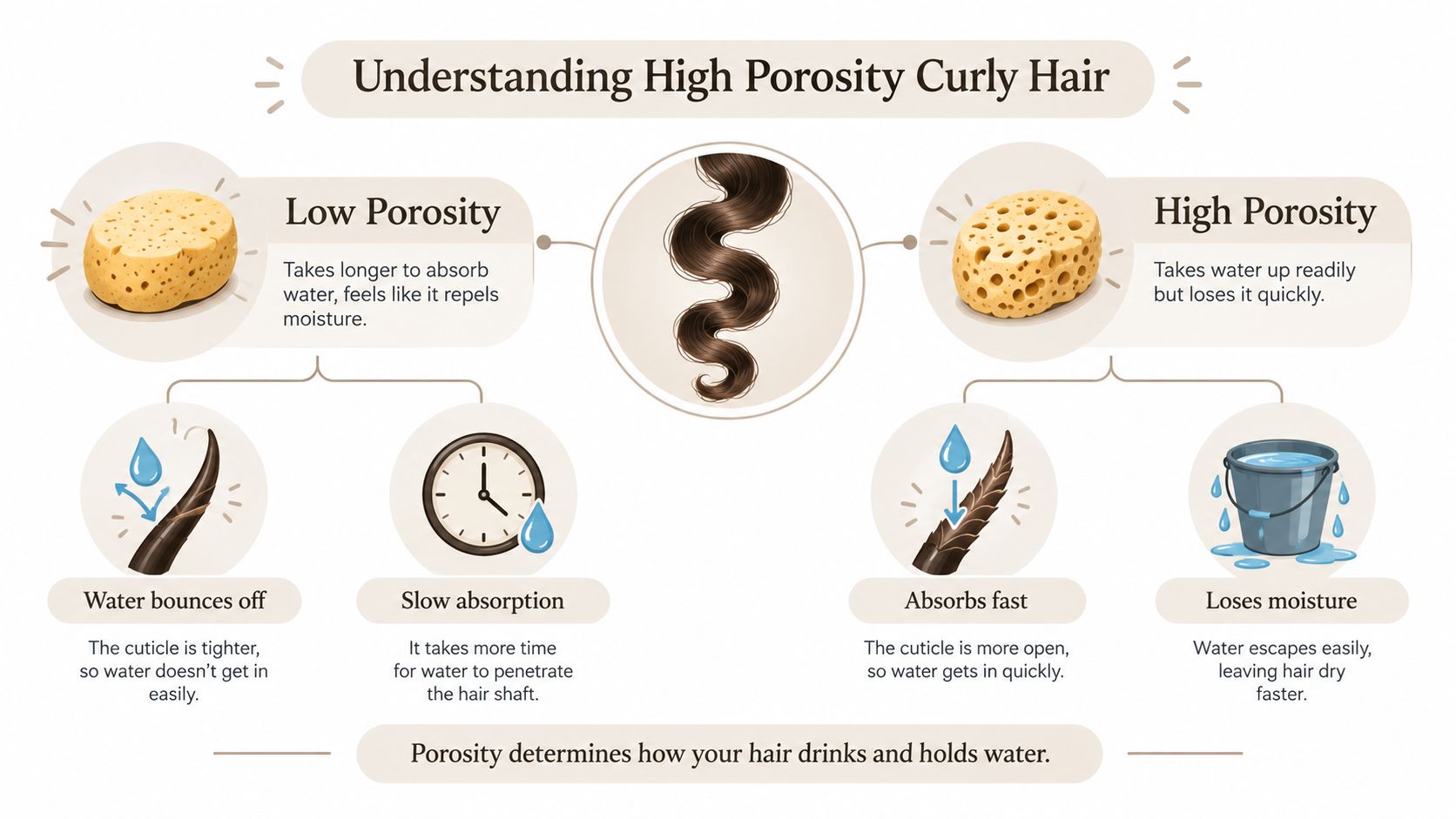
Porosity describes how your hair interacts with water. As a teaching analogy, think of a more closed sponge compared with a more open one. The comparison helps you picture differences in water uptake, but your hair isn't a sponge, and a quick home observation can't reveal everything about its structure.
Higher porosity is associated with greater water uptake and swelling. For fragile or chemically treated curls, that swelling matters because washing and grooming can add mechanical stress, particularly during detangling, as explained in this review of hair cleansing and fiber damage.
Use the illustration as a starting point for understanding the concept, not as a diagnostic test.
Establish a baseline before choosing products
Rather than assigning yourself a permanent porosity label from an isolated strand test, record what you notice during your usual routine. Treat these observations as clues to discuss and compare, not proof of damage.
- Wetting behavior: Does water seem to spread readily, or do you need more time to wet your hair thoroughly?
- Handling: When does detangling feel comfortable, and when does your hair feel vulnerable?
- Condition after washing: Record softness, roughness, and how your ends feel before adding styling products.
- Between-wash changes: Note when your hair begins to feel dry, coated, stiff, or difficult to manage.
- Scalp experience: Keep tightness, itching, and discomfort separate from how the lengths feel.
Dryness alone shouldn't become your diagnosis. Your product history, chemical treatments, washing habits, and handling are relevant context. Likewise, a tightly coiled pattern shouldn't automatically become a high-porosity label.
For a visual companion to the porosity concept, watch the explanation below.
Give the app useful observations
Write a baseline in everyday language: “My ends feel rough after cleansing, conditioner helps detangling, and my scalp feels comfortable.” That description gives you a clearer testing target than “My hair hates everything.”
If moisture-focused ingredient terms are confusing, this guide to humectants for curly hair provides a focused next step. Keep the question practical: what are you trying to improve, and how will you recognize improvement?
How Ingredient Labels Reveal Product Tendencies
Read an ingredient list like a map, not a finished photograph. It shows parts of the formula and offers clues about their relative prominence. It doesn't show the complete experience you'll have after applying, rinsing, drying, and styling.
In the United States, cosmetic ingredients generally appear in descending order of predominance. However, ingredients present at 1% or less may appear in any order, and fragrance can be declared as "fragrance," according to the FDA's cosmetic labeling guide. These rules make label order useful, but they don't let an app calculate exact concentrations or reconstruct a fragrance mixture.
Ask what the ingredient is doing in this product
An early-listed conditioning ingredient may suggest a prominent conditioning role. That's different from knowing precisely how rich the finished formula will feel. The same caution applies when an app spots protein, oil, or a film-forming ingredient.
Use this reading sequence:
- Identify the category: Is the product designed to cleanse, condition, style, or provide a targeted treatment?
- Read the prominent ingredients: Look for the formula's likely main functions.
- Interpret later ingredients cautiously: Their position may not reliably indicate their relative amounts.
- Separate presence from performance: Finding an ingredient doesn't establish the finished product's strength, weight, or suitability.
For a cleanser, that means asking about the whole washing experience rather than making the decision from a single ingredient name. This guide to shampoo and oil control can help you frame the scalp-related part of that choice.
Account for regional labeling
European Union rules also require cosmetic ingredient lists and provide an authorization framework for categories such as preservatives, colorants, and ultraviolet filters. The Cosmetics Europe labeling guidance explains that labeling framework.
Regulatory compliance and personal compatibility answer different questions. A properly labeled formula may still feel too heavy, insufficiently conditioning, or uncomfortable for a particular user.
A useful scan explains what the label suggests, what it cannot reveal, and what you should watch for during use.
When comparing apps, favor wording such as “possible weight-down risk” over an unsupported promise that a product will definitely suit your curls.
Choosing Products for High-Porosity Curls
Start with the problem you need a product to address. If detangling is uncomfortable, assess conditioning and handling. If your hair feels coated after repeated styling, investigate cleansing and residue. Buying the richest formula available isn't a reliable substitute for identifying the problem.
“Sulfate-free” isn't a complete description of cleansing strength. As the cleansing review discussed earlier explains, stronger cleansing can be useful for accumulated oils and styling residue, while excessive cleansing without adequate conditioning can leave vulnerable hair harder to manage. Your wash frequency, scalp oiliness, and current routine belong in that decision.
High-Porosity Ingredient Compatibility Guide
| Ingredient Category | What Screening Can Suggest | Possible Benefit | Points to Monitor | Best Context for the Decision |
|---|---|---|---|---|
| Surfactants | Likely cleansing role and potential cleansing intensity | Removal of oil and accumulated styling residue | Roughness, tangling, scalp dryness, or incomplete cleansing | Wash frequency, scalp oiliness, buildup history |
| Conditioning agents | A formula's likely conditioning emphasis | Better lubrication and manageability | Whether hair feels easier to handle or unnecessarily coated | Detangling needs and the conditioning already in your routine |
| Silicones | Surface-film tendencies and possible cleansing requirements | Reduced friction, shine, and protection | Accumulation and weight on your particular hair | Fiber condition, density, and cleansing habits |
| Oils | Oil presence and whether a formula may emphasize lubrication or coating | Conditioning support, depending on the oil and formula | Heaviness and how hair feels after repeated use | Ingredient identity, amount applied, and observed response |
| Protein hydrolysates | Presence of protein-containing ingredients, not their exact dose | A conditioning option worth assessing for compromised fibers | Stiffness, roughness, or no useful change | Fiber condition, frequency, and total routine |
| Waxes | A reason to investigate styling-film and removal behavior | Suitability must be judged in the finished styling product | Residue, weight, and ease of washing out | Styling goal and the cleanser used alongside it |
The distinctions matter particularly for silicones and oils. Dimethicone is hydrophobic, while modified silicones differ in deposition and hair affinity; silicones can also reduce friction and improve shine. Coconut oil has properties that enable penetration into the hair shaft, distinguishing it from purely surface-coating materials, as described in this medical review of hair cosmetics.
Rank your trial priorities
Use the table to narrow a choice, not assemble a banned list. A silicone flag should prompt a question about accumulation and removal, not an assumption of inherent damage. A protein flag should prompt attention to frequency and response, not an automatic strengthening claim.
For a practical shortlist, prioritize:
- Scalp compatibility: Don't overlook previous discomfort while chasing curl definition.
- The missing function: Choose for the problem your current routine doesn't address.
- Manageable trade-offs: Decide what you're willing to monitor, such as extra weight or a need to reassess cleansing.
A product is worth testing when you understand why you're trying it and what outcome would justify keeping it.
Matching Routines to Different Curl Profiles
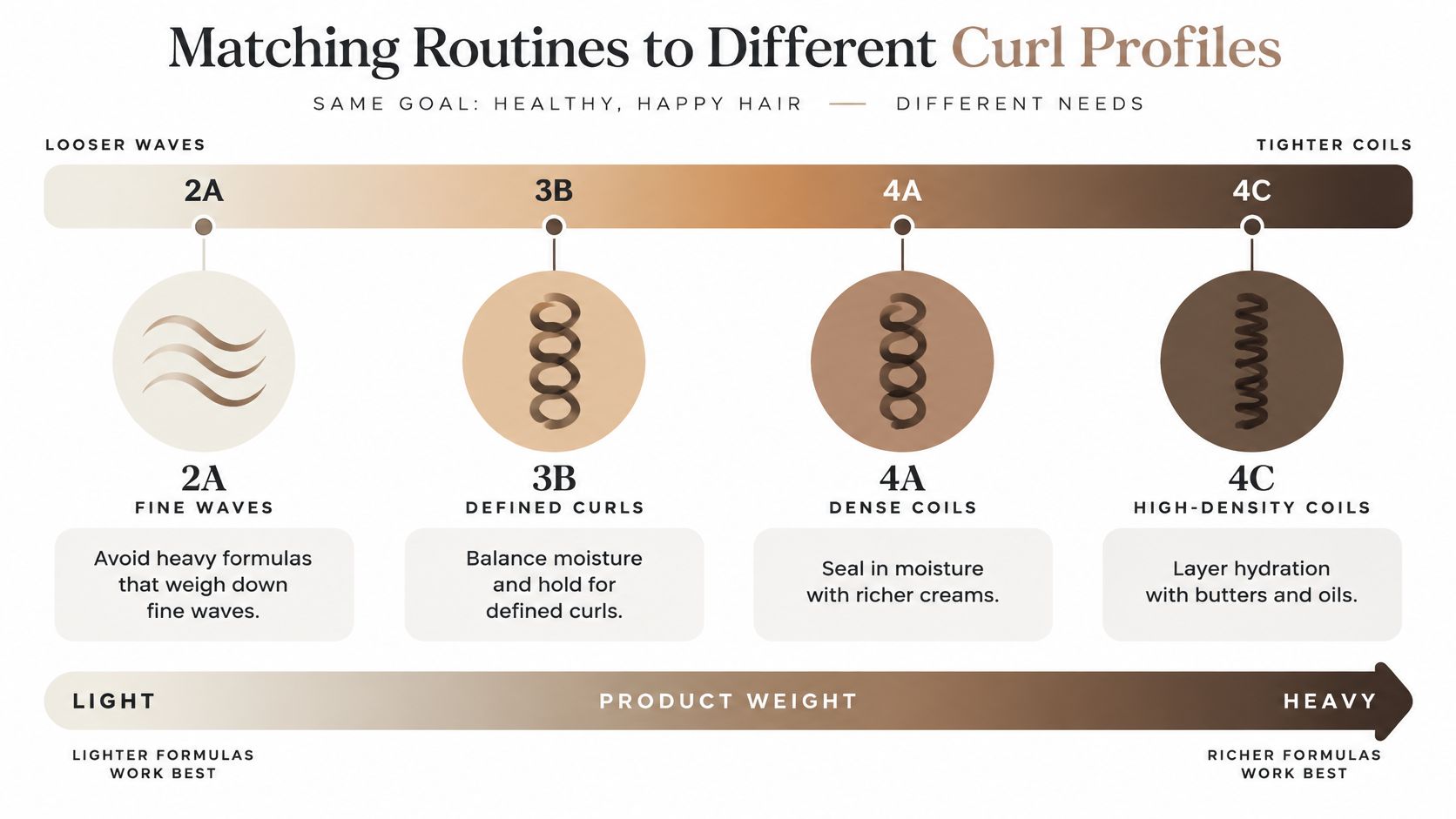
Consider a hypothetical wash day for someone with fine, low-density waves. Their curls look defined while wet, but a rich leave-in leaves the finished style flatter than they wanted. A useful app would help them investigate product amount, overlapping conditioning steps, and formula weight instead of treating the curl pattern alone as the explanation.
Now consider someone whose porous curls feel difficult to detangle after washing. Removing every film-forming ingredient because a scanner flags them could work against their immediate goal. The better question is whether their chosen conditioning step improves handling without creating a new problem.
The chart offers broad examples of routine priorities. Treat the pattern labels as orientation, not instructions about how rich every person's products should be.
The same flag can lead to different decisions
For the person with fine waves, a possible weight-down flag might justify trialing less leave-in product. For the person with fragile lengths, a film-forming formula might be worth evaluating for detangling comfort. Neither decision requires calling the ingredient universally good or bad.
For a tightly coiled routine, useful observations might include whether the product spreads evenly, whether detangling feels easier, and whether residue remains after washing. Don't assume that tighter coils automatically call for more layers of butter or oil.
| Example profile | Question to investigate | Useful result to record |
|---|---|---|
| Fine, low-density waves | Is the routine heavier than needed? | Movement, root fullness, and coated feeling |
| Porous curls | Does conditioning improve handling? | Detangling comfort and softness after drying |
| Tightly coiled hair | Does application and removal work well? | Distribution, residue, and scalp comfort |
Choose an app that can revise its suggestion
A questionnaire can organize your starting profile, but it shouldn't lock you into a routine regardless of results. Look for a tool that lets you record what you used, correct an interpretation, and compare changes over time.
If your observations point toward a different porosity profile, explore a low-porosity hair routine rather than forcing your experience into a high-porosity plan.
Photo-based feedback can help organize visible changes, but it shouldn't overrule your report that a product feels uncomfortable or makes detangling harder. The useful combination is a structured record plus your own observations, not an image-based verdict alone.
Why Good and Bad Ingredient Scores Can Mislead
A polished score can feel reassuring because it compresses a complicated decision into something simple. The difficulty is knowing what that score represents. Ingredient presence, potential hazard, likely buildup, and personal styling compatibility aren't interchangeable measures.
Label visibility also has limits beyond ingredient order. A laboratory study of 31 personal-care products used by women of color found that only 23% of 165 detected chemical occurrences of concern appeared on ingredient labels, according to the published exposure study. That finding does not establish that every product or label has the same limitations, but it shows why a label scan cannot function as a complete chemical analysis.
A “clean” claim doesn't settle the question
Marketing language deserves the same scrutiny. An analysis of 150 products marketed as “clean” for textured hair found that 70% listed fragrance, as reported in the textured-hair product analysis. This doesn't prove those products are unsafe; it challenges the assumption that a “clean” claim reliably answers a fragrance-sensitive shopper's question.
The practical distinction is between identifying something worth investigating and establishing a meaningful personal risk. An ingredient name alone doesn't tell you the exact dose or your exposure under real use.
A score is a screening aid, not a safety certificate or a promise of a good wash day.
Check whether the score explains its limits
Before relying on an app's ranking, look for answers to these questions:
- What is being scored? Compatibility, ingredient hazard, cleansing intensity, or something else?
- How is uncertainty shown? Does the app acknowledge missing concentration and formulation information?
- Can you separate concerns? A possible residue issue shouldn't look identical to a scalp-sensitivity concern.
- Can you add your experience? A useful tool should let you record comfort, stiffness, heaviness, or a satisfactory result.
Be especially cautious when a tool turns “silicone-free,” “natural,” or “sulfate-free” into a universal recommendation. Those descriptions tell you something about a product, but they don't replace a reasoned comparison with your needs.
The strongest app explanation leaves you better equipped to decide. It shouldn't make you more afraid of a label you still don't understand.
A Practical Product Testing Workflow
Bring the process back to a manageable wash day. You don't need to change your entire routine to learn whether a conditioner or styling product deserves a place in it. You need a clear starting point, a limited change, and a record you can interpret.
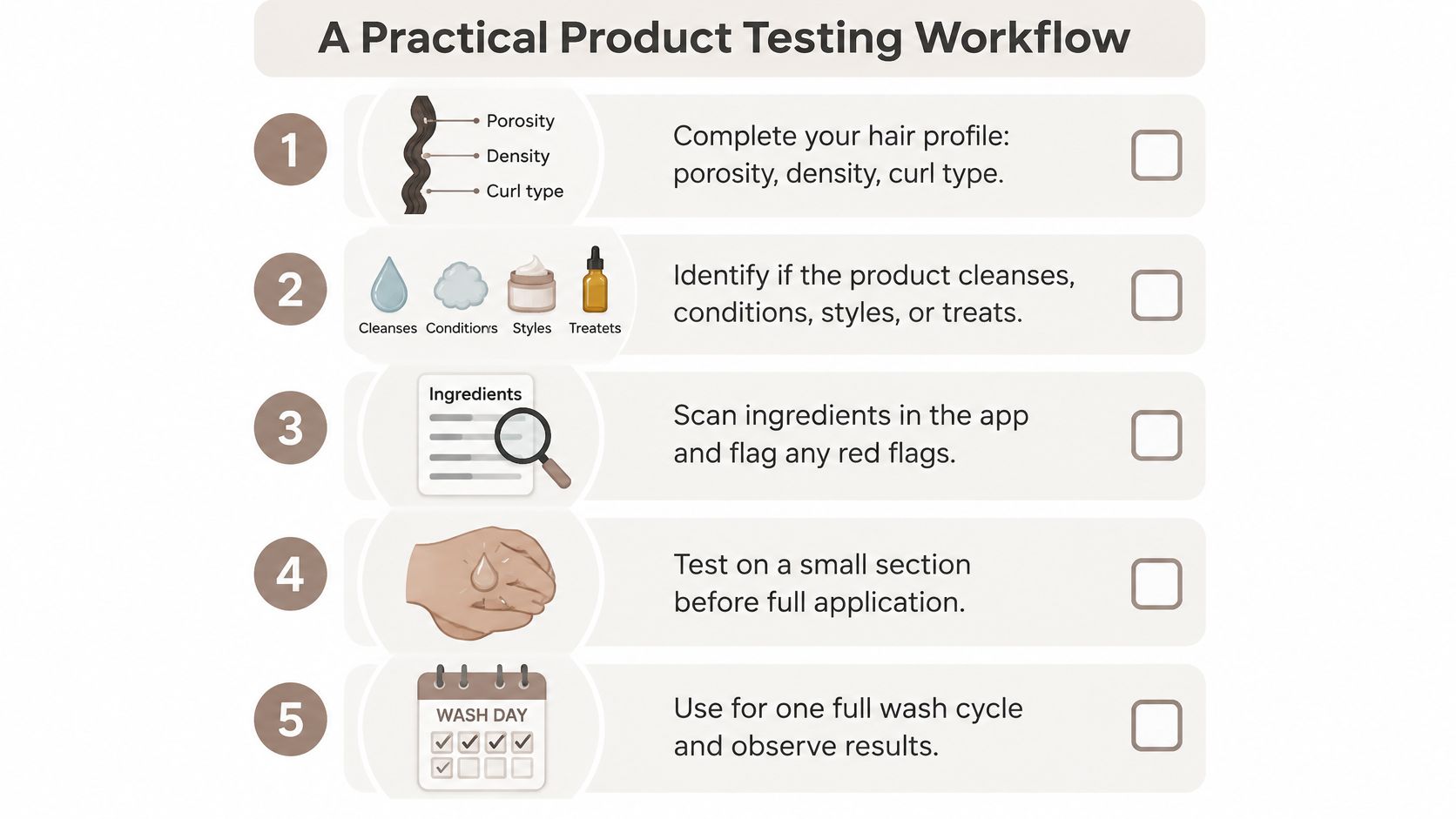
The checklist below shows the basic sequence. Treat a small-use trial as a cautious observation step, not proof that a product cannot cause a later reaction.
Set up a test you can interpret
- Write your starting point: Note your current products, scalp comfort, handling difficulties, and desired change.
- Name the product's job: Decide whether you're evaluating cleansing, conditioning, hold, or another specific purpose.
- Read the scan conditionally: Turn its main flag into a question, such as “Will this feel too heavy with my existing leave-in?”
- Limit competing changes: Keep the rest of your routine reasonably consistent so the comparison remains useful.
Follow the product's directions. If you're concerned about sensitivity, don't treat an app result or a home test as medical clearance.
Record the result before changing again
A brief daily record is more useful than a complicated journal you abandon. Track what you used and how your hair and scalp felt, with an optional photograph taken under reasonably comparable conditions.
Keep visible results and physical comfort separate. You might like the definition but dislike the coated feeling, or prefer the softness while finding the hold insufficient. Those are different outcomes and may require different adjustments.
Use a focused review:
- Keep: Which part of the result met your original goal?
- Question: What unexpected change needs another observation?
- Adjust: Could application amount or an overlapping step explain the mismatch?
- Stop: Don't keep applying a product that causes discomfort to complete your experiment.
Photo analysis and a combined curl score can serve as trend signals. Let your notes explain those signals rather than asking a single score to summarize everything that matters.
Build a Routine That Keeps Improving
The best ingredient app helps you make a testable decision and learn from it. It doesn't need to issue the strongest verdict. It needs to help you connect a formula, a purpose, and a result without hiding uncertainty.
For high-porosity care, that means resisting the urge to add every popular oil, protein treatment, and rich conditioner at once. Your aim is a workable balance of cleansing, conditioning, protection, and handling. A growing collection of approved ingredients isn't the same as a routine you enjoy using.
Compare tools by what you can do afterward
Choose an app that leaves you with a useful next action. Can you explain why you selected the product? Can you record a mismatch without being told your hair is wrong? Can you revisit the recommendation after your routine or goals change?
- Before buying, describe the need: Write down the problem you want the next product to address.
- Before trusting a score, inspect the explanation: Look for product context, uncertainty, and a practical interpretation.
- Before changing your routine, choose your observation: Decide whether you'll judge the trial by scalp comfort, detangling, weight, definition, or another clear outcome.
You can use a dedicated app or a simpler record if it helps you stay consistent. The deciding factor is whether the tool makes your next choice clearer.
Your hair and scalp experience should remain the final checkpoint. Keep the products that serve a purpose, reconsider the steps that don't, and use ingredient information to ask better questions before your next purchase.
Coil offers personalized curly-hair routines, ingredient compatibility screening, and a brief daily check-in with optional selfies to help connect product choices with real results. Visit Coil to organize your next product trial and follow your routine through photo timelines and trends, rather than relying on a good-or-bad ingredient verdict alone.