3A Hair Type Guide: Identify, Care and Style Curls
Learn what 3A hair type looks like next to 2C and 3B, why it frizzes, and which routine and fixes keep curls defined.
If your curls look wavy after washing and spiral-shaped once dry, which version should determine what you buy? The 3A hair type describes loose, springy S-shaped spirals, the loosest curls in the curly group, between wavy 2C and tighter 3B. It doesn't tell you how much conditioner those curls can carry.
A useful routine starts with the conditions behind the shape: strand thickness, density, porosity, scalp health, damage, and weather. Understand those first, and you can stop treating every change in definition as a reason to replace your products.
Confirm Your 3A Type Before Buying Products
In the André Walker system, the number identifies the hair family, from straight through wavy and curly to coily, while the letter indicates increasing tightness within that family. A systematic review of hair classification systems explains that the numbers run from 1–4, and that 3A appears in André Walker and FIA classifications but not LOIS.
That makes 3A a visible descriptor, not a biological diagnosis. You can have loose spirals at the nape, stronger waves near your temples, and tighter ringlets elsewhere without having classified your hair incorrectly.
Compare the recurring shape
3A compared with neighbouring curl types
| Type | Curl shape | Approximate size reference | Wet versus dry look | Often confused with |
|---|---|---|---|---|
| 2C | Defined S-bends with loose spring, rather than consistent full loops | Wide marker or thick brush as a loose visual reference | Can look stretched when wet; stronger waves appear dry | 3A |
| 3A | Loose, springy S-shaped spirals | Sidewalk chalk or thick marker | Often looks wavy when wet, then forms spirals as it dries | 2C and 3B |
| 3B | Tighter corkscrews | Pencil or chopstick | Wet weight can stretch ringlets; dry curls look more compact | 3A and 3C |
| 3C | Closely packed, tight corkscrews | Straw or thin pen | Wet coils elongate; dry coils contract into a compact shape | 3B and 4A |
These object comparisons are memory aids, not measuring standards. Look for repeated complete loops rather than trying to fit every curl around a particular pen.
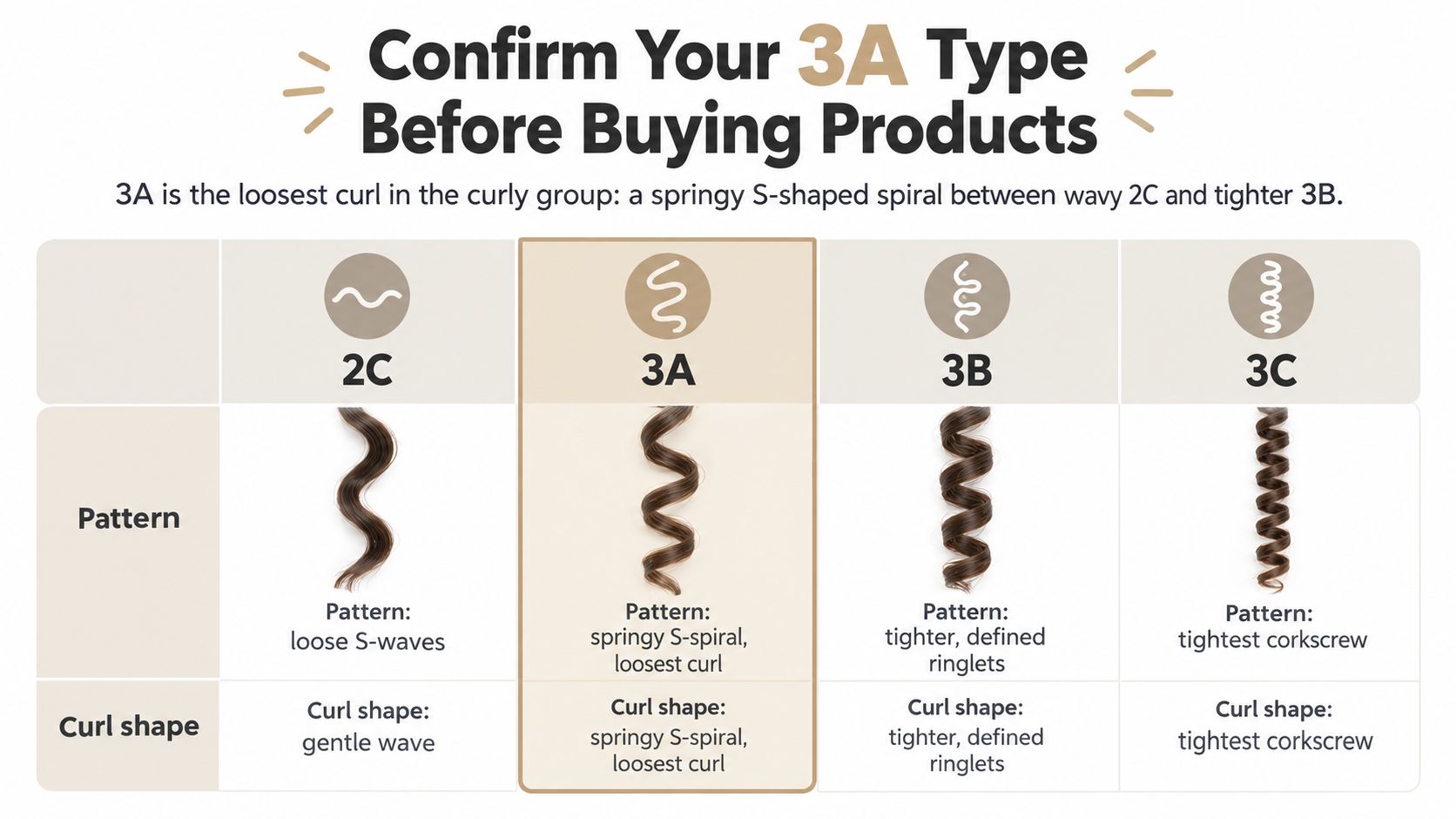
Healthline's guide to hair types notes that loose curls may look nearly straight when wet and curl after drying. Don't let a shower photograph outweigh what your hair repeatedly does when dry.
Check more than curl pattern
Repeat these checks across wash days rather than relying on a single test:
- Compare wet and dry hair. Photograph freshly washed hair without styler, then photograph it dry in natural light. Don't brush or stretch it while drying. Recurring open spirals suggest 3A; predominantly loose bends suggest 2C.
- Roll a naturally shed strand between your fingers and inspect it against a contrasting sheet. A strand that's difficult to see or feel is probably fine; an obvious, substantial strand is coarser. This is a rough comparison, not a measurement.
- Assess density separately. Part your hair and inspect scalp visibility in consistent lighting. Ponytail fullness can offer another clue, but strand thickness and length also affect it.
- Check porosity through behaviour: how readily clean hair wets, how products spread, and whether damaged ends behave differently. A float test isn't reliable enough to diagnose porosity; residue and surface tension can keep a strand afloat.
- Inspect scalp and damage. Note oiliness, flakes, itch, split ends, unusual stretching, and snapping. Persistent irritation or sudden shedding needs professional assessment, not a different curl cream.
These answers together guide the routine. The label is only the starting point.
Why 3A Curls Spring Back and Shift With Water
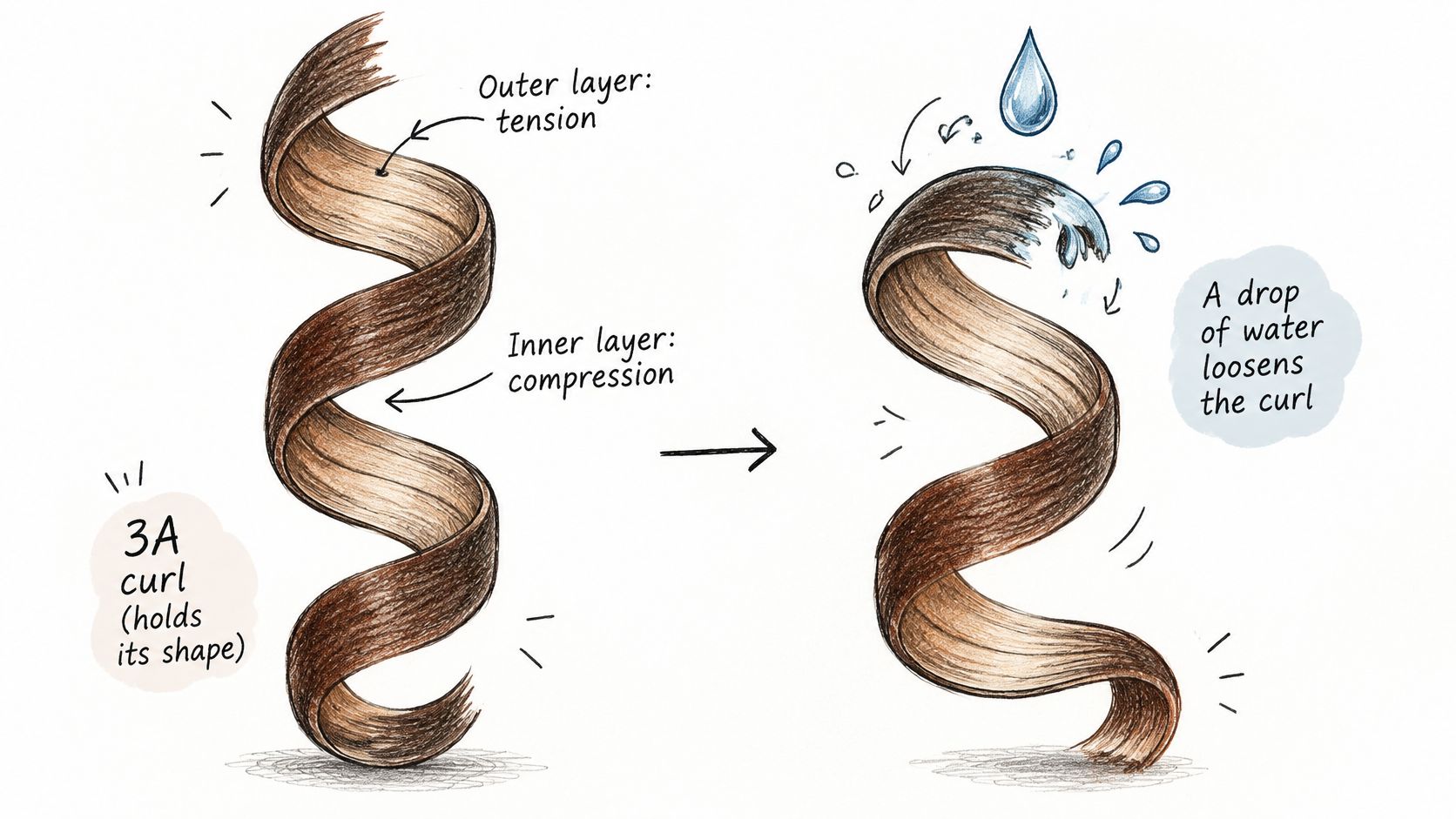
A curl works like a layered ribbon whose sides carry unequal tension. If the sides don't behave identically, the ribbon bends instead of lying flat. Hair is more complicated than ribbon, but the comparison shows why its internal structure matters more than the outline you see in a mirror.
Inside the cortex, different cell populations contain different arrangements of keratin, the protein that gives hair much of its structure. Unequal mechanical stresses help the growing fibre develop a bend. A 2020 review in Experimental Dermatology identifies these internal arrangements as major drivers of curl formation, with a flattened or elliptical cross-section contributing rather than acting as the sole cause.
What spring-back actually means
Early movement when a curl is pulled comes largely from its curved shape opening up, not only from the fibre stretching, which is why a curl can look longer under tension and shorter after release. That first give is geometry, not strain. Only once the spiral has opened does the strand itself begin to extend, which is where real stress on the fibre starts.
Water also affects temporary bonds within hair. A stretched curl may recover after wetting, but that doesn't mean water repairs heat or chemical damage. Because wet and dry hair follow different rules, your curl pattern isn't a fixed identity: the same head can show elongated bends under tension and tighter spirals once fully dry, and both observations are true.
The everyday triggers are straightforward:
- Wetting: Changes temporary bonding and allows a previously stretched pattern to reform.
- Drying: Sets a temporary arrangement, including whatever stretching or shaping happened while wet.
- Tension: Ponytails, brushing, and pulling can elongate the visible spiral.
- Handling: Repeated loading and friction can reduce definition and increase wear.
A curl that stretches isn't automatically damaged. A strand that repeatedly snaps needs gentler handling, not a stronger test of its elasticity.
Don't pull individual hairs to prove they spring back. Observe how sections recover during ordinary washing and styling instead, because that reflects how the whole pattern behaves day to day. Good technique protects that response: support the lengths while detangling, avoid taut hairstyles, and resist repeatedly touching a curl as it dries. Each touch adds a small load while the temporary bonds are still setting, and small loads add up across a wash day.
Matching Symptoms to the Right First Fix
A halo of fuzz after humid air does not call for the same response as dull strands that feel coated after several stylers. A 3A label can cover hair that changes with wet or dry state, humidity, porosity and damage, so diagnose the variable before buying another product. Touch tells you more than a mirror: rough, slippery, sticky, stiff or unusually soft lengths point toward different first moves.
Change one thing at a time. If cleanser, conditioner and styler all change together, the next wash cannot show which variable helped.
Read the symptom before changing the product
Curl symptoms, likely causes and first change
| Symptom | Likely cause | First change |
|---|---|---|
| Frizz soon after styling, with dry, rough lengths | Insufficient conditioning or humidity-driven expansion | Try a water-based leave-in on rough lengths; choose gel rather than more cream if hair feels soft but expands outdoors |
| Limp roots, no bounce, flat curls | Heavy conditioner or oil weighing curls down | Switch to a lighter conditioner and rinse thoroughly |
| Cloudy, stiff, or coated strands | Product residue, including possible silicone or wax buildup | Clarify, then reassess before adding another product |
| Brittle, rough, or split ends | Damage and uneven porosity | Use richer conditioner on ends; trim splits that conditioning can't repair |
| Stringy clumps and lost definition | Excess product, poor distribution, or an unsuitable styler | Reduce the amount and distribute a lighter gel evenly |
| Breakage while detangling | Pulling through knots without enough slip | Detangle wet with slippery conditioner, working from ends upward |
A firm gel cast can be a normal holding shell. Scrunch a small dry section gently; if it softens and leaves defined curls underneath, the hold is doing its job.
Balance softness against weight
Curved strands do not spread scalp oils evenly along their length, so oily roots and dry ends can coexist. Apply conditioning where it is needed rather than coating the scalp to match the ends.
Porous or damaged lengths may benefit from richer conditioning, while fine curls can lose lift under the same formula. If products seem to sit on the surface, a low-porosity hair routine can help you examine distribution, rinsing and product weight before adding more layers.
Sun and pollution can leave exposed lengths drier and more porous over time. That makes simple sun protection worth using when ends stay rough after residue and conditioning have already been checked.
First-change rule: If strands feel coated, clarify before judging another conditioner. Otherwise, change the variable that best matches the symptom and leave the rest alone.
Daily 3A Routine From Wash to Dry
Use this on wash days, not as an instruction to shampoo daily. Let scalp cleanliness and comfort determine when you wash.
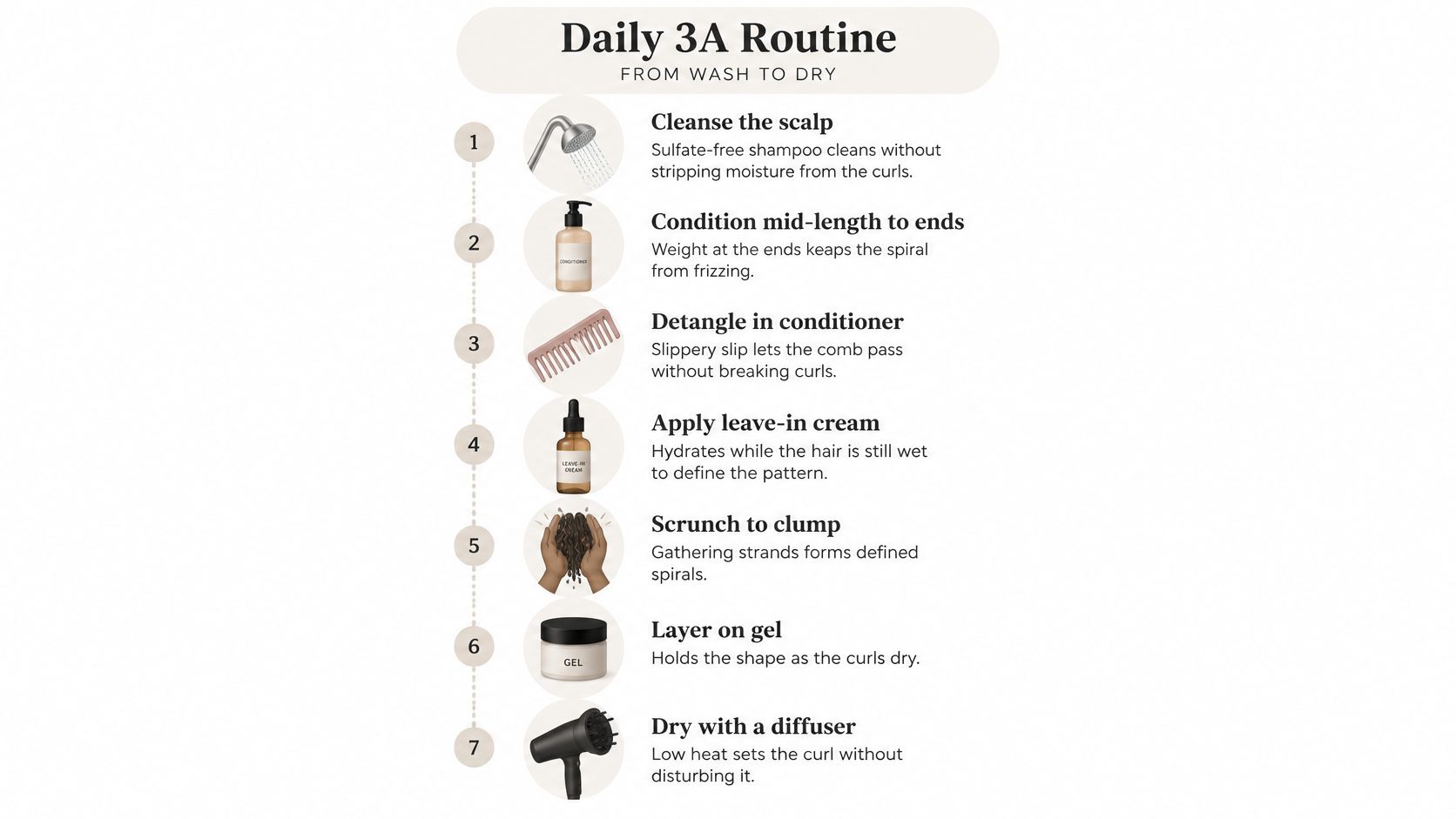
The sequence below shows how to keep cleansing, conditioning, and hold separate.
Build the wash-day sequence
- Cleanse the scalp. A gentle sulfate-free shampoo is a reasonable starting option, but sulfate-free doesn't automatically mean mild or effective enough. Massage with fingertips, not nails, and let the lather travel through the lengths. Cleanse the lengths deliberately if they're coated.
- Apply conditioner from mid-lengths to ends. While it provides slip, separate knots with your fingers or a wide-tooth comb, supporting the section above each tangle. Leave the conditioner on for about three to five minutes unless its directions specify otherwise.
- Rinse thoroughly with comfortable water. Cool water is optional; it isn't a reliable cuticle-sealing treatment. Prioritise removing excess conditioner, especially near fine roots.
- Spread leave-in through thoroughly wet lengths. Use your palms to smooth it over sections, then squeeze gently so neighbouring strands gather together. Fine hair may need very little leave-in.
- Choose hold or extra softness deliberately. Gel helps retain the formed bundles; curl cream mainly adds conditioning and flexibility. Apply in sections and scrunch upward without repeatedly breaking apart the bundles.
- Air-dry or diffuse on low heat and gentle airflow. Keep hands out until dry, then soften any gel cast with light scrunching. Don't rub with a terry towel; blot drips with a smooth T-shirt.
Match product weight to your hair
Product weight by 3A hair profile
| Hair profile | Conditioner | Leave-in | Styler |
|---|---|---|---|
| Fine, low-density 3A | Light rinse-out conditioner | Light water-based mist, or skip if unnecessary | Light gel or mousse |
| Medium density, normal porosity | Medium-weight cream conditioner | Water-based leave-in cream | Gel or curl cream |
| High-density or coarse 3A | Richer conditioner if lengths feel rough | Leave-in, with a small amount of oil on ends if useful | Cream or gel distributed through sections |
| Highly porous or damaged 3A | Conditioning treatment; protein-containing formula if it improves feel | Leave-in, with light oil on ends if tolerated | Gel for hold |
The Society of Cosmetic Chemists paper on curly hair structure and care supports separating pattern from strand thickness, density, damage, and product tolerance. High density doesn't automatically require heavy formulas, particularly when the individual strands are fine.
Add products in small increments. If your hair becomes flatter or coated, reduce weight; if clean lengths remain rough, increase conditioning there rather than everywhere.
Watch the application movements, especially how wet sections are handled without repeated pulling.
Refreshing 3A Curls Between Washes
- Mist only the sections that need help. Use plain water until the lengths are evenly damp, not dripping. Rub a little leave-in between wet palms if the ends also feel rough.
- Gather each section and scrunch upward. Gentle compression encourages neighbouring strands to regroup without brushing out the whole hairstyle.
- Keep additional cream at the ends. Smooth on a small amount only where the hair feels dry. Reapplying product throughout the lengths can leave yesterday's styler buried under a fresh coating.
- Let the sections air-dry or use a diffuser on low heat and airflow. Avoid touching them while they set.
- Check the crown when dry. For loose, fuzzy crown curls, use damp fingertips and a trace of lightweight styler. For limp roots, skip extra product and lift gently with clean fingers instead.
A refresh works best when you're restoring previously formed curls, not trying to remove residue without washing. You don't need to wet the whole head if only a flattened side needs attention.
Refresh shape, not buildup. More water and cream won't remove a coating.
If curls feel flat and coated, cleanse instead of layering again. If they feel comfortable indoors but expand rapidly outdoors, adjust weather protection rather than repeating the refresh throughout the day.
Adjusting for Humidity, Pollution and Sun
Say your curls look defined at breakfast in a humid coastal city, then expand during your afternoon commute. You didn't necessarily under-condition them. Neighbouring strands can absorb atmospheric water unevenly and separate from their shared curl bundle.
The Society of Cosmetic Chemists document on humidity resistance and hair elasticity reports that water regain rises approximately linearly as relative humidity increases from 40% to 85%. That describes fibre behaviour, not a humidity threshold at which everyone's hairstyle fails.
Choose the adjustment for the exposure
- Humid coastal weather: Distribute water and conditioner evenly during styling, dry completely before heading out when practical, and finish with a film-forming gel marketed for humidity resistance. Choose hold before automatically adding richer cream.
- Dry winter weather: If lengths feel brittle rather than coated, try a conditioning leave-in containing humectants, then a light cream or oil if needed to reduce roughness. The whole formula matters more than a single ingredient; this guide to humectants for curly hair explains the trade-off.
- Polluted, high-sun conditions: Cover exposed hair with a comfortable hat or scarf. After dusty exposure, rinse or cleanse according to how the scalp and lengths feel, rather than scrubbing aggressively.
Track exposure alongside drying method and product amount. Record definition, frizz, and perceived moisture separately: soft hair with surface frizz isn't the same problem as brittle, tangled hair.
Weather changes don't demand a completely new routine. Test the smallest relevant adjustment and compare results under similar conditions.
Track One Routine for Two Weeks Before Switching
Choose a starting routine from your hair profile, then use the symptom table to identify the most useful first adjustment. Keep the other products and techniques steady long enough to see whether that change helps.
Make your observations comparable
- Photograph consistently. Use the same lighting, angle, and stage of drying. Include the crown and ends, not just the best ringlet.
- Separate the outcomes. Note definition, visible frizz, softness, tangling, and scalp comfort rather than giving the entire wash day a single verdict.
- Record what you really did. Include product amounts, rinsing, drying, outdoor exposure, and any departures from the routine.
A photo timeline is more useful when you attach those details. If scattered notes are hard to maintain, compare hair-journaling apps for tracking curl growth, definition, and hair health and choose a format you'll use consistently.
Don't treat a photograph as a direct measurement of fibre moisture or damage. Pair visible changes with how your hair and scalp feel, and prioritise comfort over a tidier-looking curl.
Keep the routine when results improve, change a single variable when they stall, and repeat the assessment when the seasons change.
Coil offers personalised curly-hair routines, ingredient analysis, and photo tracking to help you connect your habits with your results. Visit Coil to build a starting routine around your porosity, density, scalp needs, and styling habits, not just your 3A label.