Best Apps to Build a Curly Hair Routine and Reduce Frizz in 2026
Best Apps to Build a Curly Hair Routine and Reduce Frizz in 2026—see what a quiz asks, how results personalize care, and how to compare apps.
You've finished styling, but your hair still won't cooperate. The cream made your ends feel softer, the gel helped your curls hold together, and the extra oil left your roots flatter than you wanted. Yesterday's routine looked better, and you're not sure what changed.
The best apps to build a curly hair routine and reduce frizz in 2026 should help you answer that question, without recommending another product. A useful app connects your quiz answers to care decisions, then helps you check whether those decisions work. Choose by the quality of that process, not by how polished the results screen looks.
Why a Personalized Routine Beats Generic Curl Advice
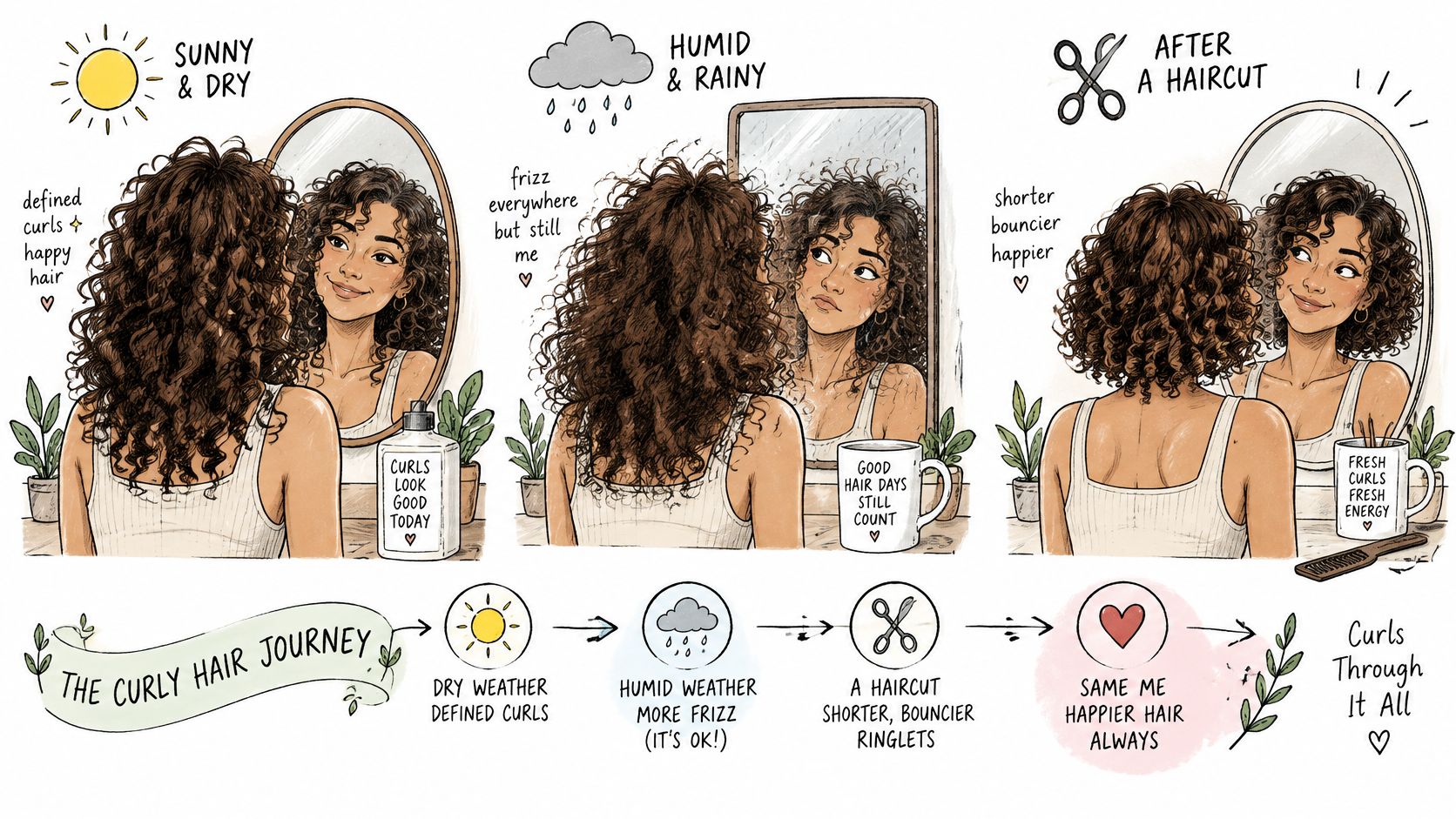
On a dry morning, your usual routine might give you the softness and definition you like. Then humid weather arrives, your curls behave differently, and you add more conditioner because someone suggested that frizz always means dryness. After a haircut or product switch, you're adjusting everything again.
That cycle doesn't necessarily mean you've chosen bad products. It may mean you're using a fixed routine for changing circumstances.
Hair responds physically to moisture in the air. Smithsonian's explanation of humidity and hair connects changes in strand shape to water molecules and hydrogen bonding within keratin. That's a reason to record weather alongside results rather than interpret every frizzy day as a conditioning failure.
Start with the whole profile
Curl pattern is useful, but it isn't a complete care plan. A scientific review of curly-hair characteristics describes structural differences associated with curlier fibers and increased fragility. Those differences support paying attention to handling and condition, not just matching a curl photograph.
Consider a hypothetical reader with loose waves, fine strands, and ends that feel rough. A richer product might improve the ends while leaving the overall style too flat. Another reader might welcome that same conditioning level.
A useful app should investigate the difference:
- Hair characteristics: Pattern, strand thickness, density, and signs of damage.
- Daily behavior: Cleansing, detangling, drying, and styling habits.
- Context: Weather, recent cuts, product changes, and available time.
- Desired result: Softness, volume, definition, comfort, or easier maintenance.
Practical rule: A personalized routine should explain what to change, why you're changing it, and what result would justify keeping that change.
The best starting recommendation is therefore a working hypothesis, not a permanent prescription.
Quick Comparison of Curly Hair Routine Apps
Don't choose an app because it asks the most questions. Choose one whose answers lead to meaningfully different recommendations.
A quiz that asks about scalp oiliness but gives everyone the same wash schedule isn't doing much personalization. Likewise, an attractive photo diary may help you remember styles without explaining why a routine succeeded or failed.
How to Compare Curly Hair Routine Apps
| Evaluation criterion | Strong-app signal | Red flag | Coil evidence |
|---|---|---|---|
| Hair-profile depth | Captures scalp needs, habits, and goals alongside texture | Assigns care from curl pattern alone | Profile-based routine building |
| Routine adjustment | Responds to completed actions and reported outcomes | Repeats the original plan indefinitely | Adaptive planning |
| Product guidance | Explains compatibility and trade-offs | Labels ingredients universally good or bad | Ingredient-label analysis |
| Daily feedback | Records actions and how hair feels | Requires photos without context | Brief check-ins |
| Photo-based analysis | Lets users correct interpretations | Treats an image as an unquestionable assessment | Selfie analysis with user feedback |
| Progress measurement | Separates outcomes and shows trends | Relies on a single overall impression | Timeline and trend tools |
These capabilities describe a useful evaluation framework, not proof that any app will reduce your frizz. A feature only matters if it changes a decision you need help making.
Match the tool to the uncertainty
If you're unsure why products leave your hair flat, prioritize product-weight guidance and clear explanations. If your routine changes constantly, prioritize an action log and trend review. If you're new to curl care, look for recommendations you can understand without learning a new vocabulary first.
You can also compare an app against a basic notes-and-photos approach. A simple journal lets you record observations on your own terms; a routine-building app should add interpretation, useful prompts, or easier review.
Before subscribing, inspect a sample result if one is available. Look for a visible connection between the profile and the recommendation. A polished list of products isn't enough if you can't tell which answer influenced the list.
What an Effective Curly Hair Routine Quiz Should Ask
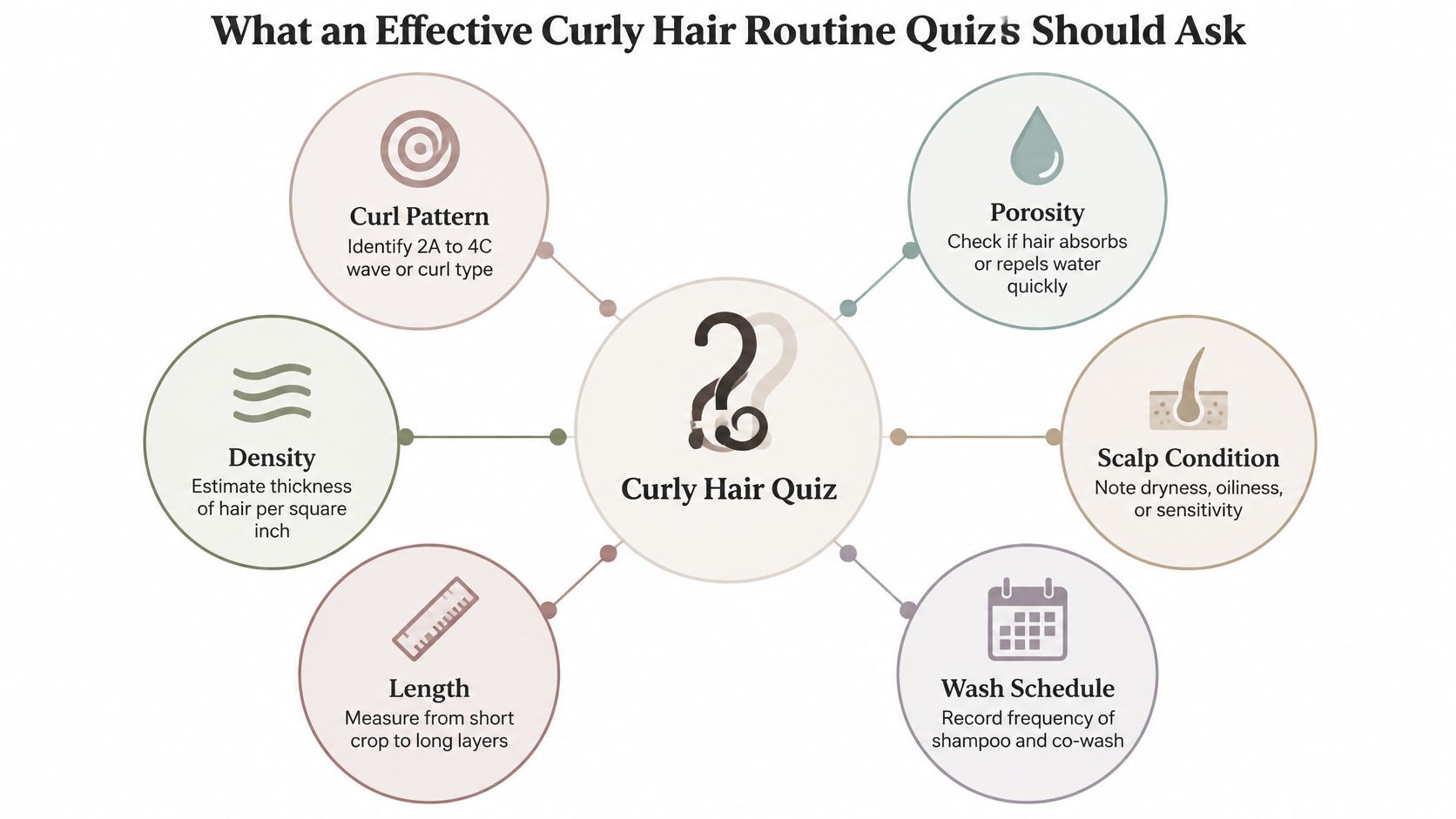
Treat every quiz question as a request for information needed to make a decision. If a field doesn't affect cleansing, conditioning, styling, handling, or follow-up, ask what purpose it serves.
The key categories are easier to assess together:
Ask about observable behavior
You don't need perfect technical labels to provide useful answers. A well-designed quiz should let you describe what happens rather than force you to guess.
- Pattern: Ask whether hair forms waves, ringlets, coils, or a mixture. The answer should influence technique suggestions without determining the entire routine.
- Porosity indicators: Ask how hair responds to wetting, conditioning, and drying, alongside chemical-processing history. Uncertain answers should remain uncertain.
- Density and strand thickness: Ask these separately. How much hair you have and how thick individual strands feel are not interchangeable.
- Scalp condition: Ask about oiliness, dryness, sensitivity, and discomfort. These answers should affect scalp-related steps independently of the ends.
- Length and cut: Ask about current length, layers, short sides, or a grow-out. Instructions should suit the hair the user has.
A prompt such as How does your hair feel after washing? can reveal more than a request to choose a beauty label. Roughness, softness, tangling, and a coated feeling suggest different questions to investigate.
Connect schedule and goals to the plan
The quiz also needs to ask what you can realistically do. Do you air-dry because you prefer it, or because your schedule leaves no alternative? Are you skipping refresh steps because they're unnecessary, uncomfortable, or too time-consuming?
Those answers should change the plan's practicality, not merely its wording. Someone who wants a concise morning routine shouldn't receive a complicated sequence without alternatives.
Scalp and strand needs may also differ. If you're unsure how cleansing fits with oily roots and drier lengths, an oily-hair care routine guide can help you frame better observations before completing a quiz.
A useful question earns its place by changing a recommendation or identifying something the app still needs to learn.
Finally, the quiz should ask which outcome matters most right now. A reader seeking comfortable, manageable hair shouldn't automatically receive a routine designed for maximum visual definition.
How Quiz Results Become a Personalized Routine
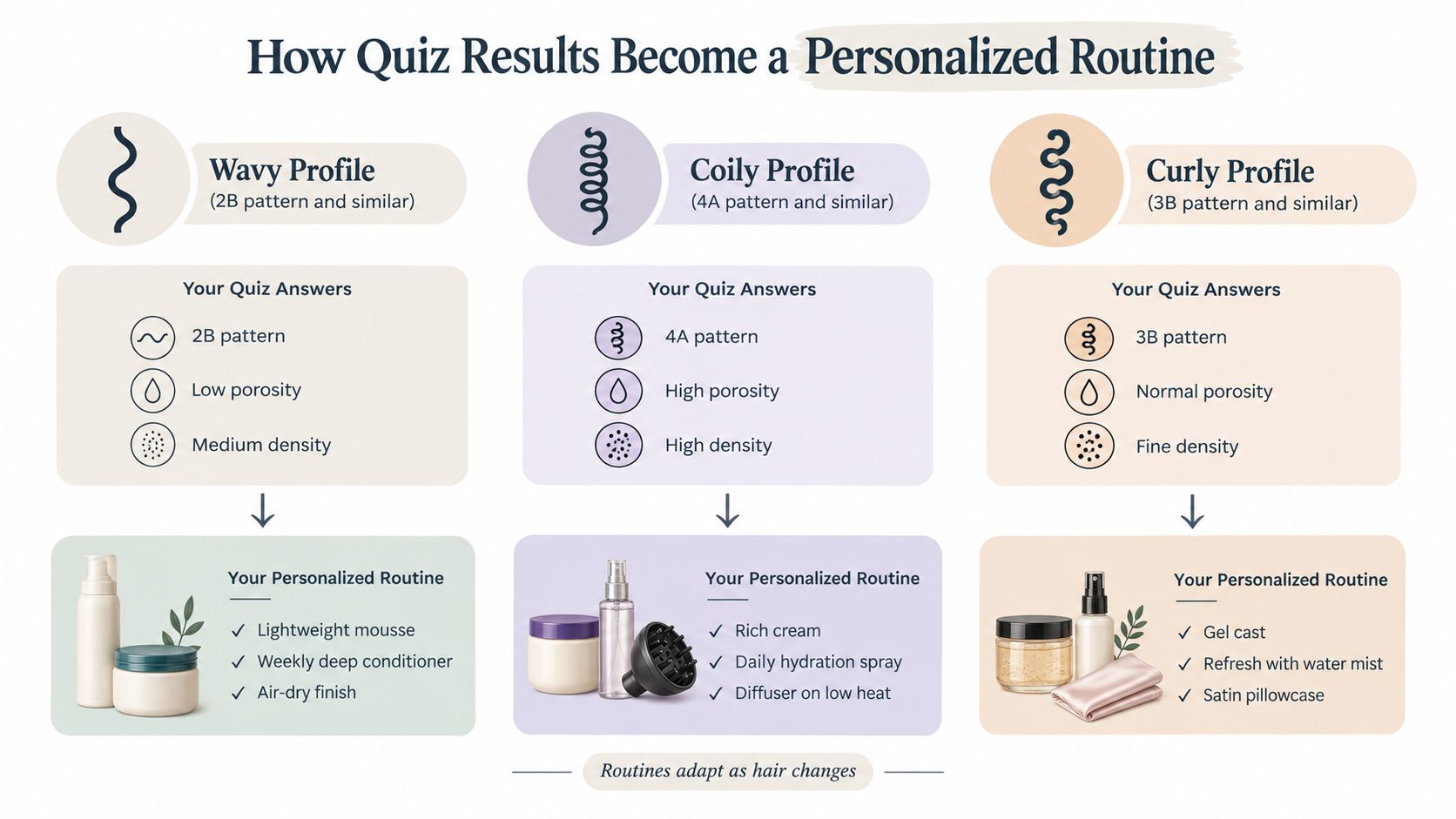
Good results should show a chain of reasoning: your answer, the proposed adjustment, the outcome to watch, and the reason to revise it. They shouldn't turn a texture label into an inflexible shopping list.
The following visual illustrates possible starting points, but its routine cards should be treated as examples, not schedules that everyone with those labels should follow.
A wavy profile focused on flyaways
Suppose your waves feel soft, but styling creams leave them flatter than you prefer. A sensible starting test might be a lighter styling approach while keeping cleansing and conditioning otherwise familiar.
The result should explain the trade-off: you're testing flyaway control without sacrificing your preferred movement. It shouldn't automatically add a rich mask just because you selected frizz as a concern.
If you've identified your hair as low porosity, use a low-porosity hair routine guide to refine your observations. The label should support practical testing, not prohibit whole product categories.
A curly profile balancing softness and hold
Consider curls that feel comfortable after washing but lose the shape you want as the day continues. The app should ask whether the change follows drying, touching, weather exposure, or a product switch before recommending more conditioning.
A reasonable experiment might hold the conditioning steps steady while changing the styling approach. If the curls retain shape but feel unpleasant, the next adjustment should address that trade-off rather than declare the experiment a complete success.
For an additional styling demonstration, watch with your own profile and priorities in mind:
A coily profile prioritizing manageable handling
For someone reporting roughness, difficult detangling, and concern about breakage, I'd prioritize a manageable conditioning and handling experiment over a narrow anti-frizz target. Hair-fiber and conditioning research supports attention to moisture-related behavior and friction associated with damaged cuticles.
That doesn't mean every coily profile needs the richest available cream. Density, strand thickness, scalp comfort, and the user's experience with product weight should still influence the starting point.
A dry-scalp oil step also needs a reason. It shouldn't appear because the hair is coily, and reported itching or irritation shouldn't be treated as proof that more oil is appropriate.
When answers conflict, the app should ask a follow-up question or suggest a smaller test. Confidence isn't a substitute for missing information.
How Adaptive Apps Improve Results Over Time
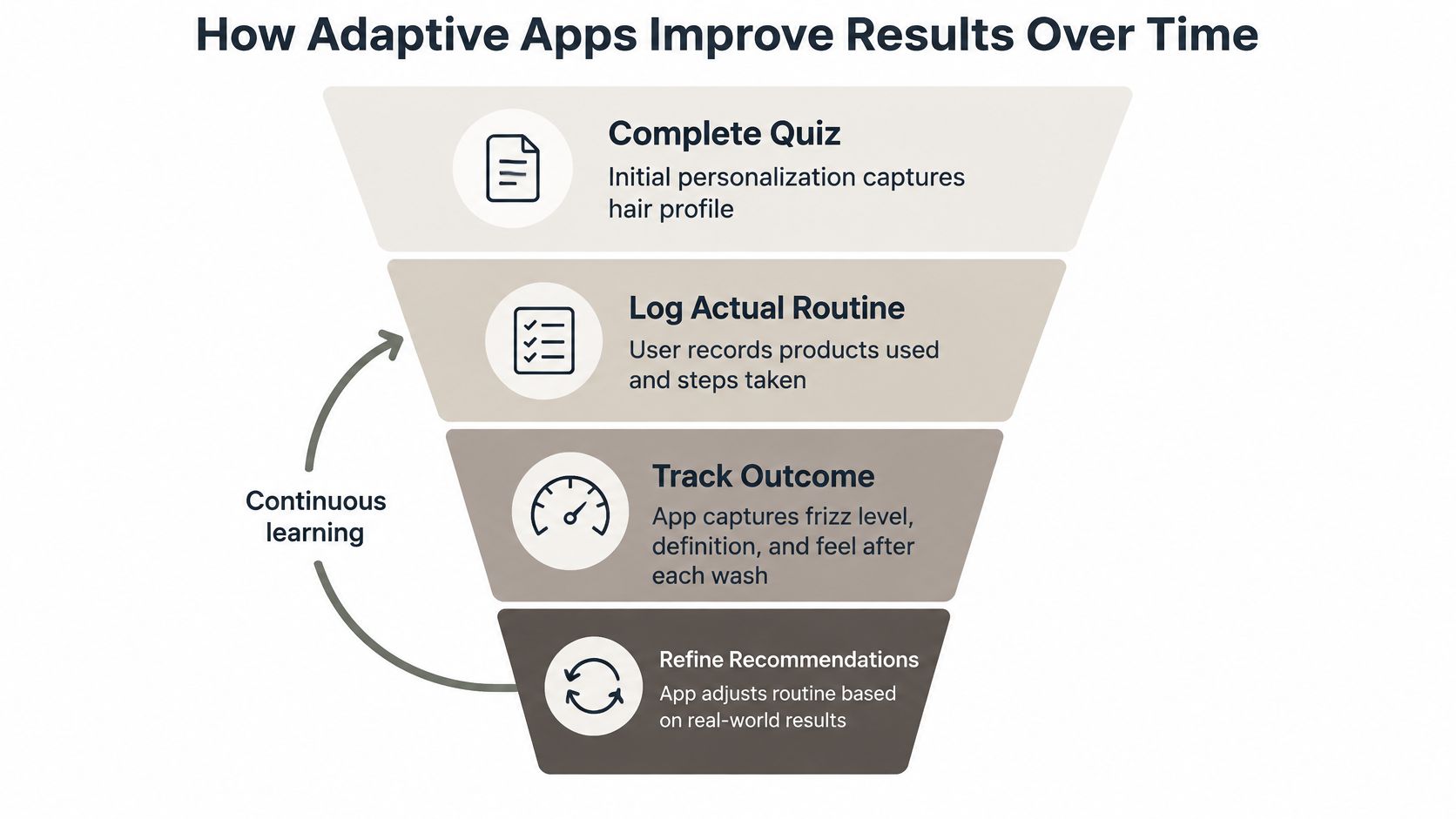
Completing a quiz gives an app your best description of your hair. Logging a routine tells it what happened.
Those are different inputs. You might intend to diffuse, then air-dry because you're rushed. You might skip a suggested product, use something already in your cupboard, or apply a different amount than usual. An app shouldn't evaluate the planned routine as though you followed it exactly.
The useful feedback process looks like this:
Separate suitability from practicality
Suppose a recommendation requires a drying technique you repeatedly skip. The immediate problem may be that the plan doesn't fit your day, not that the technique is unsuitable for your hair.
Compare that with a step you consistently complete but dislike. If your hair repeatedly feels coated after following the recommendation, the app should help you reconsider that step rather than keep reminding you to perform it.
| Logged observation | Useful response |
|---|---|
| Suggested step wasn't completed | Ask why and offer a practical alternative |
| Step was completed but felt unpleasant | Review the recommendation and its trade-offs |
| Outcome changed alongside weather | Preserve that context before drawing conclusions |
| Several products changed together | Avoid assigning the result confidently to a single product |
Keep the user in control
Photo analysis can provide another observation, but it shouldn't override how your hair feels. A photograph doesn't let you touch the strands or describe scalp comfort.
Look for tools that let you correct automated interpretations. If you think a result misrepresents your hair, you should be able to record that disagreement rather than distort your own assessment to match the app.
Keep the distinction clear: A recorded association can suggest what to test next. It doesn't establish that a product or technique caused the result.
My recommendation is to log enough context to make comparisons useful without creating a second job. Completed actions, a short description of feel, and an optional photograph can be more sustainable than an exhaustive diary you abandon.
Adaptation should make the routine easier to understand and maintain, not generate constant changes for their own sake.
Comparing Anti-Frizz Routines for Different Hair Goals
Less frizz isn't a complete definition of success. You might like your volume but dislike tangles, or prefer soft movement over tightly grouped curls.
Consumer priorities also differ across textures. Consumer data summarized in this curly-hair market report identifies fighting frizz as the leading concern for 48% of wavy consumers, compared with 9% of coily consumers, while moisture leads among coily consumers. That's a reason to let readers choose their goals rather than assume everyone wants the same finish.
Compare the trade-off, not just the finish
| Routine direction | Starting priority | What to monitor |
|---|---|---|
| Lightweight styling | Flyaway control with movement | Whether smoothness comes at the cost of volume |
| Moisture-focused care | Comfortable-feeling lengths | Whether added conditioning leaves hair coated or less defined |
| Reduced-manipulation care | Easier handling and fewer repeated styling actions | Whether the routine remains comfortable and manageable between washes |
| Scalp-sensitive care | A cleansing approach that suits scalp needs | Whether changes help comfort without creating unwanted effects on the lengths |
These aren't competing systems with a universal winner. They're possible directions for experiments, and a person may need elements from more than one.
For example, someone could prefer lightweight styling while needing more attention to rough ends. Another person might be satisfied with visible frizz if the routine makes detangling less frustrating.
Judge ingredients in context
An ingredient warning should lead to a question, not an automatic rejection. Ask what the product is intended to do, how you use it, and what you've observed when using it.
If you're considering changes involving moisture-attracting ingredients, a guide to humectants for curly hair provides a focused starting point for thinking about that choice.
For app selection, look for explanations that separate appearance, feel, scalp comfort, and effort. An app that treats a smoother photo as the only desirable result may encourage changes that don't match your priorities.
A successful routine should produce an outcome you want, at a level of effort you're willing to sustain.
What Coil Offers in 2026
For an iPhone routine app, the important question is whether the features support connected decisions. Quiz results, ingredient analysis, check-ins, and progress displays are more useful together than as isolated screens.
Start by examining the path from your profile to your plan. You should be able to identify why a wash step, product category, or technique appears, and what would make the recommendation change.
Evaluate the guidance behind the features
A profile-based routine builder can organize the information you provide about texture, porosity, density, scalp condition, and habits. Its practical value depends on whether you recognize your needs in the resulting instructions.
Use these checks when evaluating the experience:
- Recommendation clarity: Can you explain why a suggested step belongs in your routine?
- Product compatibility: Does ingredient guidance describe possible buildup, protein-load, or weight concerns without presenting every flag as a universal ban?
- Correction options: Can you update an inaccurate profile answer or disagree with an automated assessment?
- Actionable feedback: Does a disappointing result lead to a clear next test rather than a completely unexplained replacement routine?
An ingredient scanner is best treated as decision support. A compatibility assessment can help you investigate a mismatch, but it shouldn't replace your observations or require you to discard products that suit your needs.
Interpret summaries carefully
A unified curl score can make progress easier to review, but a weighted summary reflects the priorities built into its calculation. Your personal priority may differ.
If you care most about comfortable-feeling hair, don't judge the routine solely by an overall score. Inspect the underlying outcomes and consider whether a change improved something you value while worsening something else.
The same caution applies to selfie-based feedback. Use it alongside your own description rather than as a verdict on whether your natural texture looks acceptable.
The right app should help you understand your hair, not persuade you that every visible irregularity needs correcting.
Before paying, inspect the current subscription terms and trial conditions in the App Store. Confirm the billing interval, local price, renewal arrangements, and how to manage the subscription.
A trial can reveal whether the instructions make sense and whether the workflow suits you. It may not settle every question about long-term hair outcomes, so distinguish a usable tool from a proven personal routine.
How to Verify Progress and Choose the Right App
Begin with a baseline you can describe clearly. Record your current routine, what you like about the result, and the issue you most want to change.
For useful comparisons, keep photographs and notes reasonably consistent. Include relevant product changes, whether you followed the proposed steps, and conditions that might explain an unusual result. Don't compare a carefully styled photograph with a rushed morning and assume the routine alone explains the difference.
Make the subscription earn its place
Use this final checklist:
- Quiz depth: Did the app capture information that affected your recommendations?
- Meaningful adaptation: Could you revise the plan when your needs or behavior changed?
- Product transparency: Could you understand the reasons behind compatibility guidance?
- Feedback burden: Was logging manageable enough to continue?
- Readable progress: Could you distinguish improved definition from better feel, scalp comfort, or easier maintenance?
A photo timeline can help you revisit earlier results, while trend charts can make repeated observations easier to review. Trim reminders may also help you keep relevant maintenance changes in your record.
Keep the app if it helps you make clearer decisions and maintain a more workable routine. Reconsider it if you're collecting scores without learning what to do differently.
Choose the decision support you need, then test whether you use it. The best routine app isn't the one with the most confident recommendations. It's the one that helps you judge those recommendations for yourself.
Coil offers personalized routine building, ingredient analysis, and progress tracking for wavy, curly, and coily hair. Visit Coil to explore its approach, then use your own curl goals and observations to assess whether it makes your routine easier to manage.