Best Curly Hair Apps for Men in 2027: Routines, Product Scanners, and Curl Track
Best Curly Hair Apps for Men in 2027: Routines, Product Scanners, and Curl Track. Discover the best curly hair apps for men in 2027
You leave the bathroom with a clean taper and defined curls. By lunchtime, the top looks fuzzy, your scalp feels coated, and you're wondering whether the problem was the shampoo, the cream, or how you dried it. Buying another product is easy. Figuring out what went wrong takes a better system.
For anyone comparing the best curly hair apps for men in 2027, routines, product scanners, and curl tracking should answer practical questions, not just produce attractive scores. Choose an app that helps you make better decisions, not one that gives your hair another label.
Why Men With Curls Needed an App Before 2027
Say you've got a fade with enough length on top to show your curl pattern. You follow a wash-day tutorial, layer the recommended products, and end up with flat roots and greasy sides. The tutorial might suit its creator perfectly. It still doesn't fit your haircut, schedule, or tolerance for styling.
My advice is to treat short-hair care as its own routine, not a scaled-down version of someone's shoulder-length wash day. You need instructions that distinguish the longer top from closely clipped areas, account for scalp comfort, and tell you what to change when the finish looks wrong.
A useful app replaces guesswork with decisions
The commercial interest is understandable. An industry forecast identifies men as the fastest-growing end-user segment in curly-hair care, with a projected 12.6% compound annual growth rate over 2026–2035, although that remains an estimate rather than an observed outcome (Next Move Strategy Consulting's market forecast).
That doesn't prove any app works. It does explain why dedicated tools for men's curls deserve attention beyond generic grooming checklists.
Look for help with these decisions:
- Porosity testing: Can you record uncertainty, or must you accept a confident label?
- Scanner trust: Does the app explain compatibility, or blacklist ingredients?
- Adherence versus results: Can you separate what you did from how your hair looked?
- Scalp safety: Does it recognize when more styling advice isn't appropriate?
Buying rule: Don't pay for a prettier version of advice you already understand. Pay for clearer decisions and a record you'll actually maintain.
For a short crop, that might mean discovering that your application method needs adjusting, not replacing everything in your shower. For a grow-out, it might mean adapting your technique as your length changes. Neither requires a bathroom shelf full of products.
What the Best Curly Hair Apps for Men Actually Do
My recommendation is a routine builder for beginners, a scanner for label questions, and a tracker for controlled experiments. Choose a hybrid only if you'll use the connected workflow. More features aren't automatically more useful.
A quiz-driven routine builder suits someone who wants to know what to do on wash day. Its weakness is the starting information: if you guess your porosity or scalp condition, the plan can look personalized while resting on shaky assumptions.
An ingredient scanner suits someone comparing products they already own or are considering. It can organize label information, but it can't establish the finished formula's performance from ingredient names alone.
Curly hair app categories at a glance
| App category | Porosity testing | Routine builder | Ingredient scan | Progress score |
|---|---|---|---|---|
| Quiz-driven routine builder | Usually self-reported guidance | Main purpose | Check availability | May use check-ins |
| Ingredient scanner | Usually an input, not a test | Often limited | Main purpose | Usually product-focused |
| Photo-only tracker | Can't establish porosity | Usually limited | Not its core job | Appearance-focused |
| Hybrid app | Should combine observations and corrections | Connected to feedback | Personalized interpretation | Combines logs and photos |
These are selection criteria, not a guarantee that every app in a category includes the same tools. Check the current listing and trial experience before subscribing.
A photo-only tracker is useful when your main problem is memory. Comparing consistent photographs beats trying to remember whether your curls looked better before a haircut. Its limitation is explanation: an improved photograph doesn't identify which habit caused the change.
A hybrid is my preferred category when product confusion and inconsistent execution happen together. Still, a simple photo timeline plus Apple Notes can be the better choice if you dislike daily prompts.
A scanner without routine context gives you labels. A tracker without an action log gives you pictures. Neither, by itself, explains your hair.
Before paying, check whether you can correct an assessment, inspect individual outcomes, and retain useful notes. An opaque score that you can't question isn't meaningful personalization.
Testing Porosity at Home Without Ruining Your Hair
Treat home porosity checks as observations, not a diagnosis. Don't pull out hair, scrape strands, or use harsh cleansing just to get a quiz answer. An app should let you record an uncertain result rather than force you into a permanent category.
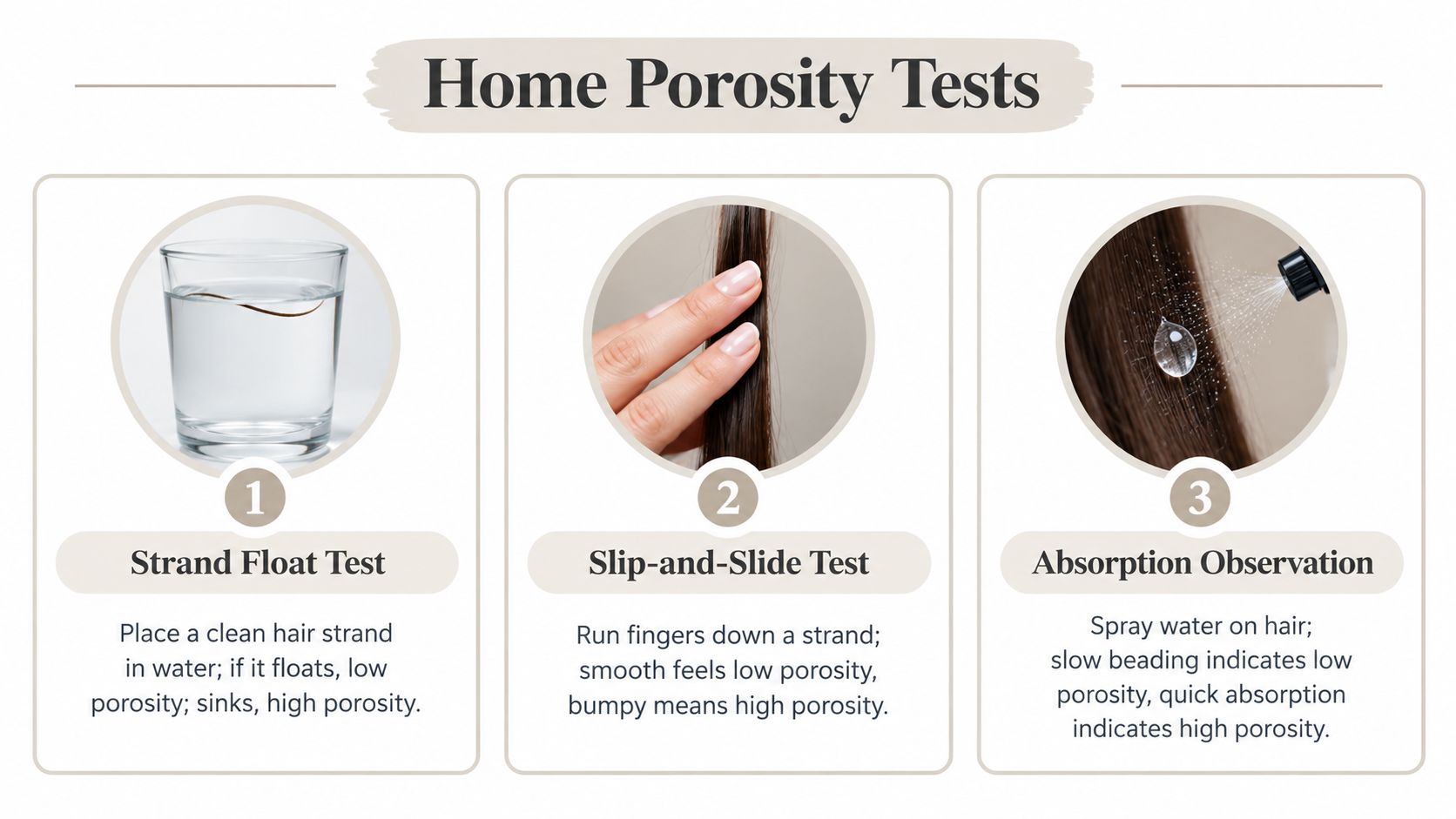
The familiar tests below can organize your observations, but their simple low-versus-high labels shouldn't be treated as conclusive measurements.
Use the tests without forcing an answer
The strand float test involves placing a naturally shed, clean strand in plain water. Don't push it underwater or count a product-coated strand as a clean sample. Record what happens, but don't interpret floating or sinking as proof of porosity.
For a very short crop, skip it if you can't collect a usable strand. There's no benefit in damaging your hair to satisfy an app's onboarding screen.
The slip-and-slide check involves gently feeling a clean, detached strand. Avoid tugging a strand still attached to your scalp or repeatedly rubbing against it. Smoothness and roughness are subjective sensations, so record the feel rather than automatically translating it into a porosity label.
Wash-day absorption observation is the option I'd prioritize for practical routine building. Watch how your freshly cleansed hair wets, how conditioner distributes, and how it feels after drying. Keep the preparation consistent instead of comparing freshly washed hair with yesterday's styled hair.
Record a clean signal
Use this checklist before entering a result:
- Comparable preparation: Note whether you used styling products or changed your cleansing method.
- Relevant sample: Observe the hair you're trying to style, not just a clipped side.
- Gentle handling: Stop if a test requires pulling, scraping, or repeated manipulation.
- Repeatable behavior: Look for a recurring pattern rather than an isolated result.
- Visible uncertainty: Save conflicting observations instead of choosing whichever answer sounds convincing.
Fast wetting and a floating strand don't require you to pick a winner. Repeat your wash-day observations under comparable conditions and leave porosity provisional. An honest “not sure” is more useful than a confident guess that drives every later recommendation.
Turning a Porosity Result Into a Wash Day That Works
A porosity result should suggest a starting experiment, not dictate your entire shelf. Density, length, scalp response, and the finish you want still matter. Don't let an app prescribe a heavy routine because you selected a particular category.
For men with short cuts, I'd start with the smallest workable routine and add complexity only when you can name the problem it's meant to solve. Keep scalp cleansing separate from styling the longer hair on top.
Choose a starting sequence
| Working porosity result | Suggested wash-day experiment | What to watch |
|---|---|---|
| Low | Cleanse, rinse thoroughly, condition, then trial a light styling layer | Coated feel, flatness, uneven distribution |
| Medium | Cleanse, condition, then use your preferred hold product | Whether the simple routine stays comfortable and manageable |
| High | Cleanse gently, condition, then test a leave-in with a separate hold product | Dry feel, tangling, loss of definition |
These are trial sequences, not universal prescriptions. Follow rinse-off and leave-in directions rather than improvising because a porosity quiz told you to retain more conditioner.
If your low-porosity starting routine leaves a film, don't immediately add a richer butter. Test application and product amount first. A focused low-porosity hair routine can help you organize that experiment without turning every wash day into a new shopping list.
Adapt the routine to your cut
On a fade, direct styling product toward the hair you want to define. On a crop or brush-top style, check distribution before deciding you need more. During a grow-out, record when your existing technique stops reaching the longer sections evenly.
Choose air-drying or diffusing according to your schedule and preferred finish, then keep that choice consistent while evaluating the routine. Don't ask an app to compare different drying methods as though everything else stayed equal.
Keep it simple: For a low-porosity working result, investigate coating before adding richness. For a medium result, preserve a routine that already works. For a high result, test conditioning and hold separately instead of assuming more oil is the answer.
There's no responsible universal wash frequency for every reader here. Adjust around your recorded scalp comfort, cleansing needs, and product use, not a streak counter that rewards delaying wash day.
Reading an Ingredient Scanner Without Trusting It Blindly
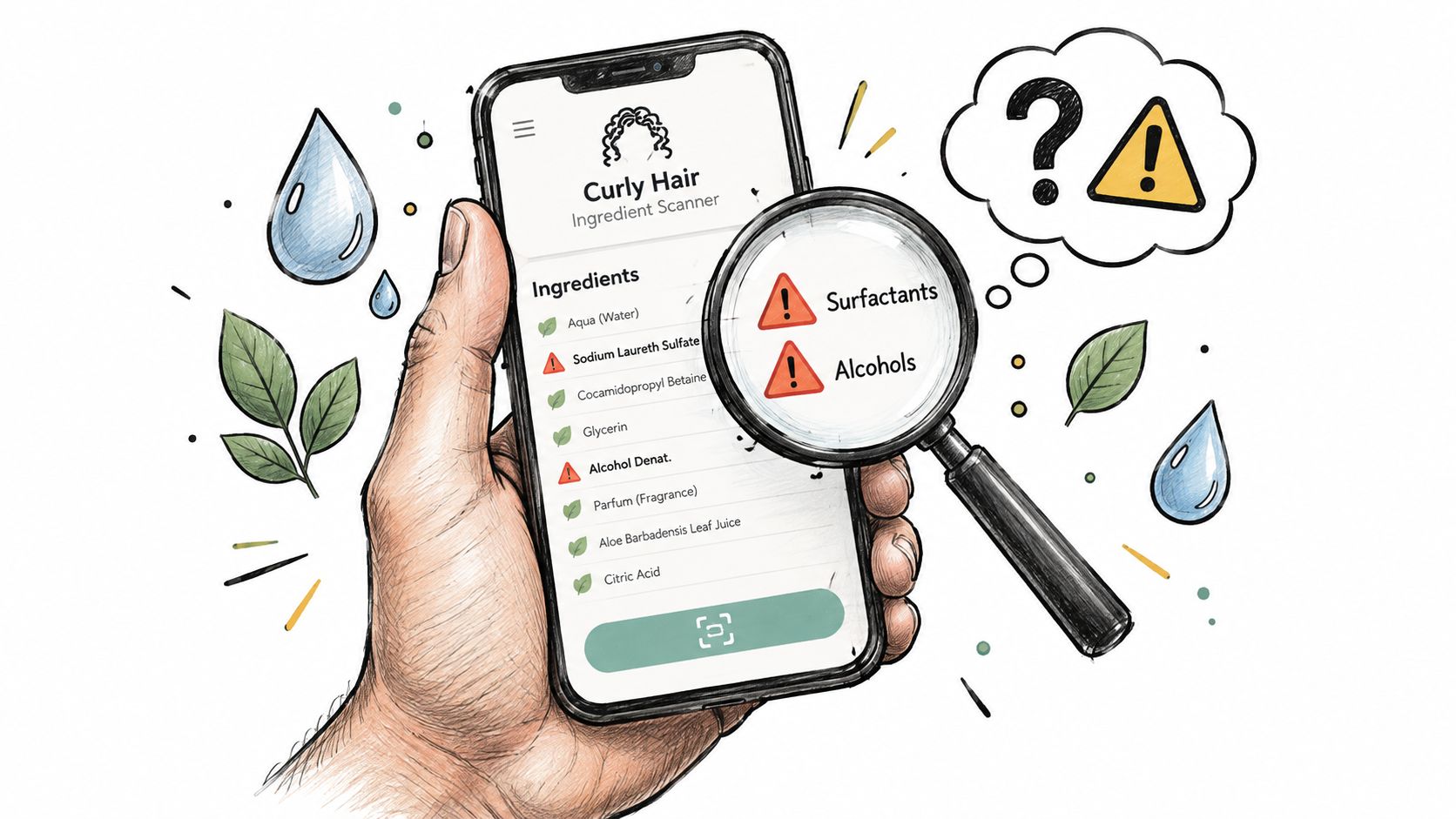
A red flag is a question, not a verdict. Reject any scanner that treats every sulfate, silicone, alcohol, or wax as universally incompatible with curls.
Ingredient interest isn't new. The TextureTrends research summarized by BASF found that only 17% of textured-hair consumers didn't look for specific ingredients, showing why label interpretation deserves a place in curl-care tools (BASF's discussion of curly-hair ingredient preferences).
Ask what the flag actually means
A useful scanner distinguishes ingredient function, exposure, and personal compatibility. A cleanser and a leave-in shouldn't receive identical advice merely because they share a flagged ingredient.
Ask the app to explain its reasoning:
- Surfactants: Is it describing cleansing function or making an unsupported claim about harshness?
- Alcohols: Does it distinguish ingredient types rather than flagging a shared word?
- Silicones and waxes: Does it consider your cleansing routine and desired finish?
- Proteins: Does it explain a possible compatibility issue without declaring “overload” from presence alone?
- Fragrance allergens: Does it distinguish a label flag from evidence that you personally react?
Ingredient names alone don't establish concentration, predict allergy, or guarantee that a formula will weigh down your hair. Treat a compatibility score as a hypothesis you can challenge.
Make the recommendation earn your trust
Start with a product you already own and decide what you're evaluating: residue, definition, comfortable wear, or next-wash manageability. Keep the rest of your routine stable and use the tracking protocol below rather than changing everything the scanner dislikes.
If a flagged product works well, save that correction. If a supposedly curl-friendly product leaves you uncomfortable, record that too. Your experience shouldn't disappear because it contradicts an algorithm.
The same approach applies to ingredient categories people often oversimplify. Use a guide to humectants for curly hair to understand their role, not to build another universal blacklist.
Don't discard an effective product just to improve a scanner score. Equally, don't keep using an irritating product because its label earned a green badge.
Tracking Progress So You Know What Actually Worked
Record completion and results separately. “I followed the routine” and “my curls looked good” are different observations. A useful tracker preserves both instead of compressing everything into a daily success badge.
Mobile-health research offers a reason to take adherence seriously: a systematic review found mean intervention adherence of 56.0%, although that evidence concerns mobile-health interventions, not proof that curl apps improve hair (systematic review of mobile-health adherence).
Follow a controlled tracking protocol
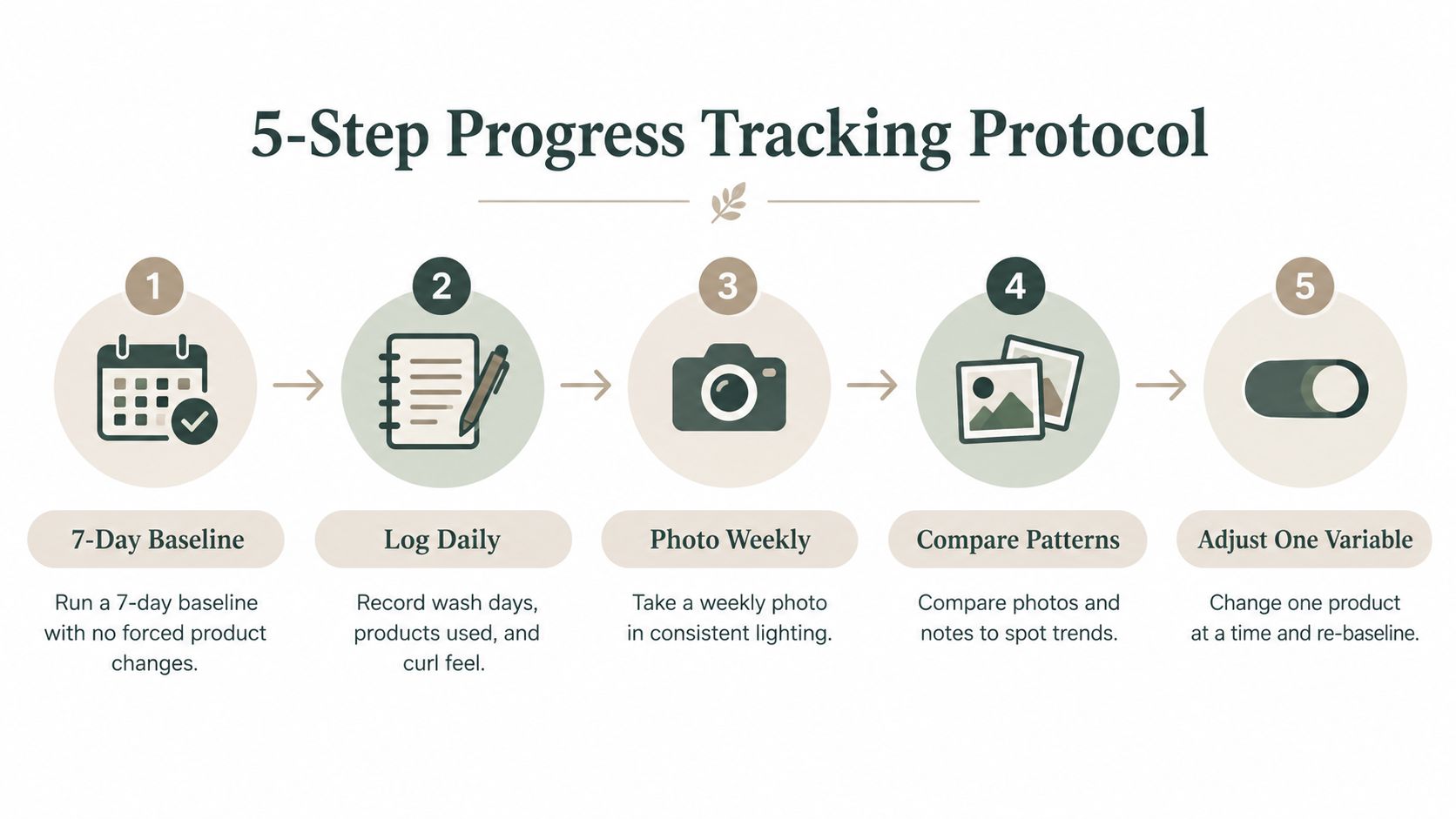
- Establish a baseline. Keep your existing products and habits while documenting your usual results. Don't clean up your routine just to make the starting photographs look better.
- Record the actual wash day. Log cleanser, conditioner, styler, drying method, scalp feel, and front-and-side photographs.
- Change a single variable. Choose an adjustment you can describe clearly, such as introducing a leave-in or changing your wash interval.
- Capture outcomes separately. Rate definition, frizz, moisture feel, and scalp comfort, then mark which planned actions you completed.
- Compare patterns. Review comparable days and photographs before deciding whether to keep the adjustment.
The practical observation window is a 7-day baseline followed by a 2–4-week intervention, using the behavioral protocol described alongside the adherence research linked above.
Read the score without surrendering judgment
Keep lighting, angle, hair dryness, and distance comparable. Wet curls and dry curls aren't a fair before-and-after comparison, and a fresh trim deserves a note rather than automatic credit to your conditioner.
Use weekly patterns rather than treating an isolated frizzy day as failure. If you skipped a planned step, preserve that information instead of blaming the product.
A combined curl score is convenient, but inspect its components. If comfortable, manageable hair matters more to you than sharp definition, judge progress accordingly. A higher appearance score doesn't cancel out an uncomfortable scalp.
Picking the Right App for Your Routine and When to Stop Using One
Choose by the problem you're trying to solve, not by the most impressive demonstration. My shortlist would be a routine builder for uncertainty, a hybrid for connected experiments, and a basic tracker when the routine already works.
For a low taper with loose curls, I'd prioritize concise instructions and product-amount notes over elaborate photo analysis. For a mid-length grow-out, I'd favor a timeline that records technique changes and trims. For a tightly coiled short crop focused on comfort, I'd demand separate scalp logging before paying for appearance scoring.
Check the boundaries before subscribing
- Correction controls: Can you disagree with a photo assessment or product recommendation?
- Useful records: Can you see what you did alongside the outcome?
- Practical fit: Does the workflow suit your haircut, phone, and morning routine?
- Clear limits: Does the app explain what it cannot assess?
An oily-hair care routine may help organize ordinary cleansing questions. It shouldn't become a reason to keep self-treating persistent symptoms.
Know when to put the app down
Record whether flakes appear oily or dry, whether itching continues after cleansing, and whether shedding is sudden or localized. Those observations are useful to share with a professional, but they aren't enough for an app to diagnose the cause.
Seek a dermatologist's assessment for persistent itching, redness, sore or inflamed bumps, sudden or localized hair loss, or concerning changes around areas under tension. Use the American Academy of Dermatology's public guidance resources as a starting point for professional information, not a substitute for an examination.
A barber-stylist can assess your cut and styling technique. Medical symptoms belong with a medical professional, not another round of scanner-approved oils.
Coil brings personalized routines, ingredient analysis, and photo-based curl tracking into an iPhone app, with brief check-ins that help connect your habits to your results. Visit Coil to build a routine around your hair, then use the tracking record to decide what deserves to stay.