Dry Scalp Curly Hair: A Practical Guide to Causes and Care
Struggling with dry scalp curly hair? Learn the real causes, scalp-focused routine steps, and product tips to soothe flakes without losing your curl pattern.
You wash, condition, and style your curls, then notice flakes on your black shirt anyway. Your lengths may still feel rough, your scalp may itch, and the whole routine starts to feel contradictory, like you're somehow both too dry and too oily at once.
That confusion is common with dry scalp curly hair, because the scalp and the strands don't always need the same care. A scalp can be flaky for one reason while the hair fiber is dry for another, and curly texture makes that split more obvious.
When Your Scalp Flakes but Your Curls Still Feel Dry
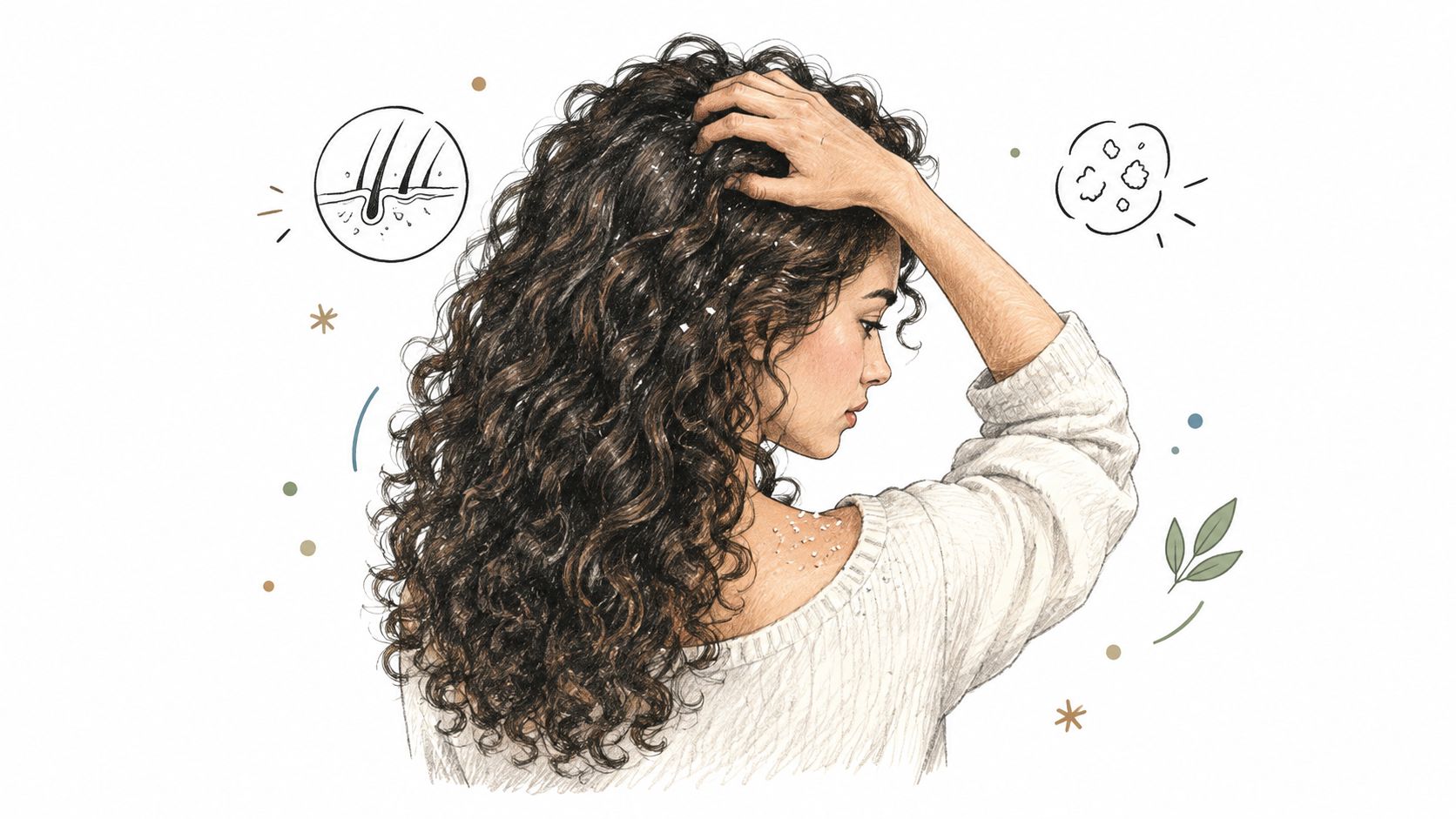
The first mistake people make is treating every flake like it came from the same place. You add more oil to the scalp, or you wash more aggressively, and the result can be the opposite of what you wanted, a scalp that still complains and curls that feel stripped.
A better mental model is simple. Your scalp is one surface. Your strands are another. They touch, but they don't behave the same way.
Two problems can happen at once
A flaky scalp can come from dryness, but it can also come from inflammation, irritation, or dandruff-like conditions. Curly hair can also feel dry because the fiber itself doesn't hold moisture evenly along its length. Those are different problems, even when they show up in the same mirror.
Practical rule: If the scalp is flaky and itchy, think about the scalp first. If the curls feel brittle, tangled, or rough, think about the strands first.
That distinction matters on wash day. A heavy oil rubbed onto the scalp might soften a little surface dryness, but it won't solve an inflamed scalp, and it can leave buildup behind. On the other hand, blasting the whole head with a harsh cleanser to fix flakes often makes the lengths feel worse.
Why the confusion lasts so long
Curly and coily hair often makes root and length symptoms arrive together. The root may feel coated, while the mid-lengths and ends feel parched. That can make it seem like one product failed, when the actual issue is that two different parts of the hair need two different kinds of care.
This is why guides that treat dry scalp curly hair like one single condition usually frustrate people. A routine that comforts the scalp can still leave the strands thirsty. A routine that makes curls soft can still miss what's happening on the scalp.
The useful question is not, “Is my hair dry or my scalp dry?” The useful question is, “What does each area need right now?”
Why Curly Hair Struggles to Move Oil From Root to Tip
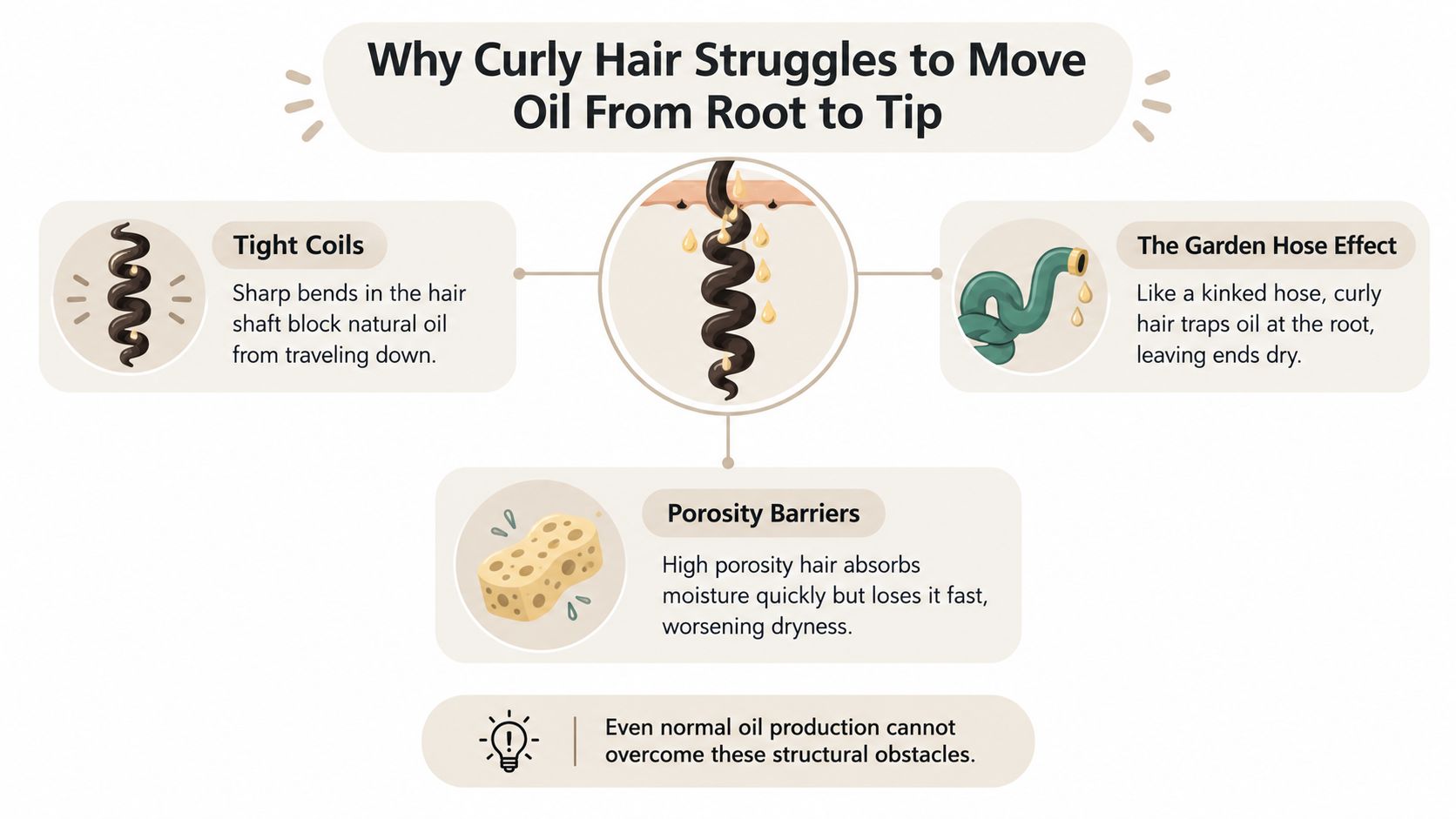
Think of a straight strand as a smooth slide and a curly strand as a twisted garden hose. Sebum, the scalp's natural oil, moves more easily down a straighter path. In high-curl-pattern hair, bends and twists interrupt that movement, so the ends often miss out.
The root can be oily while the ends stay dry
That mismatch is one reason people with curls say, “My scalp gets greasy, but my hair still feels dry.” Both can be true at the same time. The scalp may produce enough natural oil, but the hair fiber's shape makes distribution uneven.
The result is practical, not theoretical. The roots may feel slick or weighed down, while the mid-lengths and ends stay under-lubricated and more prone to knots and breakage. Friction rises because the strands don't glide past one another as easily.
A curl pattern changes how oil moves. It doesn't mean the scalp failed.
Why texture changes the routine
Loose waves and tight coils don't behave the same way. A softer wave can still let some oil travel along the strand, while tighter curls create more interruption. That's why a routine that feels balanced for one person can feel either too heavy or too drying for someone else.
This also explains why product placement matters. A conditioner distributed through the lengths can help the part of the hair that's starved for lubrication. A scalp treatment belongs on the scalp, not smeared everywhere in the hope that it reaches the ends eventually.
A simple analogy helps: if the hose is kinked, pouring more water into the faucet doesn't fix the bend. You need to address the bend itself and then treat the dry section directly. Curly hair works the same way.
Common Causes of Dry Scalp in Curly Hair
The structural problem is only half the story. Everyday habits, weather, styling choices, and scalp conditions layer on top of it. That's why one person's “dry scalp” improves with gentler washing while another person needs medicated treatment.
A 2024 systematic review and meta-analysis combined 121 studies covering 1,260,163 individuals and estimated a pooled worldwide prevalence of seborrheic dermatitis at 4.38%, with reported prevalence of 8.82% in South Africa and 5.86% in the United States. That's a reminder that scalp flaking is common, and it also shows why “dry scalp” isn't one single diagnosis, as the review explains in its pooled analysis of global prevalence and variability (systematic review and meta-analysis).
What tends to sit underneath the flakes
Some flakes come from simple dehydration or irritation. Over-washing can leave the scalp tight and uncomfortable, especially when the cleanser is too harsh for the person's wash frequency. Under-washing can do the opposite, letting product buildup sit on the scalp and irritate it.
Hard water can leave residue that makes the scalp feel coated and the hair feel dull. Tight styles can add friction at the roots. Heavy oils applied too close to the scalp can also trap residue, especially when the scalp already leans oily or sensitive.
What makes the diagnosis trickier
Seborrheic dermatitis often looks like ordinary dryness at first glance, but it behaves differently. It can show up with flaking, itch, and scale, and it's tied to inflammation rather than just a lack of moisture. Other conditions can mimic it too, including contact dermatitis, psoriasis, and fungal issues.
A few patterns are worth watching:
- Persistent redness, which suggests more than simple dehydration.
- Thick or greasy-looking scale, which is less like ordinary dryness and more like a scalp disorder.
- Itch that keeps returning, especially when it doesn't improve with gentler care.
- Soreness or hair loss, which should move the issue out of the “home care only” category.
If the scalp is asking for more than a conditioner can solve, the problem is probably not just dryness. That's the point where symptom tracking becomes more useful than guessing.
A Scalp-Focused Wash Routine That Protects Your Curls
A good wash day for curls doesn't treat the whole head like one surface. It separates cleansing from conditioning, and it keeps the most aggressive steps aimed at the scalp where they belong.
Start with the scalp. Apply cleanser there first, using your fingertips to massage the skin in small circles. Let the lather move through the lengths only as much as needed, because the ends usually need less cleansing than the roots.
A simple sequence that keeps the lengths safer
- Optional pre-wash step: Use a light pre-poo if your hair tangles easily or feels fragile. Keep it modest, because too much product can make cleansing harder.
- Scalp-first cleanse: Focus shampoo on the scalp rather than dragging it through every inch of hair.
- Short contact time: Let the cleanser sit long enough to do its job, then rinse fully.
- Separate conditioning: Put conditioner on the mid-lengths and ends, where friction and dryness usually show up first.
- Final rinse and leave-in: Rinse thoroughly, then apply leave-in only where your hair needs softness and slip.
The reason this works is simple. The scalp needs cleaning. The strands need support. Treating them separately keeps one need from cancelling out the other.
For readers who want another example of how a scalp can run oily while the lengths stay dry, the routine logic lines up well with this curl-care breakdown, especially if your roots flatten fast but your ends still snag.
A real-life version
A person with loose curls and a flaky scalp might cleanse the scalp carefully, rinse thoroughly, then load conditioner mostly onto the ends and detangle in sections. They don't need to rub conditioner into the scalp just because they see flakes there. They also don't need to shampoo the whole length aggressively just because the scalp feels itchy.
Keep the cleanser where the scalp lives, and keep the softness where the curl lives.
That one habit change often makes more difference than switching six products at once.
Ingredients That Help the Scalp Without Weighing Curls Down
Product labels get less confusing when you sort ingredients by job instead of by hype. Some ingredients add water-friendly comfort, some help with slip and softness, and some are meant for true scalp conditions rather than cosmetic dryness.
| Symptom Pattern | Helpful Ingredients | Ingredients to Avoid |
|---|---|---|
| Tight, dry-feeling scalp with little buildup | Humectants such as glycerin or hyaluronic acid, plus gentle conditioners | Harsh cleansers, heavy scalp oils, strong stripping formulas |
| Scalp that feels coated or limp at the roots | Lightweight oils such as jojoba or grapeseed on the lengths, not the scalp | Heavy occlusives at the roots, waxy buildup-prone stylers |
| Flakes with itch or recurring irritation | Targeted actives such as ketoconazole, salicylic acid, zinc pyrithione, or other anti-dandruff actives | Guessing with more oil, or layering more stylers over the problem |
| Curls that feel dry after washing | Leave-in conditioner and lightweight moisturizers on the lengths | Heavy silicones and residue-forming formulas at the scalp |
The category matters. Humectants help pull in water, but they don't seal everything on their own. Lightweight oils can soften the hair fiber without burying the scalp. Targeted actives belong in the “treat the cause” lane when the scalp issue is more than basic dryness.
For low-porosity curls, product buildup is often the bigger complaint than thirst. That's why a label-checking habit helps, especially if a formula sits on the hair instead of soaking in. The same logic pairs well with a low-porosity routine guide if your curls tend to repel heavy products.
What to be cautious with
Not every ingredient is wrong for every head, but some formulas are more likely to cause trouble at the scalp. Heavy silicones can build up. Strong cleansers can leave the scalp feeling stripped. Very rich oils can be too much when the problem is really irritation, not a lack of sealing.
Patch testing helps, especially with new scalp products. Ingredient lists also matter in order, because the earlier ingredients usually make up more of the formula than the later ones.
When At-Home Care Is Enough and When to See a Pro
If your symptoms improve when you clean more gently, condition the lengths separately, and stop overloading the scalp, you're probably dealing with a routine problem. If the flaking keeps coming back with redness, soreness, or scale that looks thick or greasy, the problem may be inflammatory.
The American Academy of Dermatology lists evidence-based anti-dandruff actives such as ketoconazole, ciclopirox, selenium sulfide, zinc pyrithione, coal tar, sulfur, and salicylic acid. It also notes that for tightly coiled or chemically treated hair, ketoconazole may increase dryness and breakage risk, so a once-weekly schedule with a moisturizing conditioner is often recommended instead of frequent full-length shampooing (AAD seborrheic dermatitis treatment).
How to tell whether to keep going at home
- Home care is often enough when the scalp feels a little dry, flakes are light, and the issue improves with gentler cleansing and better conditioning.
- A clinician visit makes more sense when the scalp stays red, sore, or very itchy, or when flakes come with thick scale or hair loss.
- Medical guidance matters sooner if the scalp problem keeps returning after you've already adjusted your routine.
A dermatologist can sort out whether the problem is seborrheic dermatitis, contact dermatitis, psoriasis, or something else. That matters because moisturization alone won't calm every condition, and the wrong routine can keep the cycle going.
If the scalp changes shape, color, or comfort in a lasting way, don't keep guessing.
Medicated shampoos can still be useful for curls, but placement matters. Keep them on the scalp, not the full length unless instructed otherwise, and follow the label or clinician instructions for contact time. That keeps treatment targeted while protecting the fiber.
Your Weekly Scalp and Curl Care Rhythm
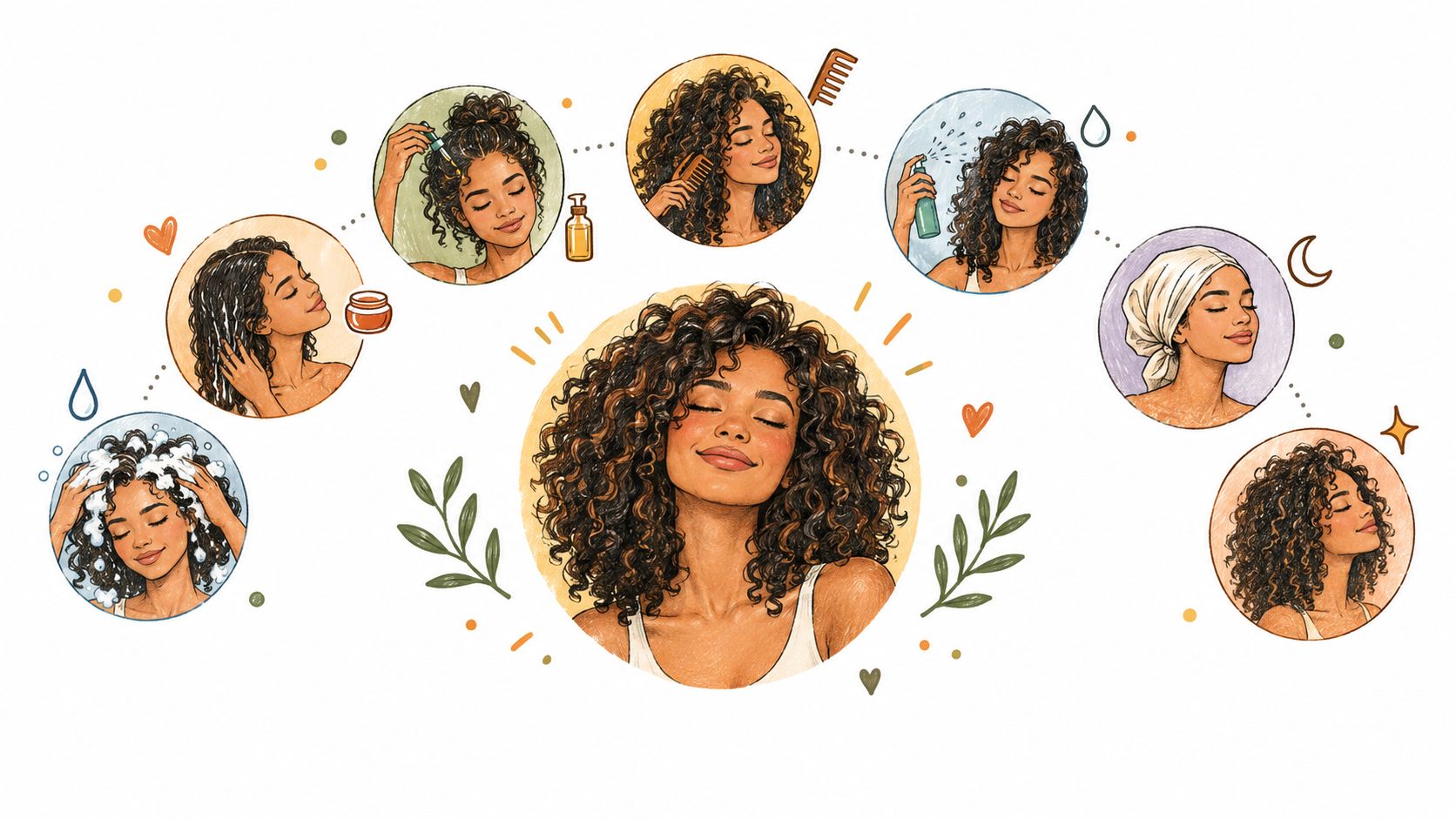
A workable rhythm doesn't need to be complicated. It just needs to separate the signals from the scalp and the signals from the curls, then let each one get the right response.
Start each wash with a quick check. Is the scalp itchy, red, or flaking more than usual? Do the curls feel rough, sticky, or soft? Those are different notes, and they should lead to different choices.
A simple weekly pattern
On wash day, cleanse the scalp with intention and treat the lengths gently. Use conditioner where the hair bends, rubs, and tangles. If the scalp is acting up, add a targeted product rather than reaching for more oil by default.
Midweek, read the cues instead of the calendar. If the scalp feels fine but the lengths are dry, refresh the ends and leave the scalp alone. If the scalp starts flaring before the lengths do, address the scalp first.
A monthly check-in helps too. If flakes are fading, you're probably close to the right balance. If they're returning the same way every time, that's a sign the issue may need a different product category or a clinician's help.
One more useful guide comes from how you react to product buildup. If heavier stylers leave the scalp congested fast, lighten the root area and keep rich products on the lengths. If the curls are still snapping or tangling, they may need more moisture support between washes.
The biggest pitfalls are usually predictable. People oil the scalp out of habit when the scalp is irritated, or they shampoo the whole head too aggressively because the roots feel greasy. Both habits blur the line between scalp care and curl care.
A steady routine should make your scalp calmer and your curls easier to handle, not force you into one rigid wash schedule forever. If you want a more adaptive way to track scalp symptoms, wash patterns, and curl response together, visit Coil and explore how a routine can adjust to the difference between scalp needs and strand needs.
Enhanced by the Outrank app