
Shampoo Oil Control for Curly Hair: What Actually Works
Find the right shampoo oil control routine for curly hair. Learn which ingredients help, which to avoid, and how to protect your curls from dryness.
Your roots look slick again, but your ends still feel rough from the last wash. You reach for a stronger shampoo, scrub everything, and hope this time the clean feeling lasts without turning your curls into frizz.
That's the frustrating part of shampoo oil control for curly hair: your scalp and your lengths may need different things at the same time. A useful routine doesn't force you to choose between greasy roots and stripped ends. It treats cleansing performance, scalp comfort, and curl condition as separate outcomes.
Why Curly Hair Makes Oil Control Harder
Consider a familiar wash-day situation. You shampoo until your roots feel completely degreased, then work the same lather through your ends because leaving anything unwashed feels incomplete. Once your hair dries, the roots look fresh, but the lengths feel less flexible and your curl clumps look fuzzier.
When the roots become shiny again, it's tempting to conclude that the shampoo wasn't strong enough. But that conclusion skips an important question: did the scalp need more cleansing, or did the lengths receive too much?
An oily scalp and dry curls aren't contradictory. They're observations about different places. The skin at your roots can need cleansing while the older lengths need less repeated exposure to shampoo.
Separate the places you're treating
Curl pattern alone can't tell you how oily your scalp is or how much cleansing your ends tolerate. Length, density, porosity, product use, and scalp condition all matter when choosing a routine.
Think of a short curly cut and a long, dense head of coils. Someone with short curls has little distance between scalp and ends, so separating product application takes care. Someone with longer hair can keep most shampoo at the roots, yet may need to part the hair carefully to reach the scalp.
Neither person needs to chase the same squeaky-clean finish.
Practical rule: Judge the scalp by comfort and accumulated oil. Judge the lengths by softness, manageability, and how the curls behave after drying.
Instead of asking whether your entire head feels clean enough, make separate observations:
- At the roots: Does the scalp feel comfortable, or does it still seem coated?
- Through the lengths: Can you detangle without an unusual struggle?
- After drying: Do your curls hold their usual shape, or do they feel rough and scattered?
These observations don't diagnose a scalp condition. They help you avoid treating every disappointing wash as a reason to cleanse more aggressively. Cleaner isn't automatically better for curls, especially when the extra cleansing happens where oil wasn't the problem.
How Shampoo Oil Control Actually Works on the Surface
Shampoo removes oil through its surfactant system, the cleansing ingredients that help oil mix with rinse water. Anionic surfactants such as sodium lauryl sulfate, or SLS, and sodium laureth sulfate, or SLES, can effectively remove surface lipids, but different sebum components don't wash away equally easily. Research on surfactant cleansing and residual sebum also shows why repeated soiling and washing can leave a different result from an isolated wash.
In plain language, some oily material is easier to lift than the material that clings more stubbornly to hair and scalp surfaces. That's why a dramatic clean feeling immediately after rinsing isn't enough to establish lasting performance.
From attached oil to rinse water
The basic process is easier to understand visually.
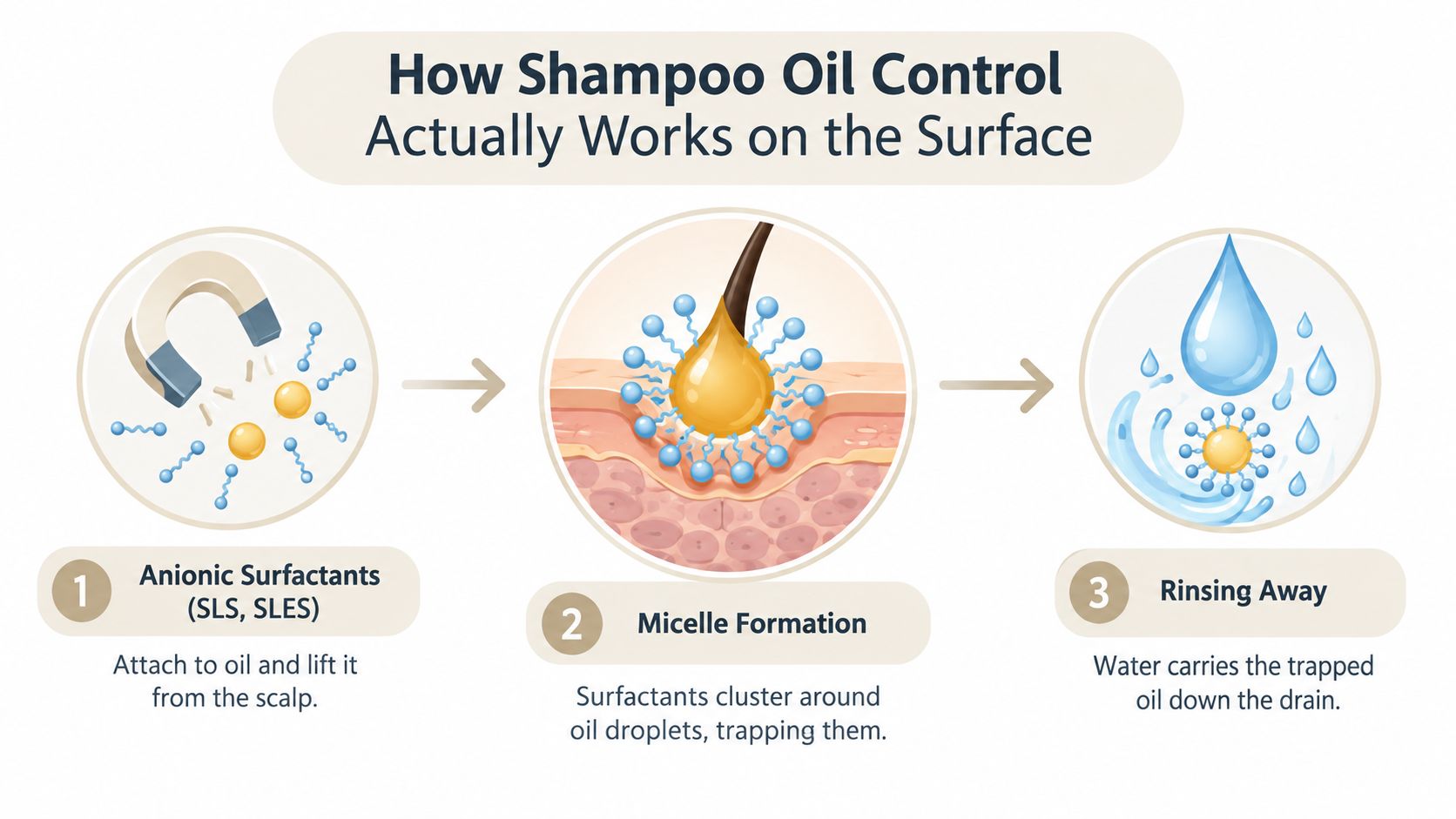
Think of surfactants as helping loosen and surround oily material so it can leave with the rinse. The finished formula matters, not just whether a recognizable cleanser appears on the label. Contact time, dilution, rinsing, and washing conditions can also influence the result.
In an artificial-sebum model, five shampoos removed approximately 40%–80% of deposited “sebollution” from hair swatches; a separate clinical investigation reported reduced surface and pore sebum after a single wash with 0.5% piroctone olamine in an SLS/SLES shampoo, as described in research on shampoo cleansing and scalp sebum.
Those findings need careful interpretation. Hair-swatches aren't living scalps, and results from a particular clinical formula don't prove that every shampoo containing the same active will perform identically. They do show why “clarifying” and “oil-control” aren't complete performance descriptions.
Define what effective means
Evaluate a shampoo using distinct outcomes rather than a single clean-or-dirty judgment:
- Immediate removal: Does washing remove the oily or coated feeling you started with?
- Return of visible oil: How does the scalp look and feel between washes?
- Tolerability: Does the routine leave your scalp comfortable and your curls manageable?
A shampoo might perform well on the first outcome and poorly on another. For example, you might like its initial cleansing but dislike how your lengths feel afterward.
That isn't a reason to ignore cleansing science. It's a reason to assess the whole formula in repeated use, rather than choosing a bottle solely because it promises a deeper clean.
Ingredients to Seek and Ingredients to Avoid
Start with the ingredient list, but don't turn it into a blacklist. An ingredient name can identify a role; it can't fully predict the behavior of the finished shampoo. Concentration, ingredient combinations, and how you use the product remain important.
SLS and SLES are recognizable cleansing ingredients, not automatic evidence that a shampoo is wrong for curls. The practical question is whether that formula removes what your scalp needs removed without leaving your lengths unpleasantly dry.
Read for function rather than fear
Look first for the cleansing system. Other anionic or amphoteric surfactants may appear alongside the main cleanser, but the ingredient family alone doesn't establish how gentle or effective the blend will be. Don't assume that an unfamiliar name means mild cleansing, or that “sulfate-free” guarantees a suitable result.
Next, distinguish cleansers, conditioning ingredients, and scalp actives. Piroctone olamine belongs in a different decision from a claim about softness or easier comb-through. Its relevance depends partly on whether you're addressing a scalp concern, not just looking for a more moisturizing shampoo.
Shampoo Ingredient Families for Oil Control on Curly Hair
| Ingredient Family | Oil-Control Strength | Behavior on Curls | Build-Up Risk |
|---|---|---|---|
| Anionic cleansers such as SLS and SLES | Established surface-oil removal; formula dependent | Assess cleansing against dryness after use | Cannot be ranked from the family alone |
| Other anionic and amphoteric blends | Cannot be reliably ranked from the label alone | Evaluate the finished blend, not a “gentle” promise | Depends on the complete formula and routine |
| Conditioning ingredients | Not a substitute for scalp cleansing | Assess softness, detangling, and definition | Monitor whether hair feels coated |
| Scalp actives such as piroctone olamine | Specific-formula evidence, not a universal oil-control rating | Scalp benefit and curl feel need separate assessment | Not established by the active name alone |
| Alcohols, silicones, and waxes | Not a standalone cleansing strategy | Flag for review rather than automatic rejection | Ingredient identity and formulation matter |
Use caution flags as questions
A label scanner may flag drying alcohols, silicones, or waxes. Treat those flags as prompts to investigate your experience, not proof that every product in those categories causes dryness or buildup.
- If hair feels rough: Review the whole wash routine before blaming a single listed ingredient.
- If curls feel coated or flat: Compare product placement and layering as well as shampoo choice.
- If roots feel clean but ends don't: Consider whether the lengths need a different cleansing approach from the scalp.
If porosity is part of your product-selection process, a low-porosity hair routine can provide a useful framework for organizing those observations. Avoid treating a porosity label as a reason to exclude entire ingredient families without checking how the finished product behaves.
Does Washing More Actually Cause More Oil
You don't have to leave an uncomfortable scalp unwashed to prove you can “train” it. Removing accumulated oil and changing how much oil your glands produce are different processes.
Sebum production is under hormonal and biological regulation. The dermatology commentary on washing frequency and scalp oil supports a more cautious conclusion than the familiar rebound-oil rule: changing wash frequency doesn't necessarily reset the gland's production rate, even though washing removes accumulated sebum.
That distinction matters because a genuine concern about dry lengths often gets turned into a much broader claim about scalp biology.
Separate a real drawback from an unsupported rule
Repeated cleansing can leave your curls feeling too dry. That experience doesn't, by itself, demonstrate that your scalp has responded by manufacturing extra oil.
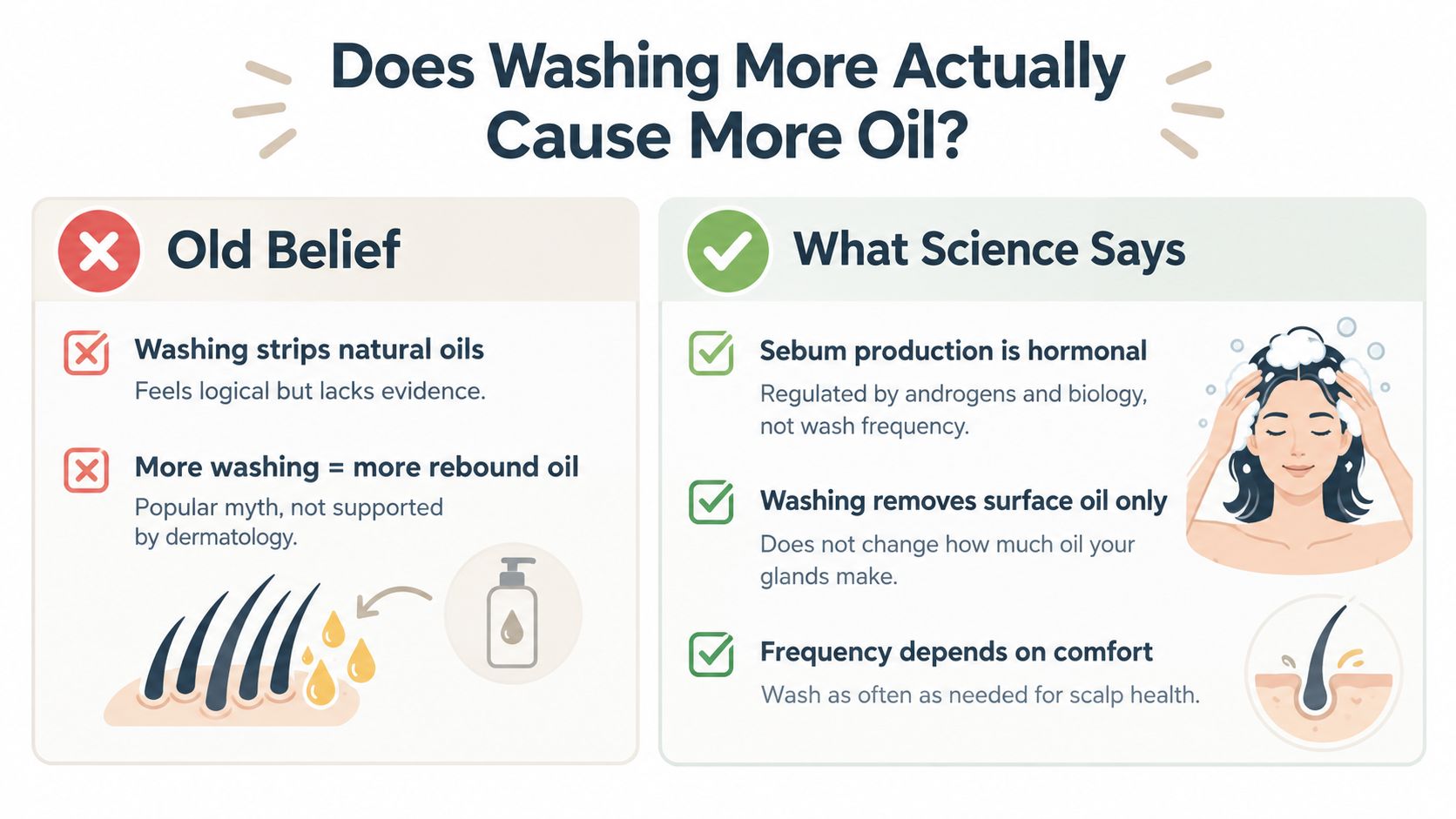
Read the myth comparison with that qualification in mind. Shampoo does remove surface oils, and excessive exposure can be unhelpful for dry lengths. The weak step is assuming that this automatically establishes a compensatory increase in gland output.
You can need more frequent scalp cleansing and less repeated shampoo exposure on your ends at the same time.
Replace scalp training with a comfort-led protocol
Let symptoms and hair condition guide adjustments rather than a rigid calendar.
- Cleanse when needed: Use accumulating greasiness, odor, itch, or flaking as reasons to reassess, not as something you must endure.
- Keep the target clear: Apply cleanser mainly where scalp cleansing is needed instead of automatically scrubbing the full length.
- Protect the dry areas: Make conditioning a separate task rather than expecting an oil-control shampoo to satisfy every need.
- Reconsider the plan when symptoms persist: Repeated discomfort deserves more attention than another attempt to extend wash day.
For a fade or short curly cut, the practical challenge is controlled placement because there's little length to separate. With dense coils, it's accessing the scalp rather than concentrating product only on the outer hair.
Neither situation proves that washing must be frequent or infrequent. The better question is whether your current interval keeps the scalp comfortable without making curl care harder. If it doesn't, change the method or product choice rather than assuming your scalp needs retraining.
When Greasy Scalp Is Something Other Than Oil
A shiny root area doesn't tell you everything about what's happening underneath. Oil, product residue, flaking, and scalp inflammation can overlap, so appearance alone isn't a reliable diagnosis.
The Canadian Dermatology Association's hair-care guidance distinguishes accumulated scalp sebum from concerns that may require treatment. It also cautions against applying oil directly to the scalp, where accumulation may attract yeast, and notes that persistent seborrheic dermatitis may call for medicated shampoos or topical treatment.
Compare patterns without diagnosing yourself
Use the following visual as a conversation starter, not a diagnostic chart.
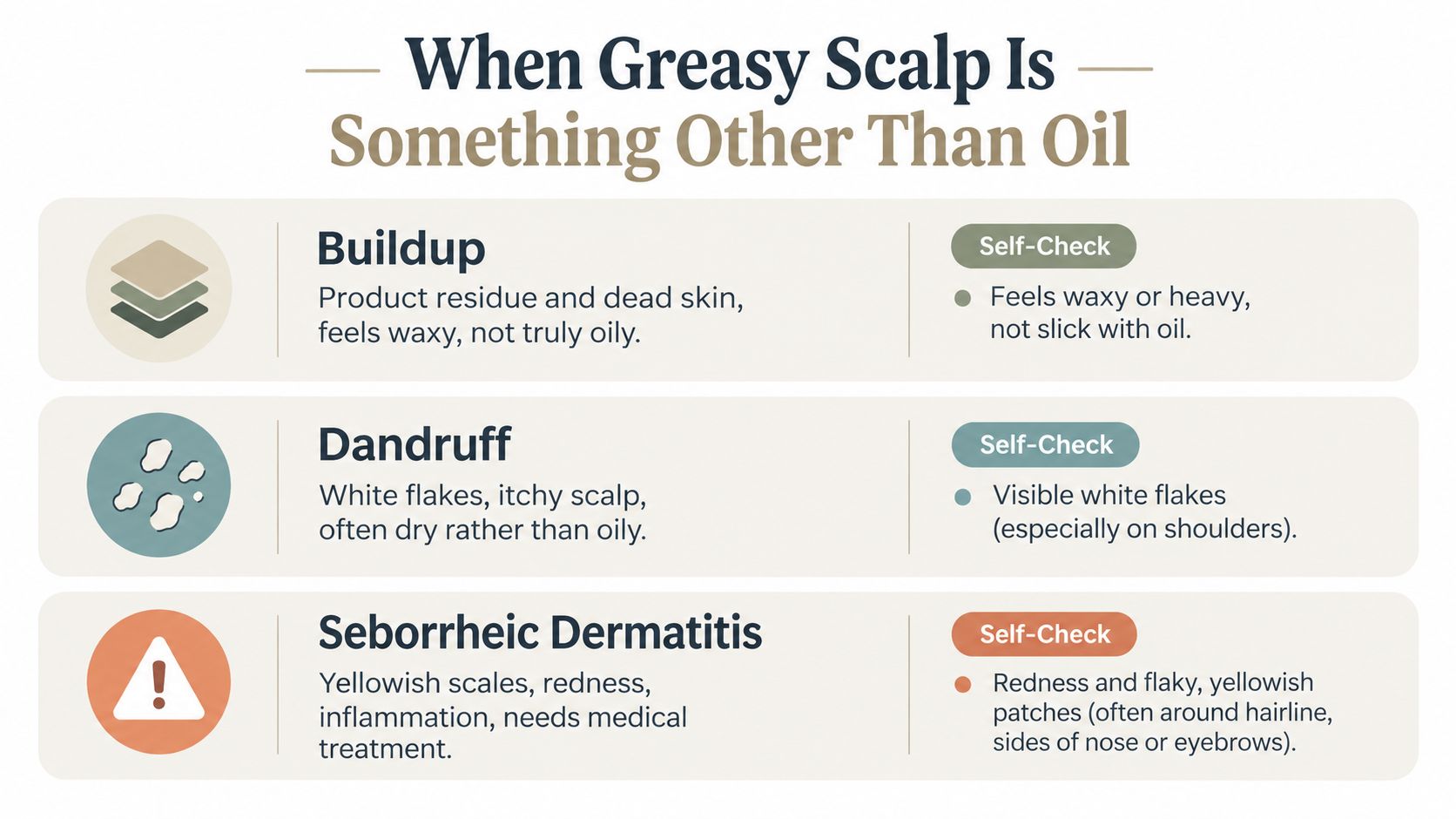
The categories aren't mutually exclusive. In particular, flakes don't automatically mean dryness, and a scalp can feel both oily and irritated. You can't reliably distinguish every cause from flake color or texture alone.
| What you're noticing | A reasonable starting point | What not to assume |
|---|---|---|
| Greasy roots without persistent discomfort | Review cleansing effectiveness and product placement | Every oily scalp needs medication |
| A coated feeling associated with product use | Review layering and consider residue removal | Every coating is excess sebum |
| Recurrent flakes or itch | Consider scalp-specific guidance and an appropriate anti-dandruff product | Flakes always need more oil |
| Persistent irritation or recurring symptoms | Seek clinical assessment | Stronger cosmetic shampoo will resolve the cause |
Choose the tool for the concern
A clarifying shampoo addresses a cleansing task. An anti-dandruff shampoo has a different intended role. A clinician can assess whether persistent symptoms require treatment beyond cosmetic care.
The piroctone olamine investigation described earlier is useful because it tested a particular active-containing formula and measured sebum directly. It isn't permission to infer that every greasy scalp has the same condition, or that an active ingredient will solve every combination of oil and flakes.
Avoid adding scalp oil because the skin feels uncomfortable. First establish whether you're dealing with dryness, accumulation, or an unresolved scalp concern. For the dryness question, use this guide to dry scalp with curly hair alongside, rather than instead of, attention to persistent symptoms.
When symptoms keep returning, stop escalating the cleansing strength on your own. Describe the itch, flakes, discomfort, products used, and response to washing to a clinician. That history is more useful than arriving with a self-diagnosis based only on greasy-looking roots.
Building a Wash Routine That Protects Curls
Build a routine around jobs, not a universal weekly timetable. You need a way to cleanse the scalp, care for the lengths, and address residue when it is present. Those tasks do not always require the same product or the same frequency.
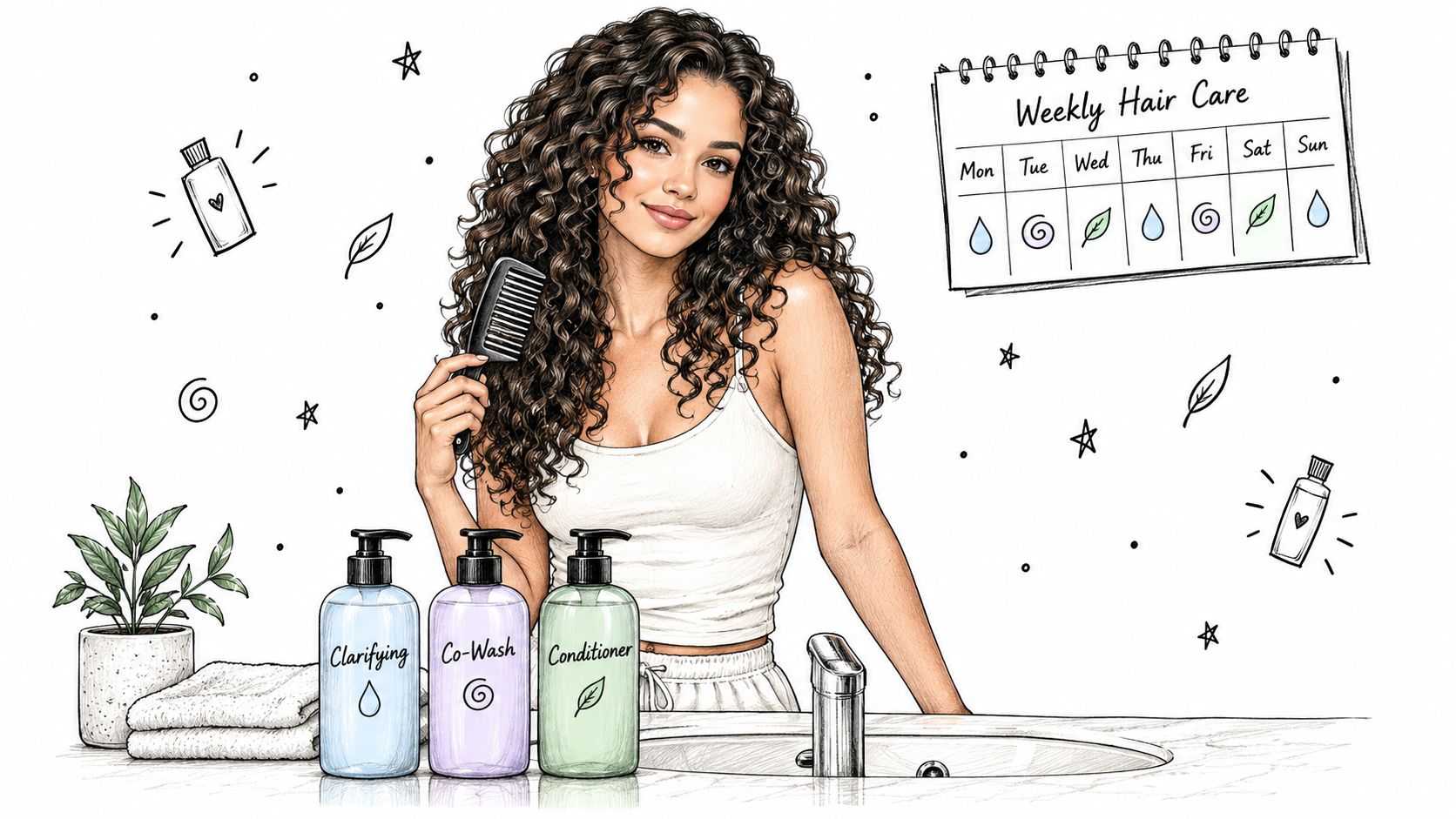
A practical plan can include a regular shampoo wash, an occasional residue-focused wash, and conditioning or refreshing between washes. Co-washing is an option to evaluate, not an automatic replacement for a scalp-cleansing step that you still need.
Give each wash a clear purpose
Use these questions before adding another product:
- Routine cleansing: Does your current shampoo leave the scalp comfortable until the next appropriate wash?
- Residue removal: Are you addressing an observable coated feeling, or clarifying because the calendar says so?
- Conditioning-only care: Do the lengths need attention while the scalp still feels comfortable?
If you try a co-wash, assess what it accomplishes. Don't keep it as the sole cleansing step if your roots remain coated or uncomfortable. Likewise, don't add a clarifying wash just because your ends need softness.
A simple schedule can help you record the purpose of each session without locking you into it.
Make application deliberate
Wet your hair thoroughly and part dense areas so you can reach the scalp. Use your fingertips to distribute shampoo rather than gathering the lengths into a pile and scrubbing everything together. Rinse carefully, allowing the rinse-through to pass over the lengths; cleanse those lengths directly when they need it.
Apply conditioner where your hair needs manageability. Distribute it gently with your fingers or a wide-tooth comb if that works for your curls, following the product's instructions. A cool final rinse is optional, not a proven substitute for suitable cleansing and conditioning.
Adjustment cue: If the scalp improves but the ends become harder to manage, change exposure and conditioning before automatically abandoning needed scalp cleansing.
Treat porosity as context, not a home diagnosis from how quickly water seems to disappear. Record wetting, rinsing, and after-drying behavior, but avoid letting a single observation dictate your entire routine. For questions about moisture-focused product choices, a guide to humectants for curly hair can help you investigate that separate task.
Look for a workable combination: comfortable roots, manageable lengths, and curls that behave consistently. You don't need to earn a longer wash interval for the routine to count as successful.
Tracking What Actually Works Over Time
A good wash can be encouraging without proving that a routine works over time. Record what happens between washes so you can distinguish a pleasant first impression from a repeatable result.
Keep a brief check-in with separate observations:
- Scalp: Greasiness, itch, irritation, flakes, and comfort.
- Lengths: Definition, frizz, softness, and ease of detangling.
- Routine: Products used, application changes, and when you next needed cleansing.
Pair those notes with photos taken under similar conditions. An ingredient scanner can help organize product differences, while a curl score can summarize visible trends, but neither replaces your account of scalp symptoms.
Change a single part of the routine at a time where practical. Keep other habits reasonably steady, then compare repeated experiences instead of reacting to an isolated wash.
Successful shampoo oil control means a scalp you can comfortably maintain and lengths you don't have to rescue afterward. Track both, and adjust the routine when either side consistently falls short.
Coil offers personalized curly-hair routines, ingredient analysis, and daily check-ins to help you connect product choices with scalp comfort and curl condition. Visit Coil to build an adaptable routine and track your results instead of choosing your next shampoo by its oil-control promise alone.