3B Curly Hair Routine for Defined Curls
Build a 3b curly hair routine for real definition: scalp cleansing, conditioning, wet styling, wash timing, and fixes for heavy curls.
Wash less, add more moisture, and your 3B curls will define themselves. That's the most popular advice, and it's why so many routines stall. Stretching washes can leave an itchy, coated scalp while your ends still feel rough, and stacking cream on cream can make curls softer but flatter, with clumps that collapse by afternoon.
A working 3B curly hair routine does the opposite. You set wash timing from what your scalp is doing this week, you separate moisture from hold, and you change one thing at a time so you can see what helped. The label tells you your curls are medium and springy. It doesn't tell you how oily your roots get, how much product your density can carry, or whether last week's gel is still sitting on your hair.
A 3B Wash Day at a Glance
Run the routine in this order today, then adjust amounts later. The sequence matters more than owning five new products. You need a scalp cleanser, a thick rinse-out conditioner, a light leave-in conditioner, and one styler with hold, such as a gel or foam, plus a microfiber towel or cotton T-shirt for blotting.
| Phase | What to do | Why it matters |
|---|---|---|
| Scalp cleanse | Massage cleanser on the scalp and let rinse water pass over the lengths | Clears oil and film without scrubbing curls |
| Condition and detangle | Thick conditioner on the shaft; detangle soaking wet from ends toward roots | Slip limits breakage and keeps clumps intact |
| Style wet | Leave-in plus gel or foam on soaking-wet hair in sections | Even coating and springier clumps |
| Dry | Blot with microfiber or a T-shirt; air-dry or diffuse on low | Rubbing and high heat raise frizz |
| Sleep | Loose high ponytail or braid on a low-friction pillow | Cuts overnight friction and breakage |
What 3B Actually Means
In the widely used 1 to 4 system, numbers run from straight to coily and letters A to C mark rising tightness. 3B sits in Type 3, between looser 3A spirals and tighter 3C corkscrews, so you're looking for medium, springy curls that form clear loops but still stretch when wet and heavy with product.
That label is common, but it's still self-reported. In a 2024 peer-reviewed taxonomy study of 506 women who self-reported natural curly hair at type 3A or tighter, 29.6% identified as 3B and 46.2% identified as 3A. The study doesn't describe the whole population, because participants were a self-selected curly-hair sample, and people picked their own type. Two heads that both look 3B can behave very differently once you factor in length, density, porosity, heat damage, and product buildup.
Treat 3B as your starting texture, not as a prescription for product weight or wash timing.
Find the Phase You Skip
Most broken routines aren't missing a miracle product. They're missing one phase. Read the table top to bottom and mark the first row you regularly skip.
- You shampoo the lengths hard: Your ends will feel rough no matter how much conditioner follows.
- You detangle before conditioner has slip: You pull knots tighter and snap strands at the bends.
- You style after toweling and getting dressed: Product lands on half-dry hair, coats unevenly, and leaves a frizz halo.
- You sleep with curls loose on cotton: You wake up with flattened, fuzzy clumps and blame the gel.
Fix that one gap on your next wash before you buy anything. If you currently rub with a bath towel, switch to blotting. If you rake product through dry sections, keep a spray bottle nearby and re-wet each section until it drips.
Your result to look for is simple. After conditioning, curls should hang in wet clumps that spring back when you scrunch upward. After drying, those same clumps should still be visible without you pulling them apart. If the clumps disappear during drying, handling, not curl type, is usually the problem, and the steps below show you where to intervene.
Set Wash Frequency from Scalp Signals
There's no single correct interval for 3B hair. A fixed weekly rule ignores sweat, oil, flakes, and how much gel you layered on last wash. So does the opposite rule, where you stretch as long as possible because you think water itself is drying.
Clinical guidance summarized in a review of textured hair care practices makes the tension clear. Infrequent cleansing can allow buildup and may contribute to scalp conditions, while appropriately performed weekly washing can help regulate the scalp environment and reduce buildup and breakage risk. Less washing isn't always gentler. Sometimes it just keeps old product and oil on skin that needs clearing.
Match the Interval to This Week's Scalp
| Scalp or length signal | Suggested interval | What to change |
|---|---|---|
| Comfortable scalp, no flakes | Every 7-14 days, not past 2-3 weeks | Keep a gentle scalp cleanser |
| Oily roots by day 3-4 | Every 3-5 days, scalp only | Light cleanser; still condition the lengths |
| Itch, scale, or odor | Do not stretch past about weekly | Cleanse the scalp; see a dermatologist if it persists |
| Heavy gel cast or product film | Clarify once, then return to the gentle interval | One clarifying wash, not every wash |
| Brittle, rough lengths with a calm scalp | Keep or lengthen the gap | Milder cleanser and richer conditioner on the lengths |
Read only the row that matches you now. If your scalp is calm and your roots don't look greasy, a 7 to 14 day gap can work. If your roots are oily by day three, wash the scalp sooner and don't punish the lengths for it. You massage cleanser on skin, let the rinse run down, then condition mid-lengths and ends as usual.
The 2 to 3 week mark is a floor for health, not a goal to beat. Going past it while you have itch, thick scale, odor, or a coated feeling isn't protective styling. It's a signal you're overdue.
Split the Head Into Two Jobs
Say your roots look greasy and smell stale, but your ends feel brittle. That split doesn't mean your hair is confused. It means you need two different treatments in the same shower.
- Scalp job: Cleanse thoroughly with fingertips, rinse well, and repeat only if the first lather barely foamed through heavy film.
- Length job: Use a richer conditioner, leave it on while you detangle, and avoid scrubbing shampoo down the ends.
Change cleanser strength before you declare a whole category right or wrong. A gentle sulfate-free shampoo may suit a calm, dry scalp. A co-wash may be enough between light styling weeks. A clarifying shampoo earns its place when curls feel waxy, won't absorb conditioner, or stay limp after a normal wash. None of those is universally correct for 3B hair.
Persistent itch, thick stuck-on scale, pain, odor that returns quickly, or noticeable shedding isn't a scheduling puzzle. Shorten the gap for now and get a dermatologist's input if it keeps happening.
Log What Actually Happened
After each wash, write five quick ratings in a notes app: itch, flakes, tightness, oil, and definition. Add the number of days since the last wash. After three or four washes, you'll see your real window. Maybe definition lasts five days but itch starts on day four. Your interval is four days, not the week you planned.
That's the same logic we build around. The daily check-in consists of ticking off what you did, rating how your curls feel, and optionally adding a selfie. The routine is re-shaped around what you did, not what you intended to do, so a skipped wash or an extra gym rinse changes the plan instead of breaking it.
How to Cleanse and Condition 3B Curls
Work in the order your hands move, and don't rush the wetting stage. 3B curls can look wet on top while the dense underlayer stays dry and resistant. That dry core is where tangles hide.
The Five Actions in Order
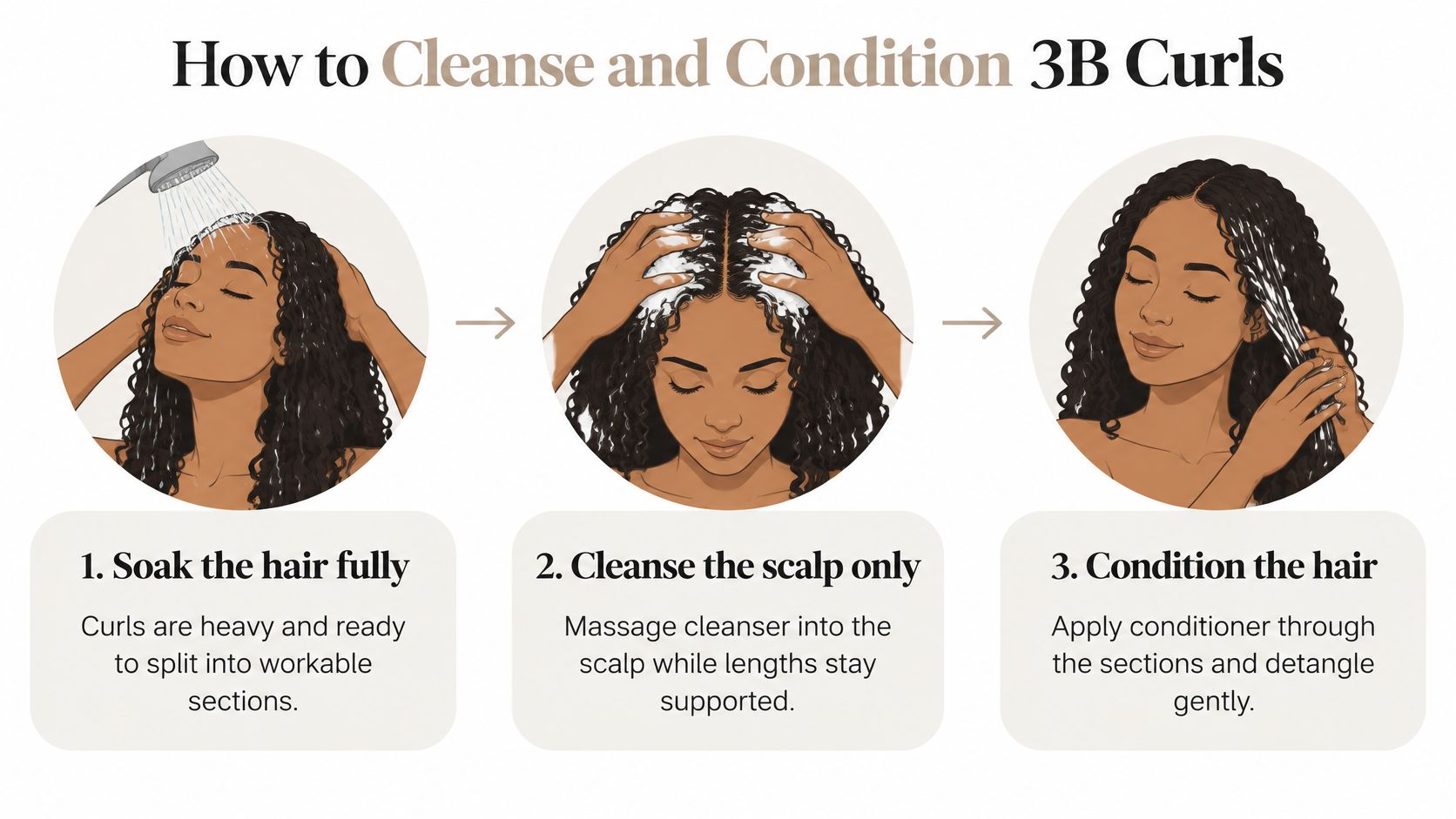
- Soak the hair fully: Stand under the water and lift sections until the hair feels heavy all the way through. Split it into two to four workable sections with clips or loose twists if it's long or dense.
- Cleanse the scalp only: Put cleanser on your fingertips and massage the skin in small circles with the pads, not nails. Let the rinse carry suds over the lengths. Don't pile curls on top of your head and scrub them like a shirt.
- Condition the full shaft: Smooth a thick conditioner through each section, using more on mid-lengths and ends. You want a slippery, seaweed-like feel. If strands feel squeaky or grabby, you don't have enough slip yet.
- Detangle wet and lubricated: With conditioner still in, use fingers or a wide-tooth comb and start at the very ends. Work a knot loose, move up a little, and repeat toward the roots. Add water and a pea-sized extra dab of conditioner to stubborn spots instead of pulling harder.
- Rinse soft, not squeaky: Rinse until strands feel soft and separated, not stripped. Leave the hair dripping. Skip the rough bath towel and don't twist curls into a tight turban.
For what a leave-in conditioner does after this step, think of it as a thin layer you keep, while rinse-out conditioner is the heavier work you wash away. You need the rinse-out step done well first. Leave-in can't rescue hair that went into styling tangled and patchy.
Where Breakage Usually Happens
The American Academy of Dermatology guide to curly hair care warns that brushing dry curls increases breakage and frizz, and it advises sectioning long or dense hair to reduce tangling damage. It also notes that the scalp should generally be cleansed at least every 2-3 weeks, with more frequent washing when sweat, oil, flakes, or styling buildup accumulate.
That guidance maps directly onto three common mistakes.
- Raking shampoo down every strand: You rough up ends that only needed rinse water passing over them.
- Combing before slip: A comb hits a knot at full speed and snaps the outer strands of the clump.
- Rubbing with a looped towel: You break up clumps you just formed and lift frizz at the surface.
Hands rule: If you're hearing snapping or seeing lots of short broken pieces, stop, add water and conditioner, and shrink the section. Force is never the missing ingredient.
Know When You're Done
Don't decide cleanser strength in the middle of detangling. Flakes, oil, and film set that choice. Your job here is to finish with hair that's saturated, clumped, and knot-free, with a clean-feeling scalp and soft lengths.
Run your fingers down a section. They should glide without catching, and the curls should fall into rope-like groups rather than a fuzzy cloud. If one section still feels rough, re-wet it and add conditioner there instead of redoing your whole head. Stop at that point and style immediately, while the hair is still soaking wet. Every minute you spend walking around with a towel on makes the next phase harder.
How to Style Wet 3B Curls
Style before the hair starts to dry, not after you've drained it, dressed, and answered messages. Keep stylers in the shower or right at the sink. If a section dries while you work on another, mist it back to dripping before you touch it with product.
The Four Styling Moves
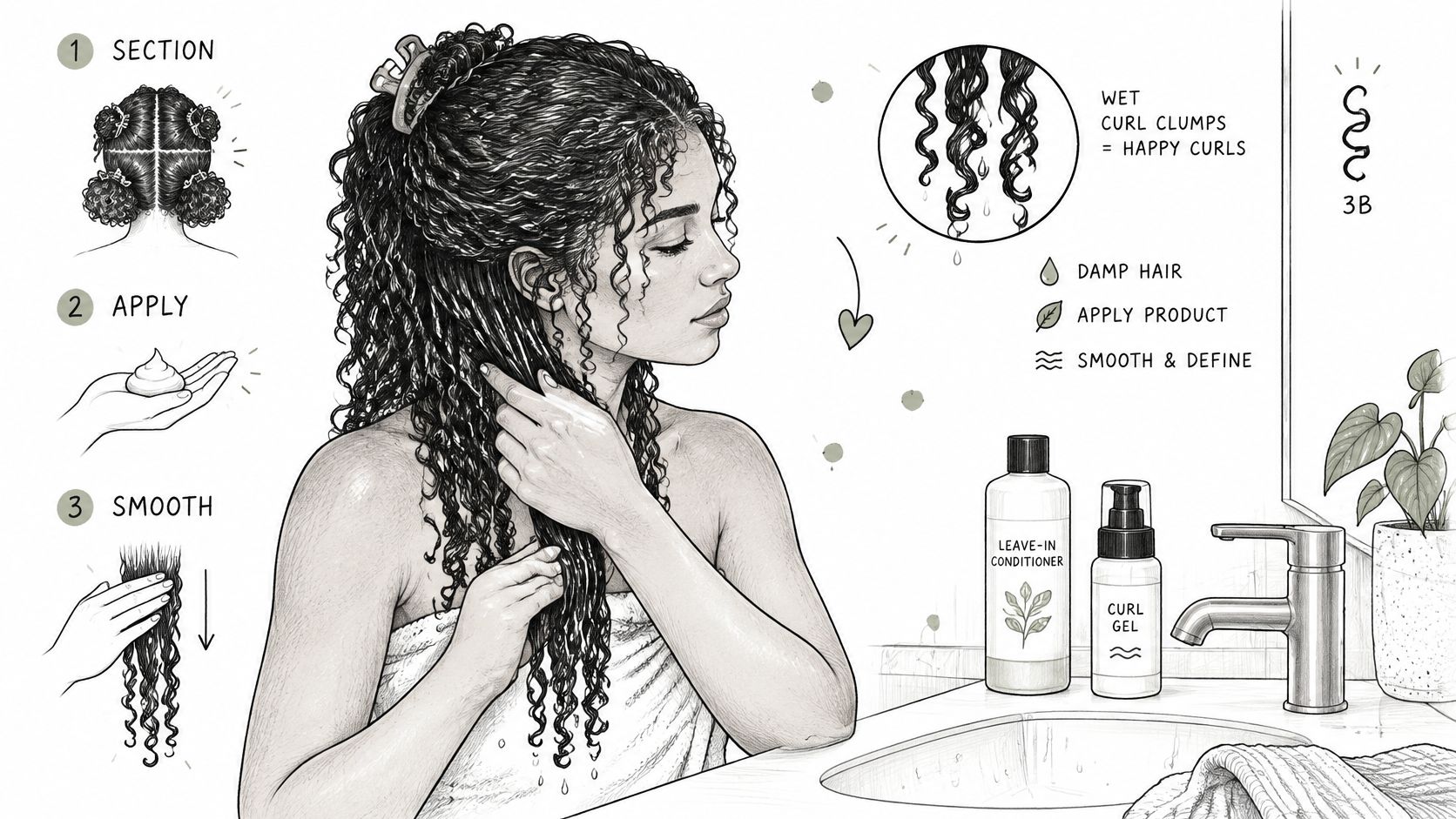
- Section and coat soaking wet: Work in small sections. Smooth a light leave-in through first, then add gel or foam. If you're weighing curl cream versus gel for hold and softness, remember that cream mainly softens and gel mainly holds, so most 3B routines need hold on top.
- Use praying hands, then scrunch: Press palms flat on both sides of a section and glide down to coat the outside of the clump. Then cup the ends and scrunch upward gently a few times. Don't rake fingers through repeatedly, because you'll shred clumps into strings.
- Blot, don't rub: Press a microfiber towel or cotton T-shirt against sections to lift drips. One gentle squeeze per section is enough.
- Dry without touching: Air-dry, or diffuse on low heat and low speed, hovering first and cupping curls only once a light cast forms. Keep hands off until hair is fully dry.
If you use gel, expect a firm cast as it dries. That's the styler holding clumps while water leaves. Once hair is completely dry, scrunch upward with clean, dry hands to break the cast. Curls should soften but keep their shape. If you scrunch at 80 percent dry because you're impatient, you'll trade crunch for frizz and lose definition by evening.
The video below shows the hand placement for coating and scrunching, which is easier to copy than a written description of palm angle.
Why Wet Application Works Better
Guidance collected in Allure's guide to caring for curly hair favors applying styling products to very wet curls because distribution improves and results are less likely to feel stiff or frizzy than when product goes on after substantial drying. Water does part of the spreading work for you. On damp hair, the same amount of gel sits in patches, so one clump feels crunchy and the next puffs up.
Say the back of your head always frizzes first. The likely cause isn't a different curl type back there. It's the section you reach last, after it has air-dried for several minutes. Re-wetting that one zone often fixes what an extra layer of cream won't.
Change One Variable Per Wash
Don't overhaul amount, products, and drying method in the same week. You'll get a different result and learn nothing. Pick one lever for the next wash.
- Product amount: Keep the same gel, use a third less per section.
- Wet versus damp: Keep amounts identical, apply while dripping.
- Drying method: Keep styling identical, diffuse on low instead of air-drying.
- Humidity note: Write down a humid or dry day so you don't blame the product for weather.
Porosity can guide your first guess. Porous or heat-damaged 3B hair loses moisture quickly and often does better with richer conditioning plus a light seal. Low-porosity hair tends to sit under heavy creams and repeated layers, so it goes limp and coated. Use lighter formulas and build slowly.
Don't treat the float test as a diagnosis. A strand in a glass can sink or float because of residue, buildup, and water chemistry. Judge by behavior instead. Does conditioner absorb or sit on top? Do curls stay defined the next morning, or collapse by lunch? Note definition, frizz, softness, and next-day hold in the same light each wash, and let those results choose the next single change.
Fix Heavy Stiff or Frizzy 3B Curls
Start with the symptom from the wash you just finished. Don't rewrite the whole routine because one outcome disappointed you. 3B hair gives clear feedback, but only if you change one row at a time and give that change a full wash cycle to judge.
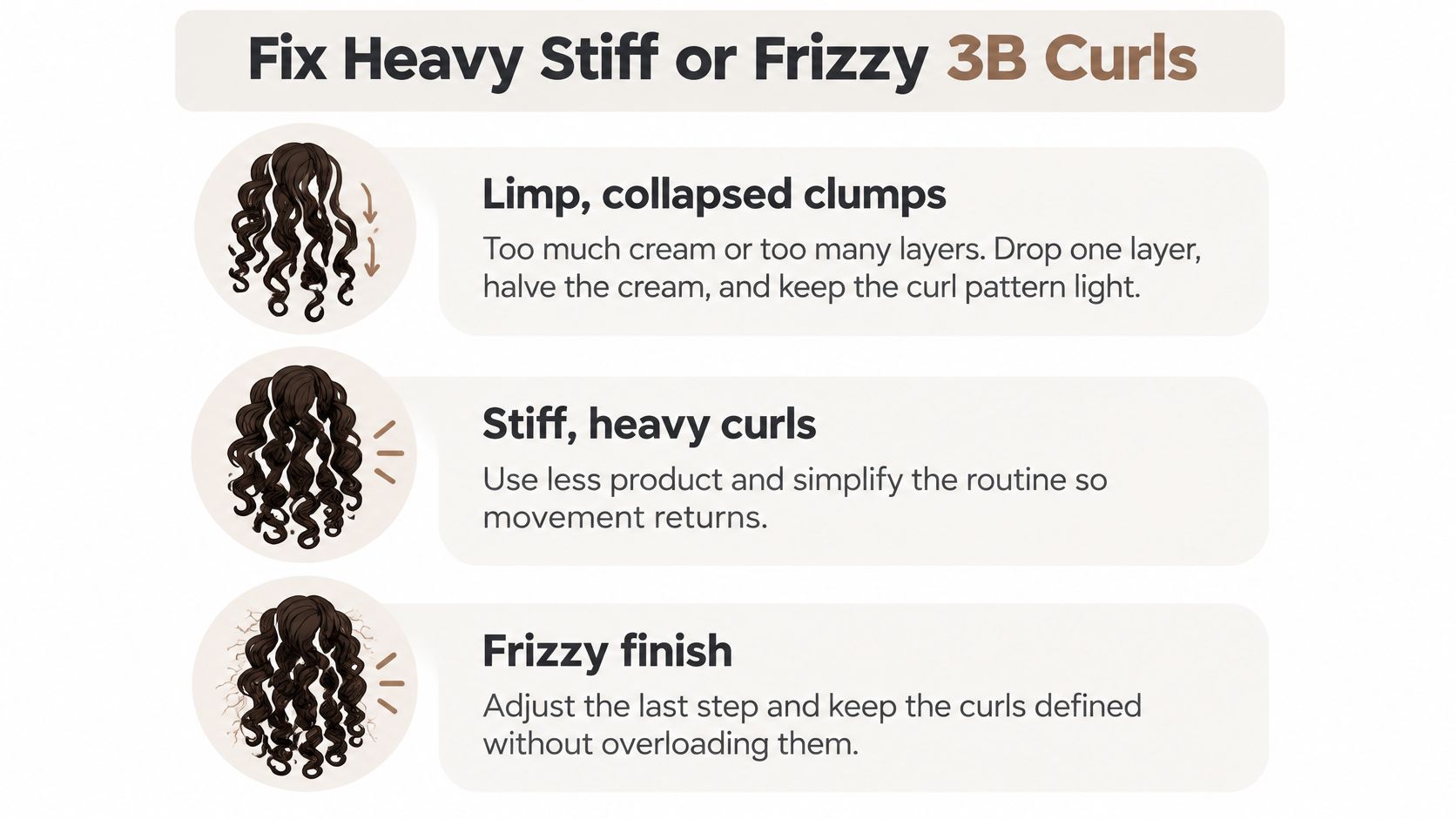
| What you see | Likely cause | Next change |
|---|---|---|
| Clumps collapse and volume drops | Too much cream or too many layers | Remove one layer and use less cream |
| Stiff, straw-like curls | Protein or film-former buildup | Clarify once and pause protein |
| Frizz halo after drying | Styler on damp hair or rough drying | Apply on soaking-wet hair and blot |
| Coated roots, dry ends | Product piled at the scalp | Apply conditioner and oils from mid-lengths down |
| Soft hair that will not hold | Moisture without hold | Keep leave-in light and add gel or foam |
Limp, Collapsed Clumps
Your curls look stringy, the top lies flat, and volume disappears even though the hair feels soft. That pattern usually means too much cream or too many layers, not too little moisture. Softness fooled you. The clump is carrying more weight than its spring can lift.
On the next wash, drop one layer entirely. Keep the leave-in light, halve the cream if you use one, and keep your gel amount the same so you can isolate the change. Dense 3B hair doesn't automatically need leave-in, cream, and gel together. Start with two layers. Add a third only if frizz remains after the hair is fully dry and the cast is broken.
Butters and heavy oils are the easiest way to overshoot on medium curls, especially if your hair is fine or low-porosity. A pea-sized amount warmed between palms for the ends is very different from coating every section. If definition drops while hair feels softer, remove a product before you add one.
Stiff, Straw-Like Curls
Hair that feels rough, squeaky, and brittle, with ends that don't bend smoothly, points to protein or film-former buildup for many people. It can also follow weeks of strong-hold products and clarifying too rarely. The curl looks defined in the mirror but feels like straw when you touch it.
Clarify once. Then pause protein-forward treatments and heavy stylers for two wash cycles while you use a plain moisturizing conditioner. Don't clarify every wash to chase the feeling, because you'll create the opposite problem. One reset, then observe. Elasticity should return gradually, meaning a wet strand stretches a little and springs back instead of snapping or staying stretched.
Market reporting in a curly hair care product market analysis describes growing interest in porosity-specific products and formulas built around humectants, butters, oils, and protein-balancing systems. Those labels don't tell you whether your limp curls came from over-conditioning, buildup, humidity, or insufficient hold. Your wash log does.
A Frizz Halo After Drying
A fuzzy layer sits on top of otherwise defined curls, worst at the crown and front. Before you buy an anti-frizz serum, audit handling. For readers asking why curly hair turns frizzy after it looked fine wet, the usual culprits are damp application, rubbing while drying, and touching before the cast sets.
Redo the next wash with product on soaking-wet hair and blot only. Keep the same products and amounts. If the halo shrinks, you had a timing problem, not a product shortage. If frizz appears only where your hands keep checking dryness, set a timer and leave it alone. Diffuse on low or walk away while it air-dries.
If you have to touch to check, touch one underneath clump, not the visible top layer.
Coated Roots With Dry Ends
Your scalp feels filmy by day two, roots look dull, and ends still feel parched. Product is piling up where your hands start. Many people apply conditioner, cream, and oil from the scalp down out of habit, so the newest hair gets the heaviest dose and the oldest ends get leftovers.
Move application down. Condition from mid-lengths to ends, with only the leftover slip on your palms near the roots if that area tangles. Put oils and butters on the last few inches first. On wash day, cleanse the scalp properly instead of adding dry shampoo over film for another three days. The ends will improve because product finally reaches them, and roots will stay cleaner between washes.
Soft Hair That Will Not Hold
This is the mirror image of stiffness. Curls feel lovely, move freely, and fall apart within hours. Scrunching brings them back for ten minutes, then the shape dissolves. You have moisture without hold, and adding more cream will make it worse.
Keep the leave-in light and add a gel or foam as the final layer on wet hair. Foam gives lighter, airier hold for fine 3B hair that collapses easily. Gel gives a stronger cast and better next-day definition for coarser or denser hair. Apply it with praying hands over clumps instead of raking it through, then don't break the cast until the hair is fully dry.
Say you loved how soft a cream-only wash felt but hated day two. Don't throw the cream away. Use half as much, add gel, and judge day two again. Separating softness from structure is the whole point.
How to Judge the Fix
Score each wash on six things: definition, frizz, softness, elasticity, scalp comfort, and breakage. Take photos in the same light and from the same angle, once dry and again the next morning. A product that wins at hour one and fails by bedtime isn't a winner for your routine.
That's why we build routines from your curl type, porosity, density, and scalp rather than from curl type alone. Our curl score is calculated with definition at 40%, frizz at 30%, and moisture at 30%, so a very soft wash that destroys definition doesn't get counted as progress. Whether you log in a notes app or with us, change only the row that failed, then run at least two washes before you judge the pattern.
One boundary matters. Hair advice here is general information and not medical advice. Recurring scalp pain, patchy shedding, thick scale, or sores should be checked by a dermatologist, not treated as a reason to try a sixth product combination. Get the scalp assessed, then rebuild definition on healthy ground.
Build your next 3B wash from your scalp signals, density, and the one result that failed last time, then let Coil track definition, frizz, and moisture across washes so each change teaches you something. Start with the five phases above, log what you did, and adjust one layer at a time until the style still holds the next morning.