2B Hair Routine: Wash, Dry and Style Waves That Hold
A step-by-step 2B hair routine for wash day, drying and styling, with product amounts and fixes for frizz, flat roots and scalp buildup.
Your waves look promising while they're wet, then the roots dry flat and the ends turn fluffy. You add leave-in to tame the frizz, but by the next morning your hair feels coated and your scalp wants a wash. Now you're choosing between another shampoo and another layer of product, neither of which seems quite right.
A useful 2B hair routine makes that decision easier. Treat the scalp and lengths as separate areas with connected needs: cleanse when the scalp needs it, condition where the hair feels rough, and use enough hold to preserve waves without burying them under product.
What 2B Waves Need From Your Routine
The 2B label doesn't settle your product list. In the André Walker system, numbers 1–4 describe straight, wavy, curly and coily hair, while letters A–C indicate progressively tighter forms; 2B sits between the looser 2A pattern and more tightly defined 2C, as outlined in this systematic review of hair-classification systems.
That describes pattern, not everything that determines care. People with similar waves can have different strand diameters, density, damage, porosity and scalp conditions. A rich conditioner might soften someone's coarse lengths while flattening someone else's fine hair.
Hair shape also reflects follicle geometry and cortical organization, with elliptical or asymmetric shafts common in curly fibers, according to this review of hair-fiber biology. That doesn't mean every 2B strand has an identical cross-section.
Before buying anything, make these checks:
- Clean-day shape: Notice how your hair dries without heavy styling layers.
- Leave-in response: Check whether a light application leaves the lengths soft or coated.
- Scalp comfort: Distinguish oily roots, tightness and itching rather than calling all of them dryness.
Starting rule: Use the label to choose a starting routine. Use repeated results to decide what stays.
How to Run a 2B Wash Day Step by Step
Keep wash day low-manipulation. The American Academy of Dermatology's curly-hair guidance recommends conditioning, detangling wet hair and avoiding dry brushing, which can increase frizz and breakage.
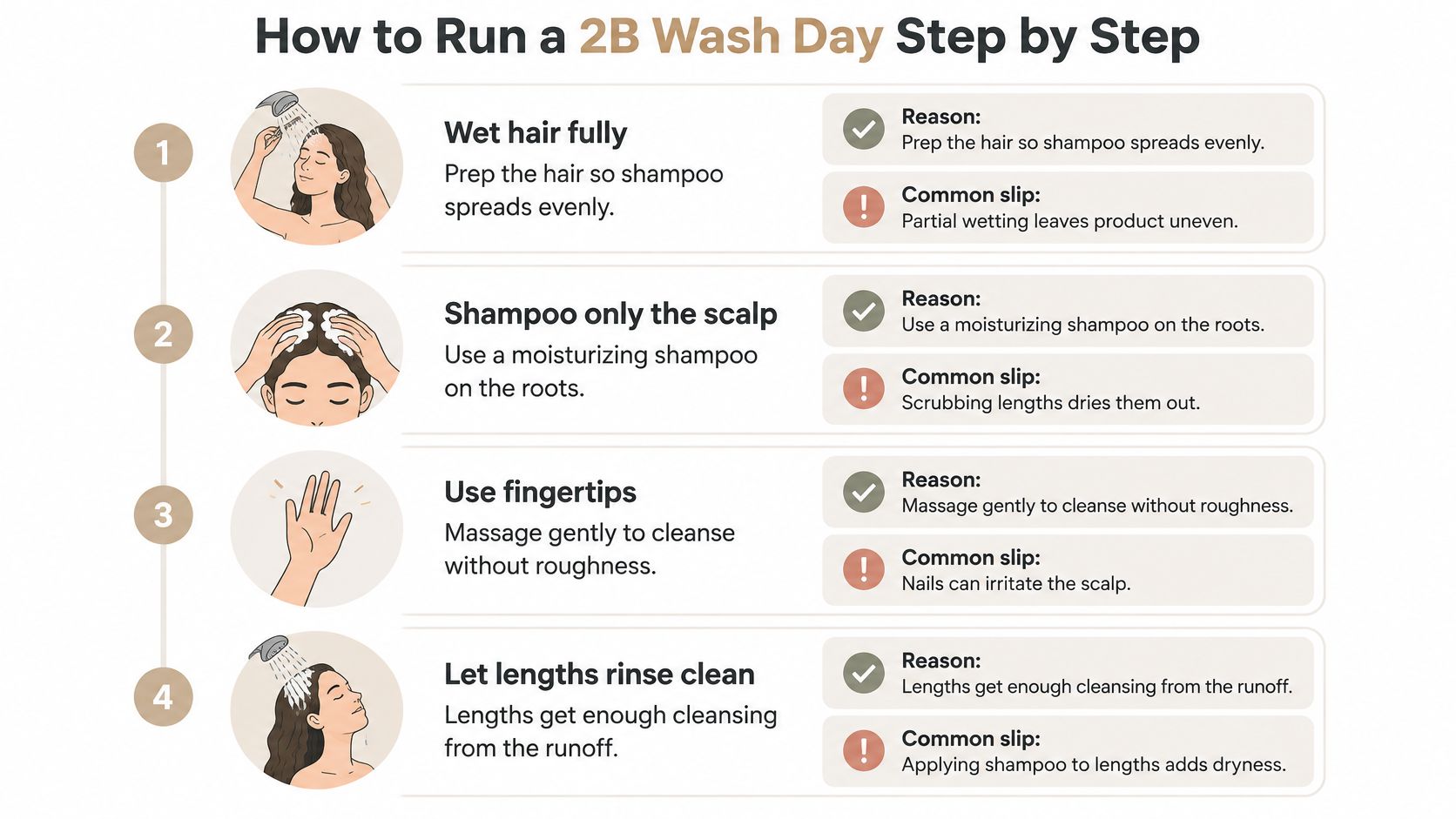
Use this visual as a reminder to keep cleansing gentle and scalp-focused.
Cleanse, condition and detangle
Wet thoroughly, then shampoo the scalp. Use a moisturizing shampoo and massage with your fingertips, not your nails, so you can lift oil and residue without scratching. Let the rinse travel through the lengths instead of bunching them up and scrubbing, unless they also have visible residue that needs cleansing.
Condition through the lengths and ends. Spread a lightweight rinse-out conditioner evenly, paying particular attention to rough ends, and give it time to provide slip before rinsing. Don't assume the top layer is the whole head: lift sections so the underside gets conditioned too.
Detangle while the hair is wet and slippery. Work from the ends upward with fingers or a wide-tooth comb, separating longer or denser hair into manageable sections. If the comb catches, add slip and loosen the knot instead of pulling through it.
The useful checkpoint is easy handling, not a squeaky-clean feel. Hair that tangles immediately after rinsing may need better conditioner distribution, not a richer styling routine.
Style without rebuilding tangles
Apply a light leave-in to soaking-wet hair. Spread a small amount between your palms and distribute through the lengths, keeping it away from roots that flatten easily. Skip this layer if your rinse-out conditioner already leaves the hair comfortably soft; leave-in isn't compulsory.
Add hold, then scrunch upward. Smooth a light gel or mousse over wet sections and cup the ends toward the scalp to encourage clumps. Once those clumps form, avoid repeatedly brushing them apart or squeezing until the hair becomes tangled.
Record what you used. Note the cleanser, conditioner, leave-in and styler, including whether each application was light or generous. An accurate note is more useful than recording the routine you meant to follow.
Watch the handling and scrunching technique without treating someone else's product quantities as your prescription.
Clarifying isn't an automatic wash-day step. Reserve it for a persistent coated feeling, visible residue or hair that has stopped responding to its usual routine. If an ordinary shampoo restores softness and movement, there's no reason to make that wash harsher.
At the first styling check, look for cohesive wet clumps, comfortable lengths and roots that aren't sticky with leave-in. A gel cast on the lengths can be useful; a rigid coating at the scalp isn't the goal.
Product Amounts and Drying Methods by Hair State
Start with the smallest application that distributes evenly, then judge the dried result before adding more next time. Treat the table as a set of starting decisions, not universal doses: product concentration, hair length and density make coin-size measurements unreliable.
| Hair State | Product | Starting Amount | Drying Method |
|---|---|---|---|
| Fresh wash, first styling | Light leave-in | A thin film across palms, spread through lengths; add only to rough areas | Scrunch gently, briefly wrap if useful, then diffuse on low |
| Roots flat, lengths fine | Mousse at the roots only | A light application across root sections, without saturating the scalp | Diffuse roots first, then air-dry lengths |
| Heavy buildup from gels | Clarifying wash on the scalp | Enough to distribute across the scalp, only when buildup warrants it | Rinse thoroughly, condition lengths and dry gently |
Choose a cleanser that leaves your scalp clean and comfortable. A sulfate-free shampoo can be a starting option, but the label alone doesn't tell you whether it will remove your styling residue. For styling, distinguish conditioning from hold: our curl cream versus gel guide explains why adding richness isn't the same as improving wave retention.
Choose controlled drying over a rigid rule
After styling, squeeze excess water with a smooth microfiber towel or cotton T-shirt. Don't rub back and forth. If wrapping your hair leaves the roots pressed flat or the wave clumps distorted, skip the wrap and move straight to careful drying.
A hair-drying damage study found that a dryer held about 15 cm away and kept moving caused less damage than natural drying under its experimental conditions. That isn't proof that every diffuser setting is safer than air-drying; temperature, distance and movement matter together.
Use low-to-moderate heat and keep the airflow moving rather than parking it against a section. For root lift, dry around the roots first, then let the lengths finish without constant handling. You can stop active drying when the hair is nearly dry, but leave any forming cast alone until it's fully dry.
A hotter dryer isn't the only drying mistake. Repeatedly grabbing, scrunching and rearranging partly dried waves can undo the definition you created while styling.
Reserve heavy oils and dense creams until you know what the lighter routine lacks. If the lengths are already soft but the waves fall out, test hold or drying technique before adding another conditioning layer.
Fixing Flat, Greasy or Itchy 2B Hair
Flat, greasy roots usually call for a scalp or product-placement adjustment, not more conditioner. Test a more timely scalp wash or remove root-applied styling product before changing everything else.
The Canadian Dermatology Association's hair-care guidance emphasizes scalp-focused shampooing and describes one or two weekly washes as an option for wavy or curly hair, adjusted for scalp condition and heavier product use. It also notes that dampening the scalp every few days can help reduce accumulated debris between shampoos.
Use the symptoms as clues, not diagnoses.
| Symptom | Likely Cause | Change to Test |
|---|---|---|
| Flat, greasy roots by day two | Scalp oil and product residue at the roots | Wash the scalp sooner; if root product is substantial, reduce that instead |
| Itchy scalp with flakes | Buildup or a scalp condition such as dandruff | Cleanse adequately and seek dermatology advice if it persists |
| Limp, stringy lengths | Too much weight from creams or oils | Reduce leave-in before testing a lighter gel-based layer |
| Dry, frizzy ends | Under-conditioning, excessive cleansing or damage | Improve conditioner coverage; reduce unnecessary washing if the scalp permits |
| Waves won't clump | Hair insufficiently wet or styling coverage inadequate | Rewet thoroughly before testing a little more styler |
Check where the discomfort or residue sits rather than judging the whole head by the ends.
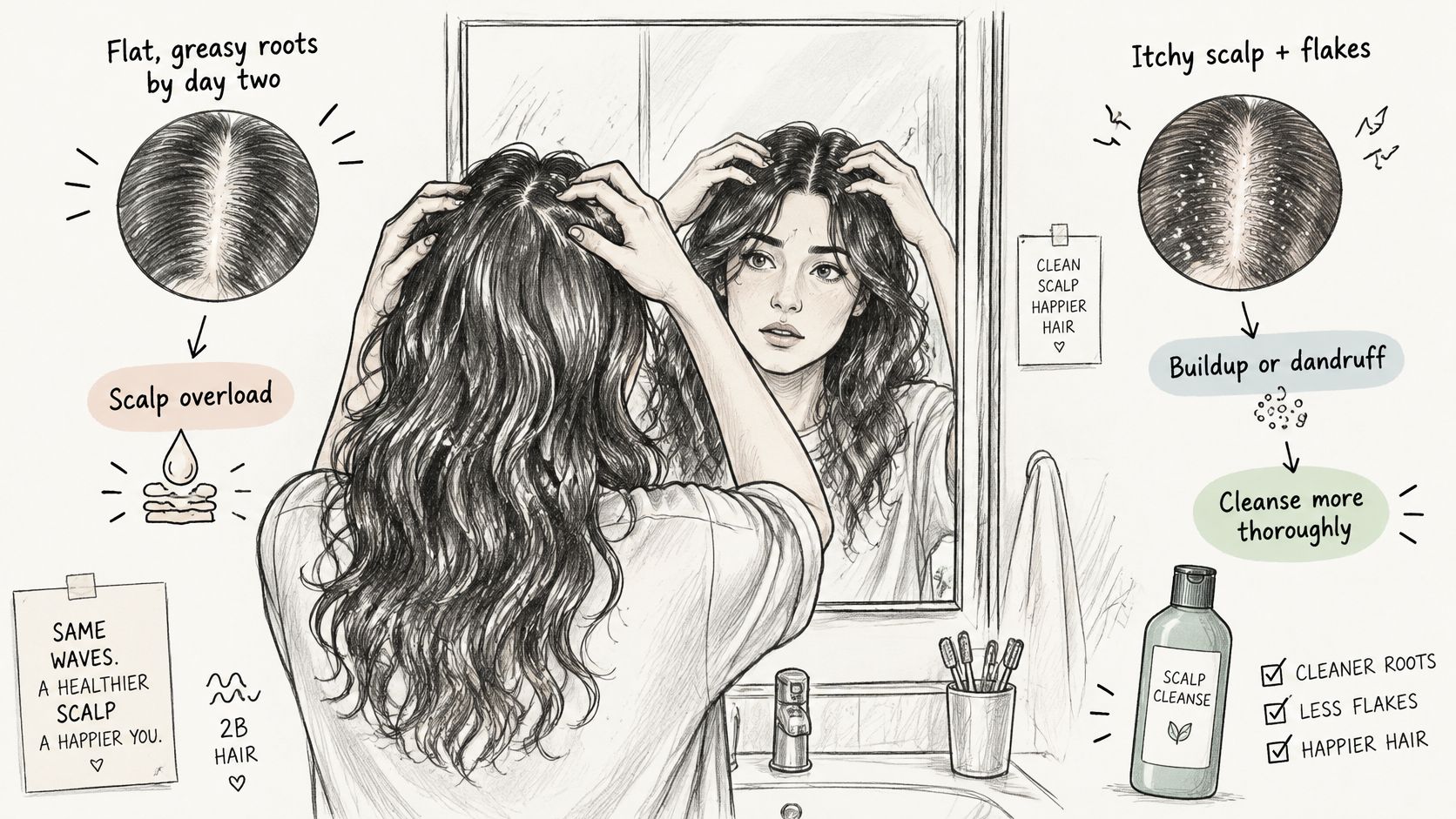
Separate an oily scalp from dry lengths
Oily roots and dry ends can coexist. Keep the scalp cleansing it needs while protecting the lengths with conditioner and gentler handling. Stretching washes despite greasy, uncomfortable roots doesn't solve dryness at the ends.
Say your scalp feels oily after exercise while your ends remain rough. Wash the scalp, let the rinse move through the lengths, and condition those lengths properly. Don't coat the scalp in oil just because part of the hair feels dry.
For tightness without obvious oiliness, review cleanser harshness, rinsing and irritation from products. Our guide to dry scalp with curly hair helps distinguish routine adjustments from symptoms that need closer attention.
Scalp priority: Washing less isn't automatically healthier. A comfortable scalp and conditioned lengths matter more than maintaining a fixed gap between washes.
Dampening isn't a substitute for shampoo when oil or residue needs removal, and clarifying shampoo isn't a universal treatment for flakes. Persistent itching, flaking, redness or hair loss should be checked by a dermatologist, particularly if symptoms worsen or become painful. Our hair advice is general information, not medical advice.
Adjusting Your 2B Routine for Humidity and Day Two
A routine that works in dry weather may feel sticky or leave waves expanded in humidity. The Albania Hair Clinic guide to 2B hair describes humidity-sensitive waves and loss of shape by the second day, but your response still needs to guide the adjustment.
Change the layer responsible for the problem. Frizz with otherwise buoyant waves suggests a different experiment from limp hair that already feels coated.
| Condition | Adjustment | Product Layer | Refresh Method |
|---|---|---|---|
| Dry climate, waves defined | Keep the successful routine | Usual lightweight leave-in and light gel | Spray water only where waves need reshaping |
| Humid day, frizz rising | Test stronger film-forming hold | Gel over a light leave-in, if needed | Mist, scrunch gently and assess before adding product |
| Humid day, fine limp hair | Remove richness before adding hold | Minimal leave-in, skip cream; retain light hold if needed | Reshape with water rather than another conditioning layer |
| Day two, waves collapsing | Refresh rather than restyle completely | Water first, then a small dab of gel only if necessary | Diffuse briefly on low until the refreshed areas set |
Weather-related changes can look similar while needing different fixes.
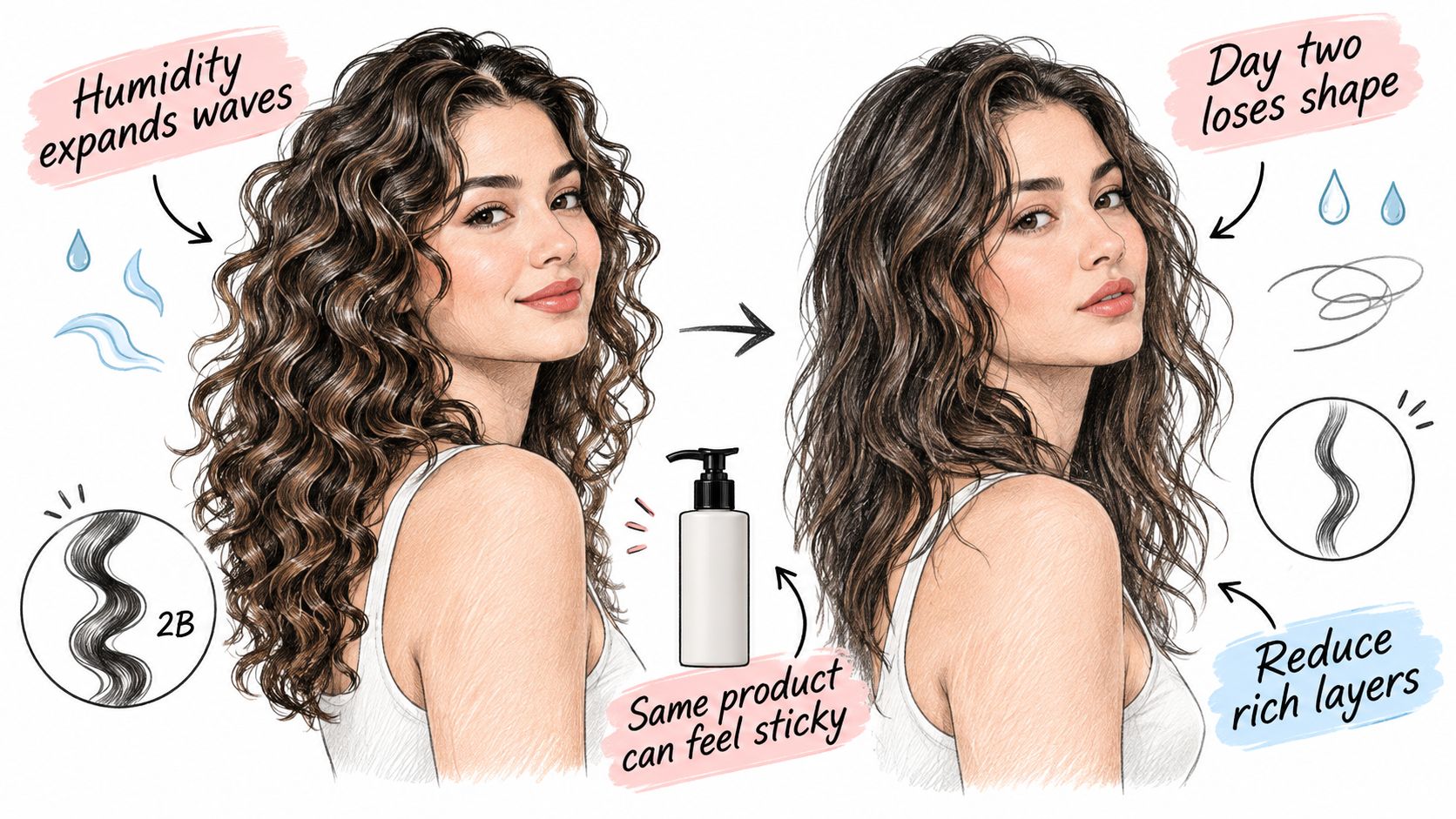
Refresh only what needs reshaping
Mist flattened sections until they're pliable, then scrunch gently. Let the existing product redistribute before deciding whether more is needed. If the hair becomes tacky, stop layering and reassess whether it needs cleansing instead.
A light gel application can help a section that has clearly lost hold. Spread it between wet palms rather than placing a concentrated blob onto a dry patch. Diffuse the damp areas with controlled airflow, leaving sections that still look good alone.
Ingredient behavior also depends on the complete formula. Use our guide to humectants for curly hair to understand moisture-related ingredients without assuming that removing a single ingredient will solve every humid-weather problem.
Record whether the day was humid or dry alongside your result. Compare the same product under similar conditions before deciding it has stopped working. Keep an adjustment only when the improvement repeats, rather than rewriting your routine after an unusually wet afternoon.
Test Your 2B Routine Over Three Wash Days
Choose a single change for your next wash and write down the result before buying anything else. A lighter leave-in application, different cleanser or gentler drying method gives you a specific question to answer.
Use a three-wash comparison as a practical personal experiment, not a scientific threshold. Keep the rest of the routine as consistent as possible so you can connect the result to the change you made.
Build a comparison you can use
- Establish a baseline: Follow your usual routine and record the amounts and techniques.
- Test the adjustment: Change the chosen variable while keeping product placement, styling and weather reasonably comparable.
- Repeat before deciding: Repeat the adjusted routine to see whether the improvement holds rather than moving immediately to another experiment.
Don't switch cleanser, halve your conditioner and add mousse in the same wash. Even if the result looks better, you won't know which change helped or which step you could remove.
Keep a dated note with root volume, wave clumping, frizz, scalp comfort, softness and refresh performance. Add a short weather note and photograph your hair from a consistent angle if that helps you compare. A line such as “comfortable scalp, lifted roots, rough ends, humid afternoon” gives you more direction than “bad hair day.”
Keep results, not intentions
Retain a change when the improvement repeats without creating a new problem. Better definition isn't a complete success if your scalp becomes itchy or your lengths feel brittle. If results conflict, return to the baseline and test again under more comparable conditions.
Our onboarding hair quiz takes about two minutes and asks thirteen questions covering curl pattern, porosity, density, scalp, chemical history, drying habits and goals. We reshape the routine around what you really did, not what you intended to do, because skipped conditioning and an unexpectedly hot drying session belong in the explanation too.
The useful outcome isn't a longer routine. It's knowing which action to take when your scalp needs cleansing, your ends need conditioning or your waves need hold.
Coil builds an adaptable routine around your wave pattern, porosity, density and scalp, with check-ins and a photo timeline to help you compare results. Visit Coil to build your starting plan, then use your next wash days to find the cleansing, conditioning and styling choices your 2B hair responds to.