
2A Wavy Hair Routine for Soft, Light Waves
Build a 2A wavy hair routine for wash day and no-product refresh days, with scalp-based wash timing and fixes for limp waves and humidity.
Stop treating limp 2A waves as dry hair in need of more moisture. That single piece of popular advice, borrowed from routines for tighter and thicker curls, is why so many fine waves look worse an hour after styling than they did soaking wet. A working 2A wavy hair routine does almost the opposite. You cleanse the scalp when it needs cleansing, you condition only the lengths that need slip, and you keep the styling load so small it can feel wrong at first. If your wave is loose, straight at the root and barely bent at the ends, weight is your main enemy, not a lack of cream.
When Fine 2A Hair Actually Needs a Wash
Fine 2A roots can look oily while the ends still feel dry. Set your wash frequency by your scalp's signals, not by a fixed calendar: shampoo when roots feel oily, sweaty, itchy, or coated with product. Keep length care separate. Apply conditioner from the mid-lengths to the ends, and rinse it well so it does not weigh down the roots.
Wash Timing by What the Hair Is Doing
| What you notice | Likely cause | Wash move | Length move |
|---|---|---|---|
| Greasy roots by day two or three | Sebum on a fine scalp | Shampoo when roots look oily, even if that is frequent | Conditioner only on mid-lengths and ends |
| Itch, flakes, or a sweaty scalp | Scalp needs cleansing, not more oil | Wash sooner; see a dermatologist if it persists | Don't coat the roots with leave-in |
| Limp waves after several product days | Styler or conditioner buildup | One clarifying wash, then return to a gentle cleanser | Pause oils and rich creams |
| Dry, rough ends with clean roots | Lengths need slip, scalp doesn't | Keep the scalp schedule | Light conditioner on ends at every wash |
| Workout or very humid commute | Sweat and moisture at the scalp | Rinse or shampoo the scalp that day | Refresh ends with water only if they feel dry |
| Fine or low-density hair going flat by noon | Too much product weight | Don't add washes to fix weight | Cut styler amount before adding moisture |
Daily washing is not automatically damaging, and weekly washing is not a goal to meet. If your scalp gets oily quickly, shampoo when it signals that it needs cleansing. If frequent washing leaves the lengths rough, keep shampoo focused on the scalp and condition only the ends.
Oil Is Not the Same as Buildup
Scalp oil starts at the roots, darkening or separating the hair near your part. Buildup tends to leave lengths coated and waves dull or stringy. If misting and scrunching does not help, or conditioner makes the hair heavier, adding moisture is unlikely to solve the problem.
Practical rule: Oil shows at the root; buildup coats the lengths. Shampoo the scalp when it is oily, and clarify when the lengths feel coated.
A clarifying wash is a reset for persistent product buildup, not a fixed weekly step. Return to your regular cleanser afterward. If you clarify repeatedly, fine lengths can feel rough, tempting you to add richer products that may leave them coated again. If oil returns quickly, check how thoroughly you cleanse the scalp and whether conditioner is reaching the roots. This guide to shampoo and oil control for easily weighed-down hair explains the root-level check.
For the next few washes, note greasiness, itch, root lift, and whether limpness improves after cleansing. If clean roots bring back lift, the issue was more likely residue or excess product weight than a need for heavier moisture.
The 2A Wash Day and Refresh Map
Run the row that matches your morning. If your scalp check says wash, run the full wash. If it doesn't, run only the refresh row at the bottom and stop there.
2A Wash Day and Refresh Map
| Moment | What to do | Product load | Success looks like |
|---|---|---|---|
| Scalp cleanse | Focus cleanser on the scalp, not the lengths | One wash; clarify only when buildup is suspected | Roots feel clean, not squeaky and stripped |
| Condition | Mid-lengths to ends only, then rinse well | Pea to nickel of a light conditioner | Lengths slip through fingers; roots aren't coated |
| Detangle | Wide-tooth comb or fingers while lubricated | No extra oil | Few snaps; no brushing dry hair |
| Style | Lightweight leave-in, mousse, or gel on soaking hair, then scrunch | Dime to nickel for shoulder-length fine hair | Soft cast or hold without a greasy film |
| Dry | Air-dry or diffuse on low; hands off once shaped | None | Waves set before they're touched |
| Non-wash refresh | Mist or dampen, scrunch, and stop | No new cream or oil | Root lift returns without flattening the wave |
The logic underneath is simple. Wet hair swells, and shampooing plus mechanical friction can increase surface damage. Conditioners reduce inter-fiber friction, improve combability and help limit frizz, which is why placement and rinsing matter more than buying a richer jar. A technical review of shampoo and conditioner effects on hair fibers supports that friction-first view. It also means sulfate-free labels and cool-water rinses are options, not requirements for a sound 2A wavy hair routine. Gentle handling does the documented work.
One Wash in Six Moves
1. Cleanse the scalp for about a minute. Wet your hair thoroughly first, so cleanser spreads without you scrubbing. Massage it into the scalp with your fingertips, not your nails, and let the rinse run over the lengths. The reason is friction. The lengths rarely hold the oil, so dragging cleanser through them adds roughness for no benefit. The common slip is piling the ends on top of your head and scrubbing everything together. On fine 2A hair that tangles fast and roughens the exact part of the strand that has to bend into a wave.
2. Condition from the ears down, then rinse until slippery, not filmed. Work a pea to nickel amount through the mid-lengths and ends and leave it in while you detangle. Conditioner near the root is the most reliable way to glue fine waves flat by noon. The slip test is easy. Your fingers should glide, but the hair shouldn't feel slimy or squeaky. If you can feel a coating after rinsing, rinse again. You can always add a tiny amount of styler later. You can't un-coat a root without rewashing.
3. Detangle only while the hair is lubricated. Use your fingers first, then a wide-tooth comb if you need it, starting at the ends. Lubricated hair lets the comb pass with less snapping, and you're forming the sections your waves will dry in. The slip is brushing dry 2A hair before the shower to save time. Dry brushing pulls the soft S-shape straight, separates the clumps into fluff, and you'll spend the rest of the wash trying to rebuild a pattern you just combed out.
4. Style on soaking-wet hair with less product than feels right. Smooth your styler over the surface, then scrunch upward in sections toward the scalp. Water is doing most of the work here. It helps fine strands clump together so the wave can form before gravity pulls it straight. The common slip is reaching for a rich curl cream or an oil because the hair looks undefined in the mirror. Wet 2A hair always looks flatter than it will dry. Heavy product applied at this moment is the main reason waves look stringy instead of soft.
Use these amounts as a ceiling, not a target:
- Shoulder-length and fine: a dime to nickel of lightweight leave-in, mousse or gel in total, not that amount of each
- Past the shoulders and thicker or denser: start at a nickel, add a pea-sized amount only to the section that won't clump
- Short or very low-density hair: start with a pea, because you can reactivate with water tomorrow but you can't remove weight without washing
Pick one styler to start. A light mousse tends to suit fine hair that needs lift. A light gel suits hair that forms a wave wet and loses it by lunch. A lightweight leave-in suits lengths that feel rough after rinsing. Layering all three on day one tells you nothing and usually costs you volume.
5. Dry with minimal handling. Air-dry if you have time, or diffuse on low heat and low speed, cupping the ends in the bowl and holding still rather than shaking the dryer around. Once you've scrunched the shape in, stop touching it. Wet, swollen hair is at its most fragile, and every squeeze to check whether it's dry breaks up clumps that haven't set yet. The slip is flipping your head, touching the roots, or re-scrunching halfway through because it looks flat while damp. It will look flat while damp. Leave it alone anyway.
If you use a towel at all, squeeze sections gently with a microfiber towel or an old cotton T-shirt. Don't rub. Rubbing lifts the hair surface and creates the halo people then blame on dryness.
6. Break any cast only when the hair is fully dry. A light gel or mousse may leave a soft cast, a slightly crisp feeling that holds the wave while it sets. Scrunch it out with dry, clean hands once there's no cool damp patch left, especially at the back. Breaking it early is a quiet cause of midday collapse. The wave feels done at the front, you scrunch, and the still-damp sections lose their shape before they've dried.
If your hair looks great soaking wet and disappointing an hour later, your first fix is less product or less touching. It isn't a richer cream.
The Check After the Wash
Do this before you add anything else. Can you see a bend at the ends. Are the roots loose rather than stuck to your scalp. Does the hair feel clean rather than filmed when you run a strand between your fingers. If all three answers are yes, you're done, even if the wave is subtle. Subtle is what 2A is. Chasing a tighter pattern with more product only makes it heavier.
If the wave didn't form, change one variable next wash. Product amount, cleanser frequency, or drying method. Pick one and hold the other two steady for several washes. Change all three at once and you'll never know which one mattered, which is how people end up with a shelf of half-used bottles and the same flat hair.
Light Styling for Days You Do Not Wash
Treat a non-wash day as a volume problem. Your styler from yesterday is usually still in the hair, so water can reactivate it without adding weight. The reflection in the mirror looks like dryness, but on fine 2A hair it's more often crushed shape and flat roots.
Start with the lightest possible refresh and only escalate if it fails.
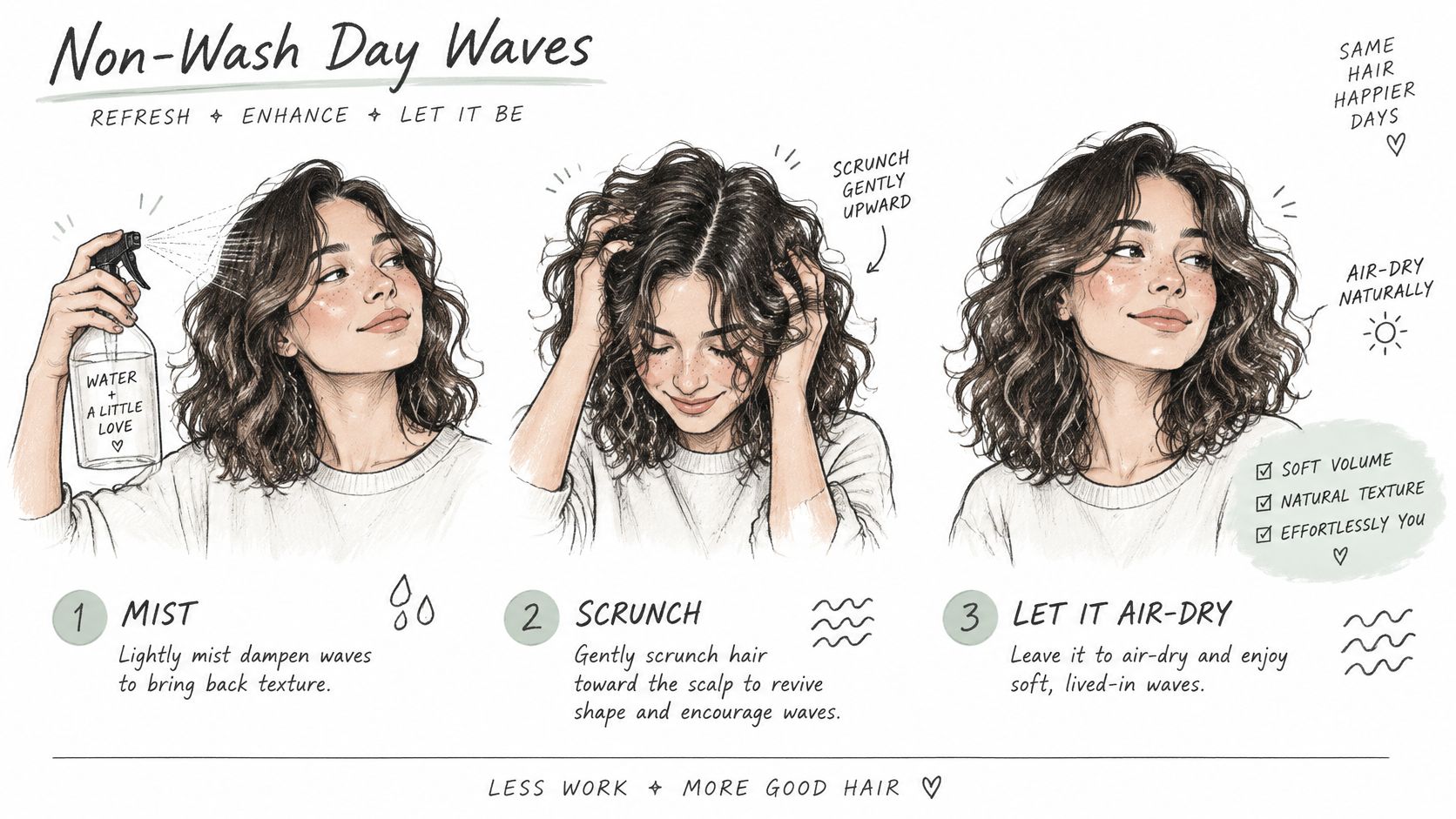
Mist until the hair is damp, not dripping, scrunch toward the scalp, and let it dry completely before you judge it. If yesterday's mousse or gel still has hold, don't layer a second styler on top. That restraint fits how wavy hair is maintained. In 2025, 33% of U.S. consumers with wavy hair used conditioner two to three times per week, according to YouGov Profiles data from November 2024 through November 2025. Conditioning belongs on wash days, not as a daily rescue layer.
Three Non-Wash Mornings
An office day needs about five minutes. Mist the mid-lengths and ends, scrunch, then lift the roots with your fingers or a root clip while the hair dries. Leave the ends alone if they're still shaped. Many tend to over-refresh the ends and under-lift the roots, which is backwards for 2A hair.
A gym morning isn't a refresh problem at all. If your scalp is sweaty, rinse or shampoo the scalp and let the water run over the lengths. Adding gel over sweat gives you flat, dull hair by midday. Water and a clean scalp will do more for the wave than any second layer.
A second-day evening out is the only one that may justify fresh product. Emulsify a pea of mousse with wet hands and scrunch it through damp hair. That's the ceiling. Choosing a light volumizing mousse for wavy hair matters here, because a cream at this stage sits on top of yesterday's styler and drags the wave down.
Watch how the scrunch and hands-off drying work in practice before you try to speed it up.
A minimal kit is one lightweight styler used on wash day, plus water in a spray bottle. A leave-in is optional, and it should be the first product you cut if your waves keep going limp. Oil on the mid-lengths undoes an S-pattern by separating clumps and adding shine that reads as grease on fine hair. A brush does the same thing faster. If you use dry shampoo, dust it lightly at the roots only, let it sit, then brush it out at the scalp without dragging the brush through the wave.
Sleep makes the next morning easier or harder. A loose silk or satin scarf, or a high loose pineapple with a soft scrunchie, keeps the wave from being crushed flat against the pillow. A tight bun creases the hair into odd angles you'll have to wet down to fix. End every refresh with the stop rule. If the hair looks better wet than it does an hour later, your next change is less product, not a richer one.
Limp Waves and Humidity Frizz Fixes
Your hair looks hydrated and defined indoors, then you step into muggy air and get a halo of frizz. That contradiction sends you shopping. Don't. Frizz on 2A hair isn't one problem, and the fix for weak hold will make product buildup worse.
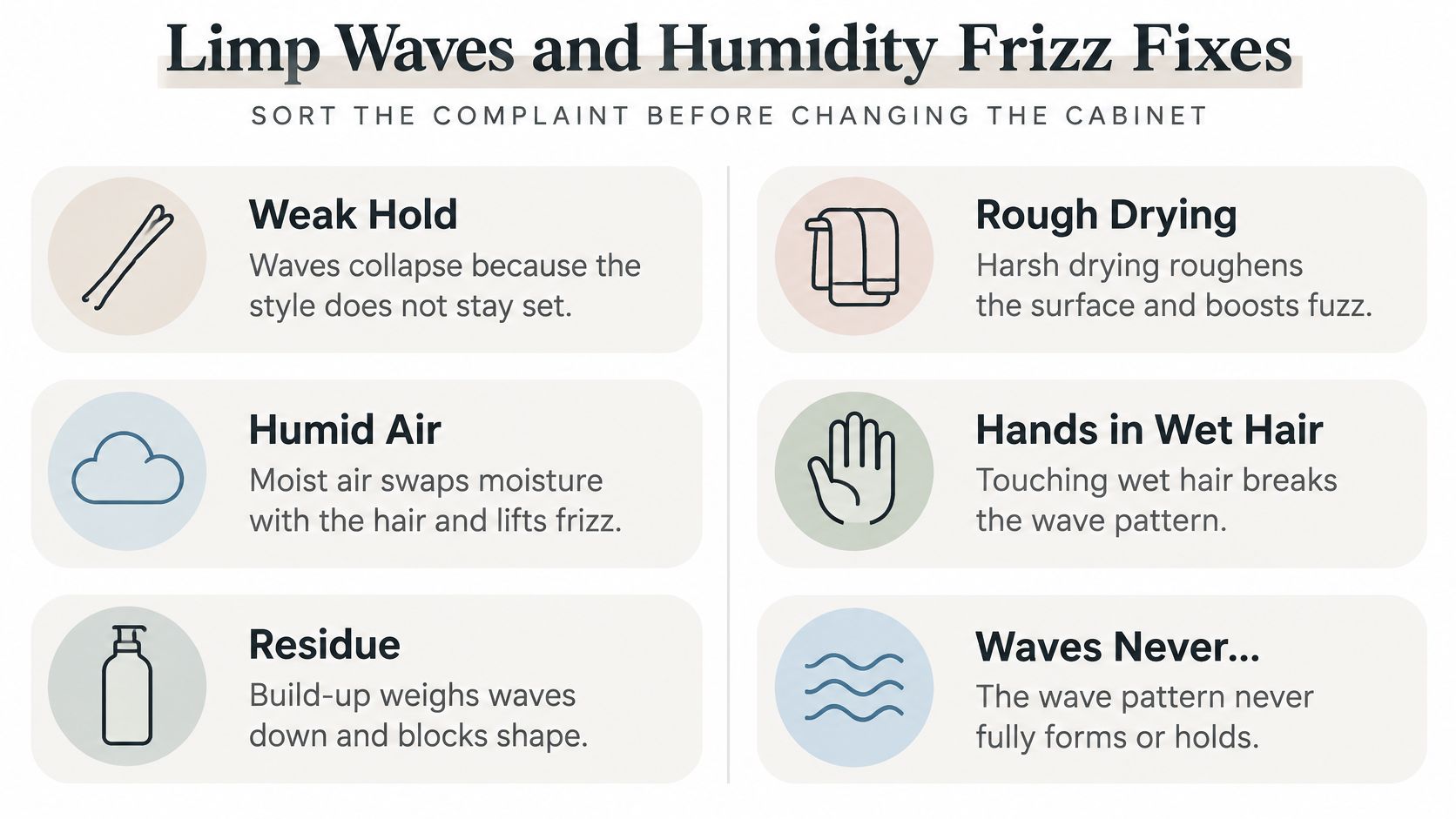
Visible frizz can come from insufficient hold, moisture exchange with humid air, residue, rough drying, hands in wet hair, or waves that never formed evenly. In recent discussions among people with fine 2A hair, humidity made waves more visible but also increased frizz, while heavy conditioners and oils weighed the pattern down. Banning glycerin or every humectant without a trial is too broad. You'd be avoiding ingredients without proving they caused your result. Reading up on humectants for curly hair helps, but your own log decides.
What Limp Waves and Frizz Usually Mean
| What you see | Test this cause first | One change for the next washes |
|---|---|---|
| Soft and full when wet, flat by afternoon | Product weight on fine waves | Halve leave-in, cream, or oil; keep the same dryer |
| Waves indoors, halo of frizz outdoors | Hold too weak for humid air | Add a light gel or mousse and dry fully before going out |
| Frizz only where hair was touched | Disturbance while swelling and wet | Hands off after the scrunch; same products |
| Dull, stringy lengths after several styled days | Residue rather than dryness | One clarifying wash, then the light routine |
| Greasy roots and rough ends together | Conditioner or oil too high on the head | Move conditioner below the ears; don't add scalp oil |
| No wave even when soaking wet | Pattern is looser or hair was brushed out | Scrunch soaking hair; skip brushes and heavy stylers |
Read the table as a sequence of single tests, not a shopping list. If your hair looks best soaking wet and collapses by noon, halve the styler for the next two washes before you switch brands. A lighter dose of a product you already own will tell you more than a new bottle will. If waves hold indoors and frizz outdoors, keep the same amount and change the ending instead. Dry the hair fully before you go out, because damp hair walking into humid air hasn't finished setting.
The greasy-roots-and-puffy-ends combination deserves its own note. That isn't a moisture imbalance you fix with a mask. It's product sitting in the wrong place, usually conditioner or leave-in applied too high. Move everything below the ears for two washes and see whether the roots lift on their own.
Humidity test: For two weeks, write down the weather, your product layers, and whether you diffused or air-dried. Patterns you can't see in the mirror show up fast on paper.
And if a clarifying wash brings the wave straight back, you've found your culprit. Buildup was blocking the pattern. Another rich mask will only rebuild it. Keep the light routine, clarify again only when the dull, stringy feeling returns, and resist turning the reset into a routine.
Change one thing per two or three washes. Cut your product in half and switch from air-drying to diffusing on the same day and you've learned nothing, because either change could explain the result. Stop tweaking when you reach this point: defined ends, a scalp that can get through a day without looking wet, and frizz that settles without cream. That's a finished routine for this hair type, even if the wave stays gentle.
Run the Next Three Washes as a Test
Lock your routine for the next three washes. No new products, no rebuilding the whole thing because Tuesday looked different from Monday. Pick your wash gap from your scalp signals, run the same six moves, and test exactly one variable.
Choose the variable your hair has been asking about loudest:
- Less styler: halve the amount if waves form wet and collapse by afternoon
- A sooner wash: shorten the gap if roots look oily or itchy before the ends feel dirty
- Hands-off drying: keep products identical and stop touching the hair until it's fully dry
After each dry-down, record four signals in a phone note. Root oiliness. Itch or flakes. Whether the ends formed a wave. Whether frizz appeared once the hair met outdoor air or humidity. A result only counts if it repeats across more than one wash, because weather and sleep can fake a win for a single day.
Then read the pattern plainly. If limpness improves after a cleaner scalp, your hair wanted less residue, not another mask. If the wave forms and then frizzes outdoors, your next experiment is hold and full drying, not a heavier leave-in. If nothing changes across three washes, that variable wasn't your problem, and you can drop it without regret.
This logging habit is the whole method. Coil builds a hair routine from your curl type, porosity, density and scalp, then re-shapes it around what you did, not what you intended to do, using a daily check-in where you tick off what you did, rate how your curls feel, and optionally add a selfie. You can do the same thing on paper. The format doesn't matter. The record does.
Two exceptions override the experiment. Persistent itch, shedding or scalp pain isn't a styling problem, and no cleanser swap will diagnose it. See a dermatologist rather than buying another product. The same goes for flaking that doesn't respond to regular washing.
Keep the change that wins across your three washes. Drop any step that only made the hair heavier. A 2A wavy hair routine that survives real life is short, light, and repeatable, and that's exactly why it works.
If you'd rather not run these three-wash tests from memory, Coil builds your routine from your curl type, porosity, density and scalp, then adjusts your wash gap, product amounts and drying steps based on what you did and how your waves responded. Log each wash in a quick daily check-in, rate how your hair feels, and let the plan sharpen until your fine 2A waves stay soft, lifted and defined without the guesswork.