Volumizing Mousse for Wavy Hair: Lift Without the Crunch
Learn how volumizing mousse for wavy hair lifts roots without weighing waves down, plus how to choose, apply, and adapt it for your porosity and climate.
Most advice on volumizing mousse for wavy hair gets the first half right and the second half wrong. The product can add lift, but piling on more mousse usually adds weight, not more air, and waves that were almost there can collapse under the extra load.
The better question is not whether mousse works. It's how little you can use and still keep the root lifted, the wave clumped, and the finish soft enough to move. That's the skill, because mousse acts through a thin polymer film, and once every strand is coated, extra product stops helping.
Volumizing mousse sits in a large, growing styling category, with one market estimate valuing the global premium hair-mousse segment at about USD 1.0723 billion in 2024 and projecting USD 2.1180 billion by 2033 (Grand View Research). Another estimate placed total hair-mousse revenue at USD 10.95075 billion in 2025, with volumizing mousse accounting for 42.6% of global revenue (Future Market Report). Those figures describe the wider mousse market, not wavy hair alone, but they do show that lift-focused mousse is a major styling use, not a side note.
Why More Mousse Rarely Means More Volume for Waves
Wavy hair has a narrow margin between lift and overload. Add a little mousse to the right zones, and the root gets enough structure to stand away from the scalp. Add too much, and the film-forming ingredients start acting like weight, especially on finer wave patterns.
The smallest useful dose wins
The logic is simple. Volumizing mousse works best when it gives each fiber just enough support to resist clumping, then disappears into the style instead of sitting on top of it. That's why the goal is a minimum effective dose, not a maximum shine-through amount.
Practical rule: if your waves look flatter after the second pump than after the first, the product amount is already past the point of helping.
This matters more for waves than for tighter curl patterns, because waves often lose shape as soon as the root gets dragged downward. A mousse can protect the structure, but only if the layer stays thin. Heavy application also raises the risk of stiffness, clumps, or buildup, which can make the hair look fuller in the hand and thinner on the head.
The right frame is dose first, product second. Once you think in those terms, the label stops being the main decision and the application pattern becomes the key variable.
How Volumizing Mousse Actually Lifts Wavy Hair
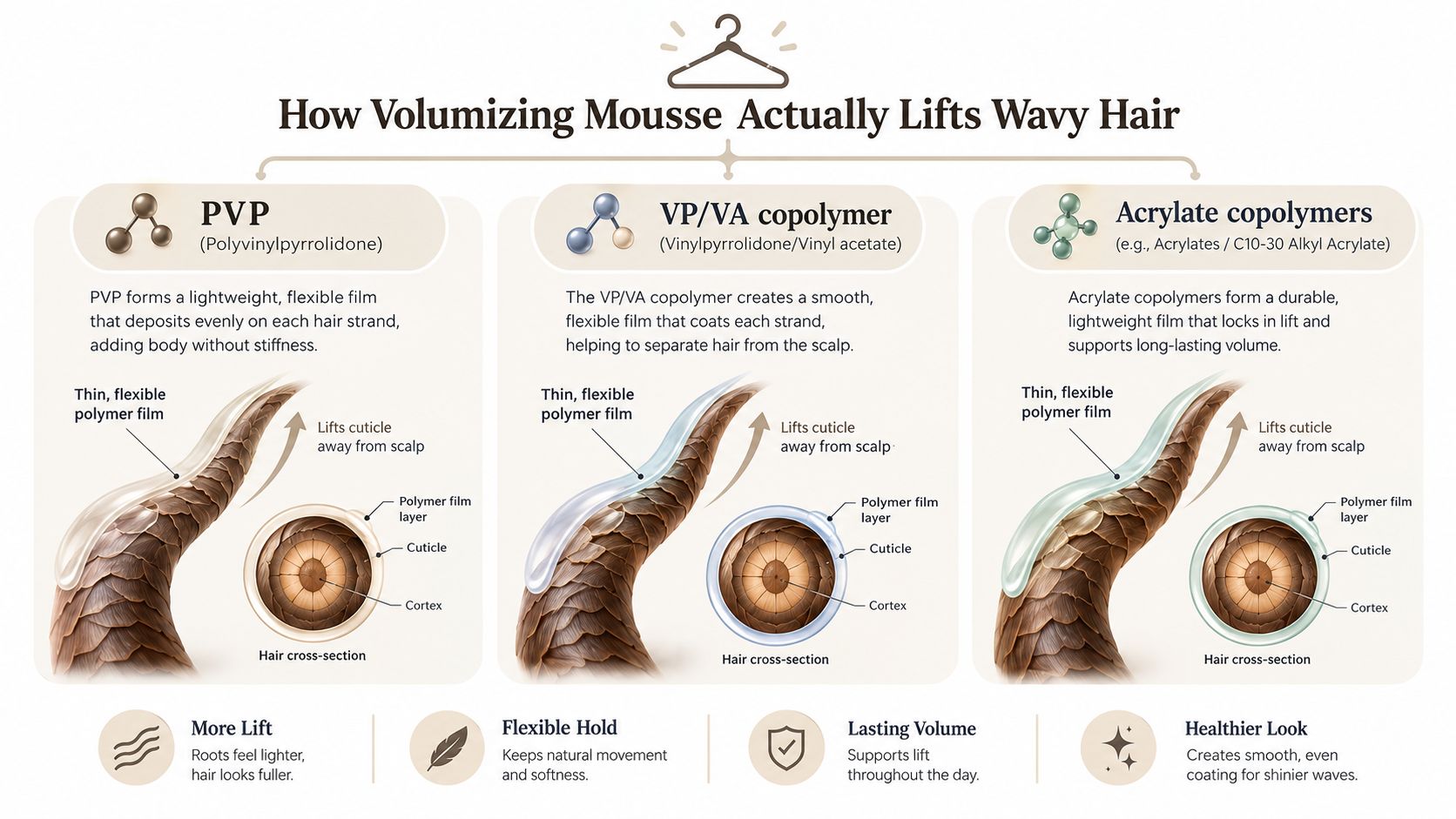
Think of a strand like a soft coat hanger. On its own, it bends easily and collapses toward whatever sits around it. Mousse changes that by leaving behind a light, springy film that helps the strand keep its shape after water leaves the hair.
The ingredients that do the lifting
The main hold comes from film-forming polymers such as PVP, VP/VA copolymer, acrylate copolymers, and polyquaterniums. These ingredients deposit a thin layer over the cuticle, and as water and volatile solvents evaporate, that layer stiffens just enough to increase fiber-to-fiber friction and prevent neighboring strands from lying flat against each other cosmeticscience.net formulation reference.
That's very different from oils, butters, or heavy creams. Those can feel nourishing, but they also add mass. A mousse built on lightweight fixatives gives the hair structure without asking the roots to carry much extra load.
Why it feels airy instead of sticky
The carrier phase matters too. Water and volatile solvents spread the product evenly, then flash off, leaving the film behind. That's why mousse can create lift while still feeling lighter than wax or pomade. The hold is there, but the bulk is not.
Use the product where the shape starts. For waves, that usually means the root zone first, then only enough through the lengths to support definition without pulling the pattern down.
The practical cue is feel. A good mousse should make the hair feel a bit more controlled, not coated. If your hands feel residue before the style sets, the formula or the amount is probably too heavy for your wave pattern.
Matching Mousse to Your Wave Type and Porosity
Wave pattern and porosity tell you how much support the hair can hold before it sags. A 2A wave usually needs a very light touch. A 2B wave often wants slightly more root support. A 2C wave can usually carry more product through the mid-lengths without collapsing as quickly.
Low porosity hair resists product entry and tends to overload fast, so it usually does better with a featherweight application focused near the roots. Medium porosity is the easiest middle ground, because most lightweight mousses spread and set predictably. High porosity absorbs styling product more readily, which can be helpful for hold, but it also means a formula with some conditioning support may feel better than a dry, ultra-firm one.
If you need a deeper refresher on how low-porosity hair behaves in general, this low porosity hair routine guide gives useful context.
A starting-dose framework
- 2A, low porosity: start with a very small amount at the roots only, then stop unless the crown still falls flat.
- 2B, medium porosity: begin with a light root-to-mid-length application, especially if density is moderate.
- 2C, higher porosity: use enough mousse to support the whole wave pattern, but keep the film light if softness matters.
The useful question is not, “How much mousse do people use?” It's, “How much does this specific head need before the root lifts and the lengths stop collapsing?” That answer changes with density too. Low-density waves usually need less product to look fuller, while dense waves can sometimes take a bit more spread through the interior without looking coated.
Choosing a Formula That Won't Weigh Your Waves Down
The label tells you a lot if you know what to scan for. One mousse might be built mainly for airy lift, another for softness, and a third for frizz control in difficult weather. Those are not interchangeable choices.
| Volumizing Mousse Archetypes for Wavy Hair | Key Ingredient Signals | Best-Fit Wave Profile | Main Trade-off |
|---|---|---|---|
| Lightweight volumizing | PVP, VP/VA copolymer, acrylate copolymers, minimal oils and butters | Fine, low-density, low- to medium-porosity waves | Can feel less cushioned on drier ends |
| Conditioning-hybrid | Light humectants, gentle conditioning agents, some proteins | Medium-density waves that need softness as well as lift | Can flatten fine roots if overapplied |
| Humidity-resistant | Stronger film-formers, anti-frizz support, firmer hold structure | Waves exposed to damp or sticky weather | May feel stiffer if the dose is too high |
The best formula for you depends on what your hair gives back. Fine waves usually need the cleanest, least cushioned option. Thicker or drier waves may prefer a hybrid, especially if the ends feel rough after drying. If humidity is the main problem, a stronger polymer system may be worth the trade-off.
For people who also deal with excess scalp oil, this oily hair care routine guide can help you separate scalp needs from styling needs, which matters more than many people expect.
The key is not to chase the lightest product in the aisle. A formula can be lightweight and still build up, or it can be slightly richer and still work well if the film stays flexible. Read the ingredient list as a balance of hold, softness, and dryness risk, not as a beauty slogan.
Applying Mousse Without Crushing the Wave Pattern
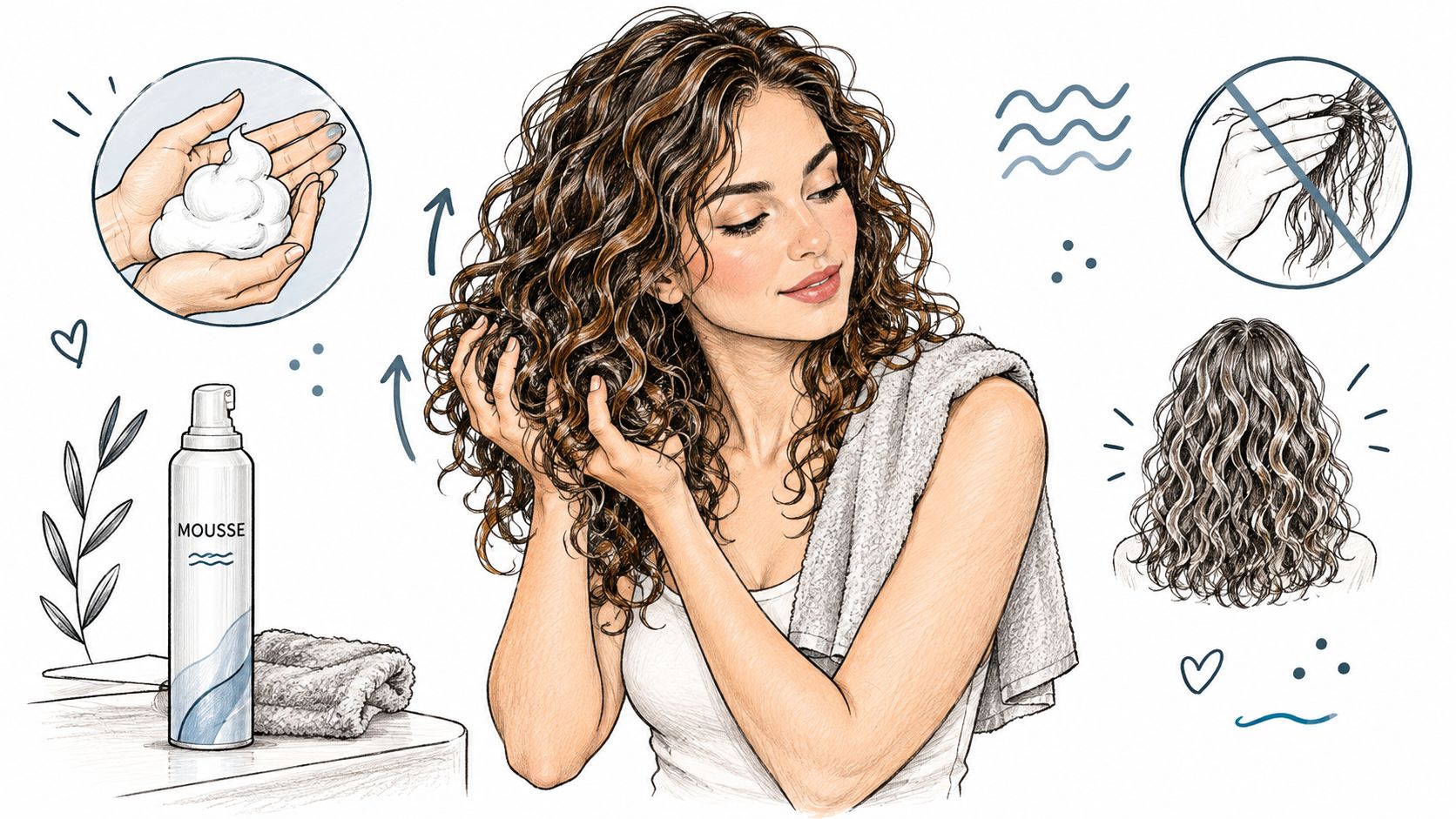
The best application starts before the product touches your hair. Waves should be damp, not dripping, because too much water dilutes the mousse and slows down how the film sets. If the hair is soaking, the polymer spends too long sliding around instead of gripping the strand.
Placement changes the result
Fine waves usually do best with mousse concentrated at the root and crown. Thicker or denser waves can take a little through the mid-lengths, but the length placement should still stay lighter than the roots. Raking aggressively through the hair can break up natural wave clumps, while scrunching keeps the pattern together.
Root lift comes from support at the base, not from saturating the ends.
Drying matters just as much as placement. Air-drying gives a softer finish. Diffusing on low heat, with the head tilted to lift the roots, can create more height if you keep your hands off the hair while the film is still setting. Touching the pattern too early often ruins the shape before it has time to lock in.
A quick video reference can help you see the motion before you try it yourself.
If the result is off
- Crunchy: use less product next wash day, or switch to a softer-hold formula.
- Limp: move the mousse higher at the roots and reduce how much water is in the hair at application.
- Frizzy: dry the roots fully and reduce manipulation before the film finishes setting.
The feel test is reliable. If the hair feels coated before it feels supported, the amount is too high. If it feels unchanged after drying, the amount is too low or the placement missed the root zone.
Humidity, Climate, and When Mousse Stops Working
Mousse can look perfect in a dry bathroom and fail by lunchtime in humid air. That isn't a mystery. Water vapor penetrates the styling film, softens it, and weakens the interactions that keep the strands aligned.
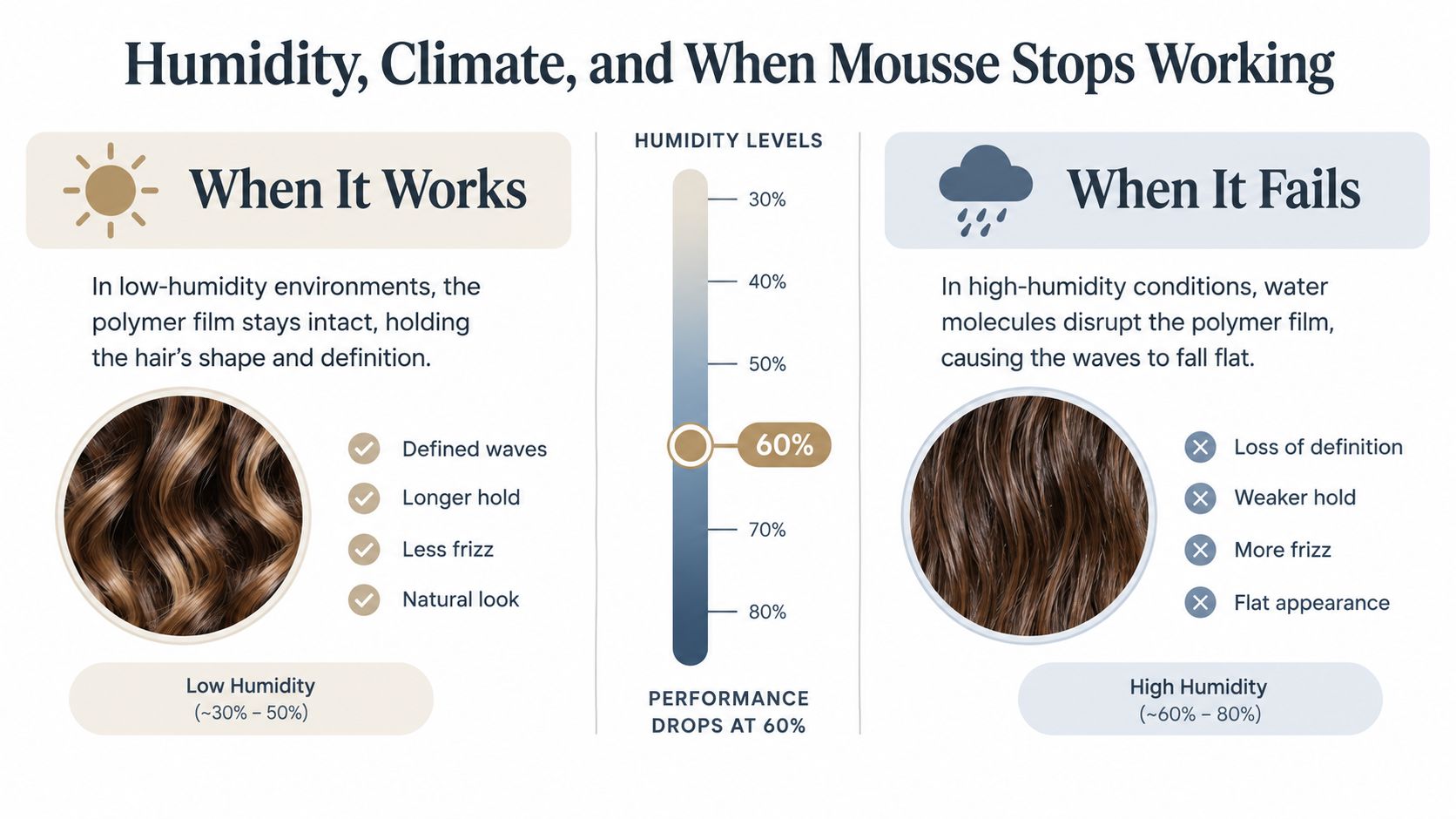
Controlled testing of styling-polymer films found that set failure began around 60% to 70% relative humidity for some treatments, with more deterioration as humidity approached 90%. A cassia-based treatment held out longer, beginning to fail closer to 80% relative humidity (PMC humidity study). That doesn't describe every mousse on the market, but it does show why climate changes the outcome.
Adjust the routine to the weather
In humid climates, lighter application usually works better than trying to overpower the air with more product. Dry the roots fully, because wet roots lose shape first when the air turns heavy. In dry climates, a bit more conditioning support may help the finish feel less brittle, especially if the ends are already thirsty.
The important distinction is between humidity resistance and everyday styling feel. A formula can hold well in damp air and still feel too stiff for a soft wave pattern. Another can feel pleasant in a dry room and then collapse outdoors. Both outcomes are possible because the polymer film is responding to moisture, not just to your technique.
The cleanest test is simple. Track whether the wave loses lift, gets frizzier, or just feels drier. Those are different failures, and they don't all call for the same fix.
Tracking What Actually Works on Your Waves
A useful routine gets better only when you change one thing at a time. A representative 2B wearer with medium porosity might start with too much mousse, then remove weight by cutting the amount, then shift the placement higher, then change the drying method, and only then settle on a formula that holds without flattening. The point isn't the exact outcome. It's the method.
What to record
Rate four things on wash day and again the next morning.
- Root lift
- Wave definition
- Softness
- Frizz
Then change just one variable. That could be dose, placement, drying method, or formula. When two variables change at once, it gets hard to tell whether the mousse itself helped or whether the result came from a better drying pattern.
Often, “more” reveals itself as the wrong fix. If reducing the dose improves lift, the original amount was too heavy. If moving the product closer to the root helps, the old placement was too low. If diffusing creates better shape than air-drying, the film needed more controlled setting time.
The useful habit is short and boring, which is why it works. Small experiments beat broad advice because your hair only has to answer one question at a time.
Your Volumizing Mousse Checklist for Next Wash Day
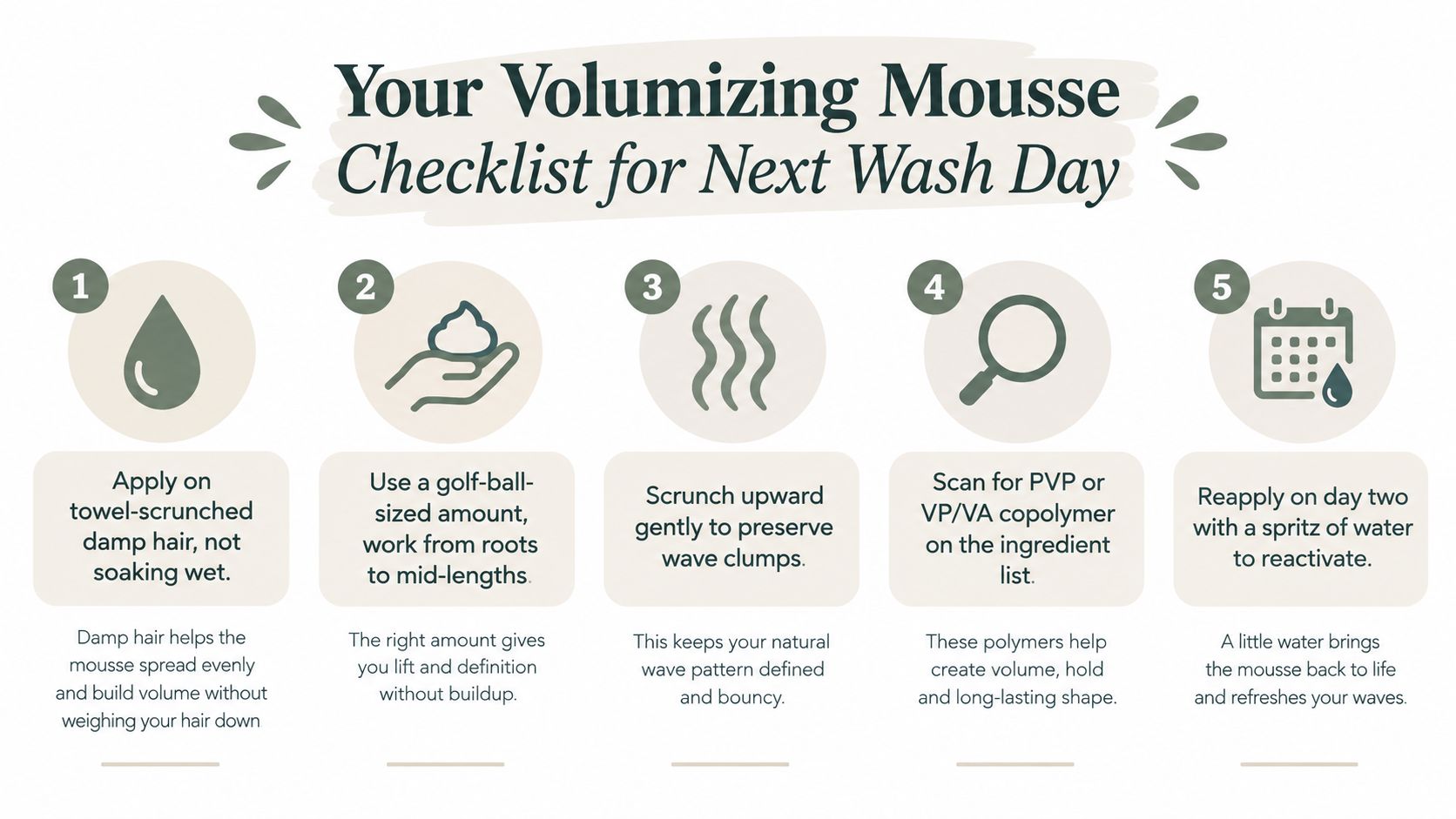
Use the minimum effective dose first, not the biggest one. Start on towel-scrunched damp hair, keep the product focused where lift matters most, and look for PVP or VP/VA copolymer if you want a classic film-forming hold.
- Apply on damp hair, not soaking wet.
- Use a small amount first, then add only if the root still falls flat.
- Scrunch upward gently to preserve wave clumps.
- Check the ingredient list for lightweight film-formers.
- Track what happens in humidity, not just in the bathroom.
The next wash day should answer one question, not ten. If the roots lift, the lengths stay soft, and the finish still moves, you've found the right dose for your pattern. If one of those pieces fails, change only one variable next time and keep the rest steady.
If you want a more structured way to test mousse against your own wave pattern, porosity, and density, visit Coil. It helps you track what your hair does after each wash day, so you can stop guessing and start refining the routine that gives you lift without the crunch.