Hydrolyzed Rice Protein Hair: Benefits and Limits
Hydrolyzed rice protein hair benefits and drawbacks explained, plus a simple test to see if it suits your curl type and porosity.
Does hydrolyzed rice protein strengthen curly hair, or does it only feel that way for a few days after wash day?
Most advice on the ingredient answers a different question. Protein gets sorted into good or bad, strengthening or drying, and that verdict is then applied to everything from a bowl of fermented rice water to a conditioner built by a cosmetic chemist. Those aren't the same material, they aren't the same molecular size, and they don't behave the same way on a curl.
This breakdown treats hydrolyzed rice protein hair care as what it is: a conditioning ingredient with a measurable molecular size, a documented safety record, and real limits on what it can do. Once you know the size and the format, you can stop guessing whether your curls "need protein" and start testing whether they like this one.
Benefits and Drawbacks by Hair Type
The short answer is that hydrolyzed rice protein is a conditioning ingredient. It smooths how the fiber feels, adds manageability, and leaves a thin film that can help curls clump. It doesn't rebuild broken bonds, change your curl pattern, or grow hair.
Whether that's useful to you depends on three things: porosity, strand thickness, and how much protein your current routine already delivers. A product that rescues bleached 4C hair can flatten fine 2B waves in the same week.
| Hair need | Likely benefit | Likely drawback | Practical approach |
|---|---|---|---|
| Fine, low-porosity curls | Light body and smoother feel | Stiff or limp curls with heavy use | Use occasionally, not every wash |
| High-porosity, dry curls | Conditioning and less frizz from a thin film | Protein overload if no moisture follows | Pair with a moisturizing conditioner |
| Coily hair (4A–4C) prone to breakage | Smoother feel and easier detangling | Brittleness if protein builds up | Trial one product at a time |
| Wavy hair (2A–2C) | Softer texture and easier styling | Heaviness on fine strands | Choose a lightweight rinse-off format |
| Chemically treated or bleached hair | Temporary smoothing of rough areas | Rough, rigid feel from overload | Check feel weekly before repeating |
| Scalp-sensitive users | Generally well tolerated in ingredient safety data | Individual reactions still possible | Patch-test first and see a dermatologist if problems persist |
Read the drawback column and a pattern shows up. Almost none of these problems come from the protein being "wrong" for hair. They come from too much of it, in a format that stays on the strand, with too little moisture following it.
Scalp-sensitive readers deserve a separate note. Ingredient-level reviews treat rice-derived proteins as well tolerated, while a finished formula still carries surfactants, preservatives and fragrance that a reactive scalp can object to (Cosmetic Ingredient Review assessment summary). Patch-test behind an ear before committing to a full wash day.
The rule the table implies: start with the lightest format you can buy, change one variable at a time, and let your hair's response over several washes decide whether the product stays.
If your strands sit flat, resist water, and take forever to get wet, you're probably on the low-porosity side, and a low-porosity hair routine will save you more money than any protein treatment will.
How Hydrolyzed Rice Protein Works on Curls
Think of a thin coat of varnish on a wooden table. It protects the surface, smooths scratches you can feel with a fingertip, and makes the grain catch light. It never turns the wood back into a tree. Hydrolyzed rice protein does the equivalent job on a hair strand.
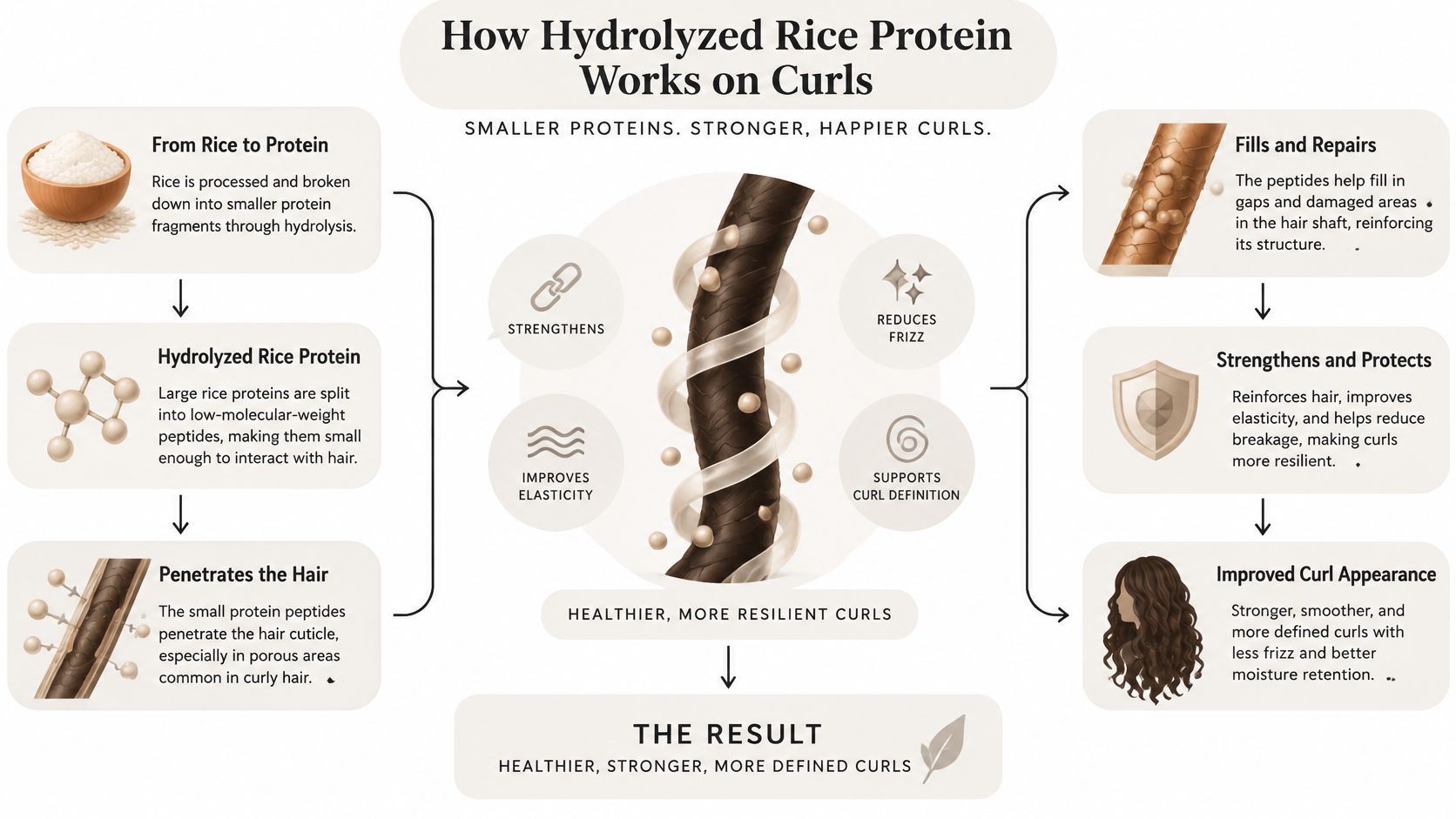
Hydrolysis is the step that makes it possible. Rice protein on its own is a large molecule. Enzymes or acid cut it into shorter peptide chains and free amino acid fragments, which are the forms that can settle onto and into the outer layers of the fiber instead of parking on the surface.
Why Molecular Size Decides the Result
Patent specifications for the ingredient describe fractions running from about 75 to 5,000 Da, with an average molecular weight around 1,500 to 2,500 Da (patent filing on rice protein hydrolysates). The small end of that range disperses easily in water and can deposit within and around lifted cuticle edges. The large end mostly builds a surface film.
Both fractions change how hair behaves. A deposited film lowers surface friction, which is why a protein conditioner makes strands easier to separate and detangle. It also nudges neighboring curls to sit together, which reads as clumping and definition.
Past a point, the same film works against you. Layer it wash after wash and the fiber stops flexing. Curls that were springy start feeling rigid, and highly porous hair can turn rough and dry instead of smooth.
The INCI name on a label won't tell you which size distribution you're getting. Supplier, hydrolysis method, charge and solids content all shift the behavior, and 2% in a lightweight leave-in doesn't perform like 5% in a rich buttercream. Cosmetic peptides don't recreate keratin, so treat the effect as surface conditioning that fades over a wash or two, not structural repair.
What the Evidence and Safety Record Support
The claims you'll meet are consistent: stronger strands, faster growth, more volume. What sits behind them is thinner than the marketing implies, and it helps to separate three piles: what reviews found, what suppliers measured, and what the safety file says.
What the Reviews Actually Found
Safety reviews of rice-derived cosmetic ingredients describe them as non-genotoxic and non-cytotoxic, meaning the tested materials did not damage genetic material or kill cells, and appropriate for cosmetic use. The core document is a Cosmetic Ingredient Review expert panel assessment that classified these uses as safe under the practices documented in 2006 (the safety assessment indexed on PubMed).
Notice what that file covers. It reviews rice bran extracts and other rice preparations, not hydrolyzed rice protein specifically, and the distinction carries weight because hydrolysis converts a large native protein into peptide-sized fragments. A safety conclusion also says nothing about performance. Whether a finished product improves definition or frizz depends on concentration, molecular size, charge, pH, preservatives, and whether the formula includes conditioning polymers or oils.
That adds up to a thin performance literature. No established percentage shows this ingredient improves definition, reduces frizz, or increases tensile strength across all wavy, curly and coily hair.
What the Supplier Benchmarks Do and Do Not Tell You
One supplier's published benchmark reports up to 32% more total hair volume, alongside a recommended use level of roughly 2 to 5%, a molecular weight below about 1,850 Da, and addition to the aqueous phase, or after emulsion formation and below 40°C for emulsions (supplier specification for hydrolyzed rice protein). The volume figure arrives with no test protocol, hair type, comparator or measurement method. Treat it as supplier performance data: useful for a formulator choosing a dose, weak as a promise about your own wash day.
The ingredient keeps spreading through formulas anyway. Mordor Intelligence projects a 7.70% CAGR globally from 2026 to 2031 for rice protein (Mordor Intelligence global rice protein market report), a projection about supply and demand rather than evidence of what the peptide does to a curl.
How Format Changes the Protein Load
Format decides how much of that 2 to 5% dose stays on your hair.
| Product format | Typical use level | Protein load | Notes |
|---|---|---|---|
| Rinse-off conditioner | 2 to 5% | Moderate, mostly rinsed away | Good starting format |
| Leave-in or styling cream | 2 to 5% | Higher, stays on the strand | Use less often on fine hair |
| Emulsion-based product | 2 to 5%, added below 40°C | Depends on the base formula | Added after the emulsion forms |
| DIY rice water rinse | No standard dose | Uncontrolled | Not a hydrolyzed protein product |
A rinse-off conditioner leaves a fraction behind after rinsing. A leave-in leaves everything you applied. Porosity steers the outcome too, since lifted cuticles on high-porosity strands give the deposited film more places to cling, so the same leave-in load sits heavier there than on low-porosity hair. That single difference explains why one person's soft, clumped wash day is another person's crunchy week three.
The safety file stops at the ingredient as well. The panel reviewed hydrolyzed rice protein, not the preservative system or fragrance in the formula you bought, and individual reactions are still possible. Judge the product by what your hair does across repeated washes.
Read the Label and Tell It Apart From Rice Water
Everything above collapses into one line on the back of the bottle, and that line is where most buying mistakes happen.
Look for Hydrolyzed Rice Protein spelled out exactly. "Rice protein" without the hydrolyzed qualifier may be an intact protein. Hydrolyzed Rice Bran Protein is a separate ingredient with its own listing. Rice water, fermented rice water and Oryza sativa aqua describe a liquid with no standard dose, and coverage of rice water rinses reports possible dryness and surface flaking while noting that growth evidence is mixed (Kitsch's comparison of rice water and hydrolyzed protein science).
Run this check before you test:
- Find the exact name on the ingredient list, not the marketing panel.
- Note its position, because ingredients are listed in descending order of concentration. Near the top means a real dose, near the bottom means a trace.
- Count the other proteins such as wheat, silk or keratin in the same formula. Stacking them raises the total load.
- Match the format to your porosity result: rinse-off for cautious testing, leave-in only once you know your hair tolerates the film.
That sequence keeps the decision tied to your hair rather than to the word "rice" on the front of the tub.
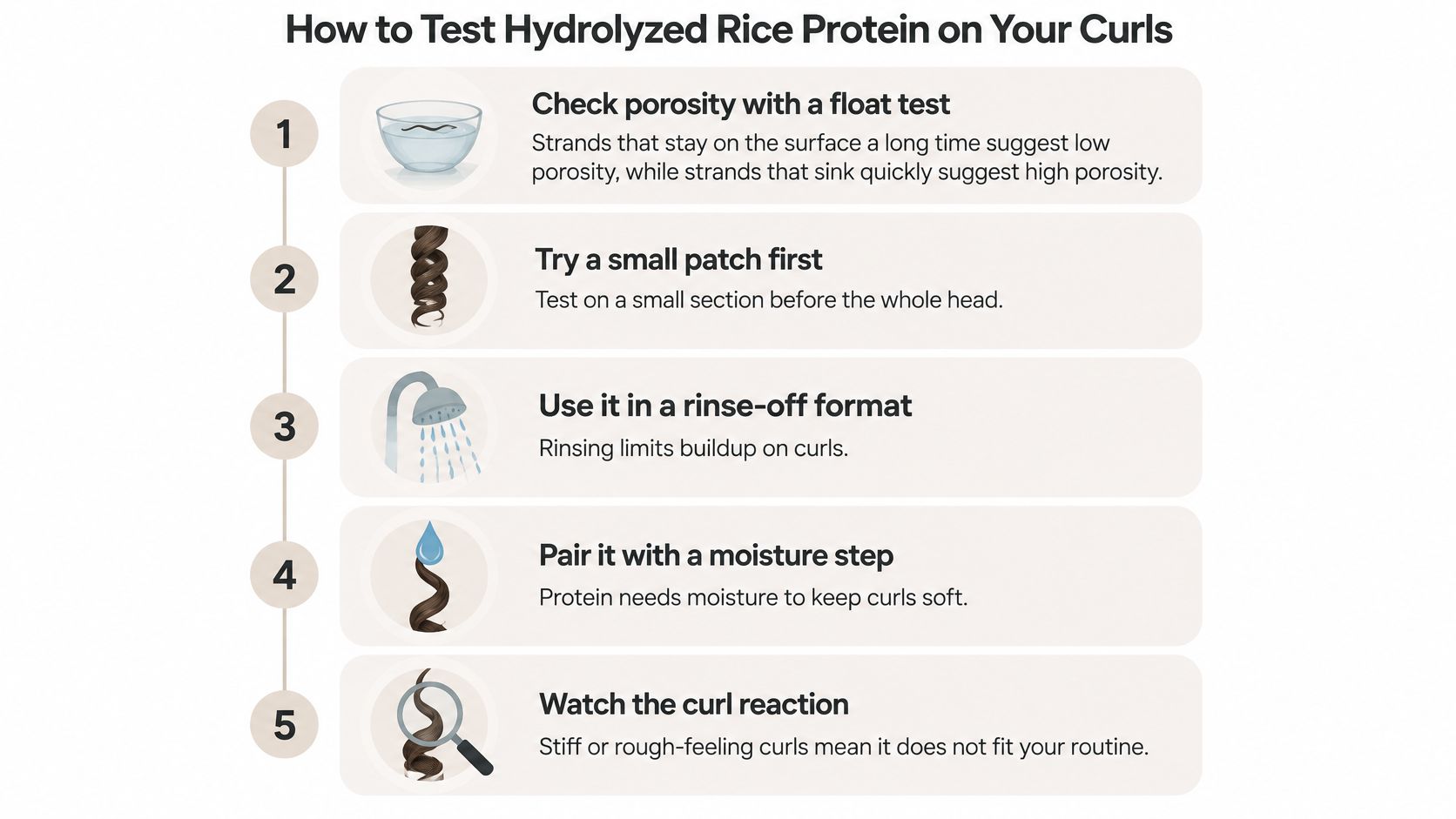
How to Test Hydrolyzed Rice Protein on Your Curls
One product, three weeks, one variable changed. That's the whole method, and it beats any universal weekly schedule.
- Check porosity with a float test. Drop a clean shed strand into a glass of water. Strands that float near the surface for a long time suggest low porosity; strands that sink quickly suggest high porosity. This sets your starting cadence.
- Record a baseline for two wash days. Rate definition, frizz and moisture from 1 to 5, and take a photo in the same light both times. Without a baseline you'll be judging week three against a vague memory.
- Add one product containing the ingredient on one wash day each week, and patch-test it on a small section first. Testing a section protects the whole head if your hair dislikes the film.
- Keep every other step identical for three weeks, same shampoo, same leave-in, same drying method. Change two things and you won't know which one moved the result.
- Compare at week three. You're looking for better definition and less frizz without stiffness, crunch or a rough feel once dry.
- Adjust the cadence, not the whole routine. Stiffness means every other wash or every two weeks. Softer curls that hold their pattern mean keep the rhythm.
Say a 3B wearer with low porosity tries a weekly rinse-off treatment and finds her curls rigid by the second wash. Moving the same product to biweekly often relaxes them by the next check, because the film stops accumulating faster than it sheds.
What Belongs in the Log
Keep it in a notes app with four fields per wash day: date, product, the three ratings, and the photo. A curl tracking app that records definition, frizz and moisture over time does the same job with less discipline required, since the entries stack into a trend instead of a folder of selfies. Coil builds a routine from your curl type, porosity, density and scalp, then reshapes it as check-ins come in.
Protein Overload Signs and Fixes
The most common problem with protein conditioners on curly hair isn't allergy or damage. It's build-up, and it gets misread as dryness, so people add more conditioner and wonder why nothing changes.
The film keeps accumulating faster than washing removes it. Curls stiffen, lose their bounce, snap when you stretch a strand, and feel rough once dry. That cluster isn't a moisture deficit on its own, and treating it with heavier butters usually makes the feel worse before it gets better.
| Symptom | Likely cause | Fix |
|---|---|---|
| Stiff, rigid curls | A built-up film across several washes | Clarifying wash, then a moisture-focused conditioner |
| Brittle strands that snap | Protein used too often | Two to four weeks with no protein at all |
| Limp curls with lost bounce | A formula too heavy for your strands | A lighter rinse-off option |
| Rough, dry feel after drying | Protein applied without enough moisture | Add a moisturizing step right after the protein |
| Frizz returning despite conditioning | High porosity losing moisture between washes | A humectant-based conditioner after the protein step |
Practical rule: the fix is almost always to lighten or pause the protein, not to abandon conditioning altogether.
Read the table top to bottom and you'll see that four of the five fixes involve changing frequency or format rather than throwing the product out. Keep the bottle, change the schedule, and note what your hair does over the next two wash days.
Decide Whether Hydrolyzed Rice Protein Belongs in Your Routine
The evidence and the mechanics add up to this, sorted by situation.
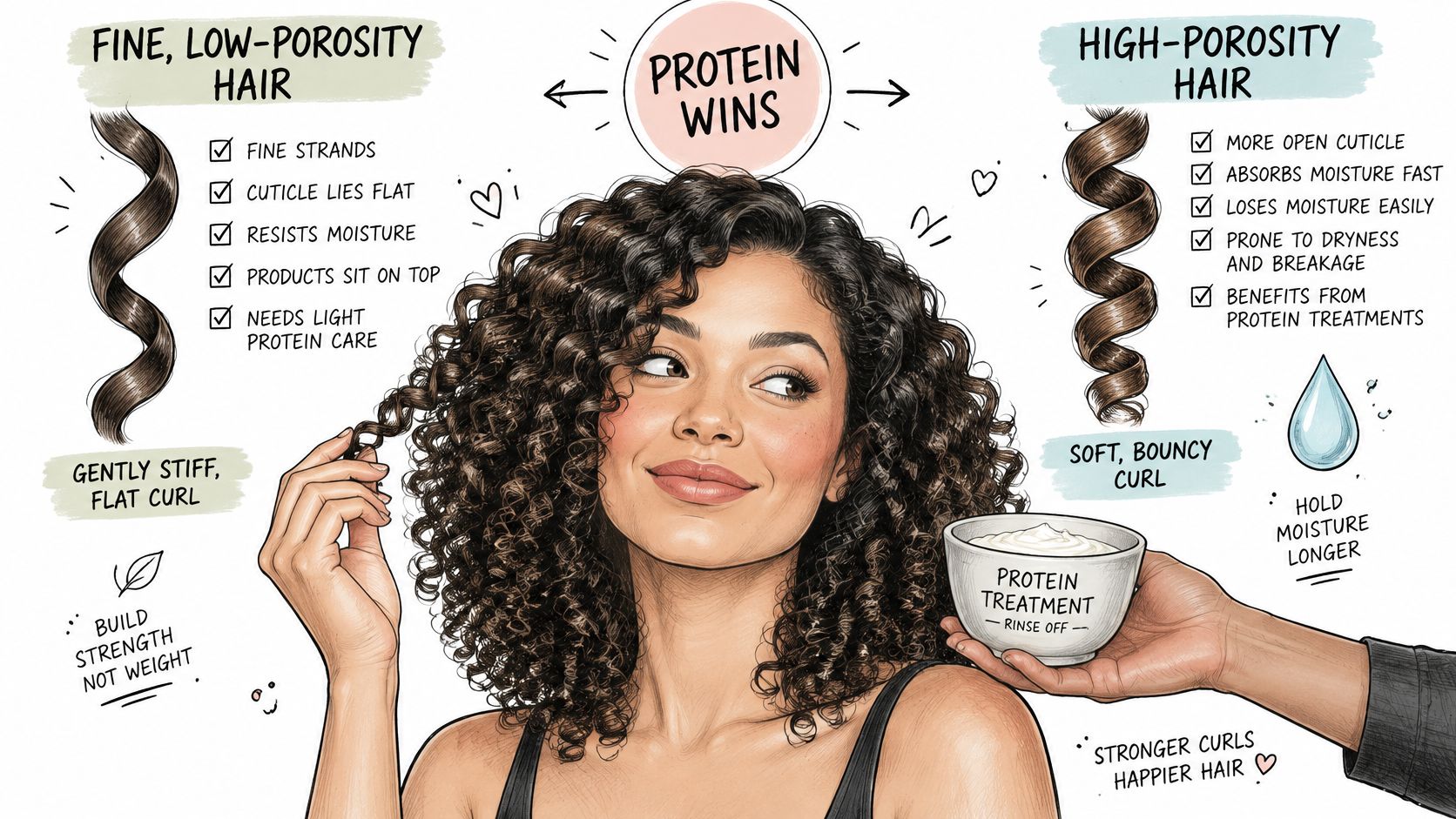
It fits high-porosity or dry curls that already tolerate protein, used in a rinse-off format and followed by a moisturizing conditioner. It fits cautiously on fine, low-porosity or easily stiffened curls, which do better with occasional use and a lightweight formula. It doesn't fit the job of growth or structural repair, so persistent scalp problems, sudden shedding or patchy loss belong with a dermatologist rather than a conditioner.
Three checks decide it, each in one line:
- Porosity first. Float test before purchase, not after.
- Three weeks, one variable. One product, everything else unchanged.
- An honest log. Feel and definition recorded, not remembered.
Hair advice here is general information and not medical advice, and persistent scalp or hair-loss problems should be checked by a dermatologist.
Coil's product scores show build-up risk, protein load and whether a product will weigh curls down, and the curl score lines up against your products and habits so the routine gets sharper as the log fills. That's a tool alongside your own notes, not a replacement for them.
One step this week: run the float test, then buy a single rinse-off product that lists Hydrolyzed Rice Protein by name. Give it three wash days, three ratings and three photos before you decide anything.
If you'd rather test with a record than a hunch, Coil builds a routine from your curl type, porosity, density and scalp, then reshapes it as your check-ins come in. Photograph the label of the product you're about to trial and you'll know what you're working with before wash day, not three weeks after it. Visit Coil to set up the float test, log each wash day and see whether hydrolyzed rice protein earns a permanent place in your routine.