3C Hair Routine: Wash, Moisture and Drying Steps
Build a 3C hair routine that keeps curls moisturized and defined. Schedule, wash steps, detangling and scalp fixes explained.
You washed on Sunday. By Tuesday the ends feel like straw, the roots have started to itch, and the clumps that formed so easily in the shower have broken into separate, frizzy strands. So you do what many do. You either wash again and dry the ends out further, or you wait it out and scratch.
Neither move is wrong, but both are guesses. A 3C hair routine gets hard for a reason that has nothing to do with the quality of your products. Your scalp and your lengths are running on two different clocks, and almost every routine treats them as one. What follows splits them apart, gives you a week you can start tomorrow, and shows you exactly where to adjust when your own curls disagree with the plan.
Your 3C Routine at a Glance
Seven stages, ordered by how often you touch them. Everything here is a default you can run this week.
| Stage | How often | What to use | Watch for |
|---|---|---|---|
| Scalp cleanse | Every 1-2 weeks, never longer than 2-3 weeks | Gentle shampoo applied to the scalp only | Itch, flaking or buildup at the roots |
| Length wash and condition | Every 5-7 days or when lengths feel dry | Moisturizing conditioner on lengths | Dry ends, tangles that will not release |
| Deep conditioning | Every 1-2 weeks | Moisturizing or balanced mask | Limp curls or a coated feel |
| Leave-in and cream | Every wash day | Water-based leave-in, then a cream or gel | Frizz by day two, weak clumping |
| Detangling | Every wash day, wet and conditioned only | Fingers or a wide-tooth comb | Snagging, shedding that spikes |
| Drying | Every wash day | Air dry or low-heat diffuse | Frizz, heat-related dryness |
| Night protection | Every night | Satin bonnet or pillowcase, loose puff | Frizz or flattened curls by morning |
Nothing in that table is fixed. A fine, low-density head that turns oily fast wants the short end of the scalp cleanse range. A coarse, high-density mane can stretch toward the far end without complaint. Product volume moves the schedule too. Layer a cream, a gel and an oil and you'll be clarifying sooner than someone using a single leave-in.
The idea that holds the whole routine together is separation. The scalp gets cleansed on its own clock, which is slower and driven by oil, flaking and buildup. The lengths get moisture on a faster clock, driven by how they feel when you touch them. Once you stop trying to solve both with one wash, the scheduling gets much easier.
What to Check After the First Wash
Give the default a full week before you change anything. On the day after wash day, curls should clump and soften without a crunch, and the scalp should stay quiet, no itch and no flake, until the next cleanse is due.
If both of those hold, the numbers are roughly right for you and you can spend your energy on technique instead of on shopping. If one fails, you now know which clock to reset. Treat the table as the default to beat, not a rule to obey.
Why 3C Hair Dries Out and Breaks
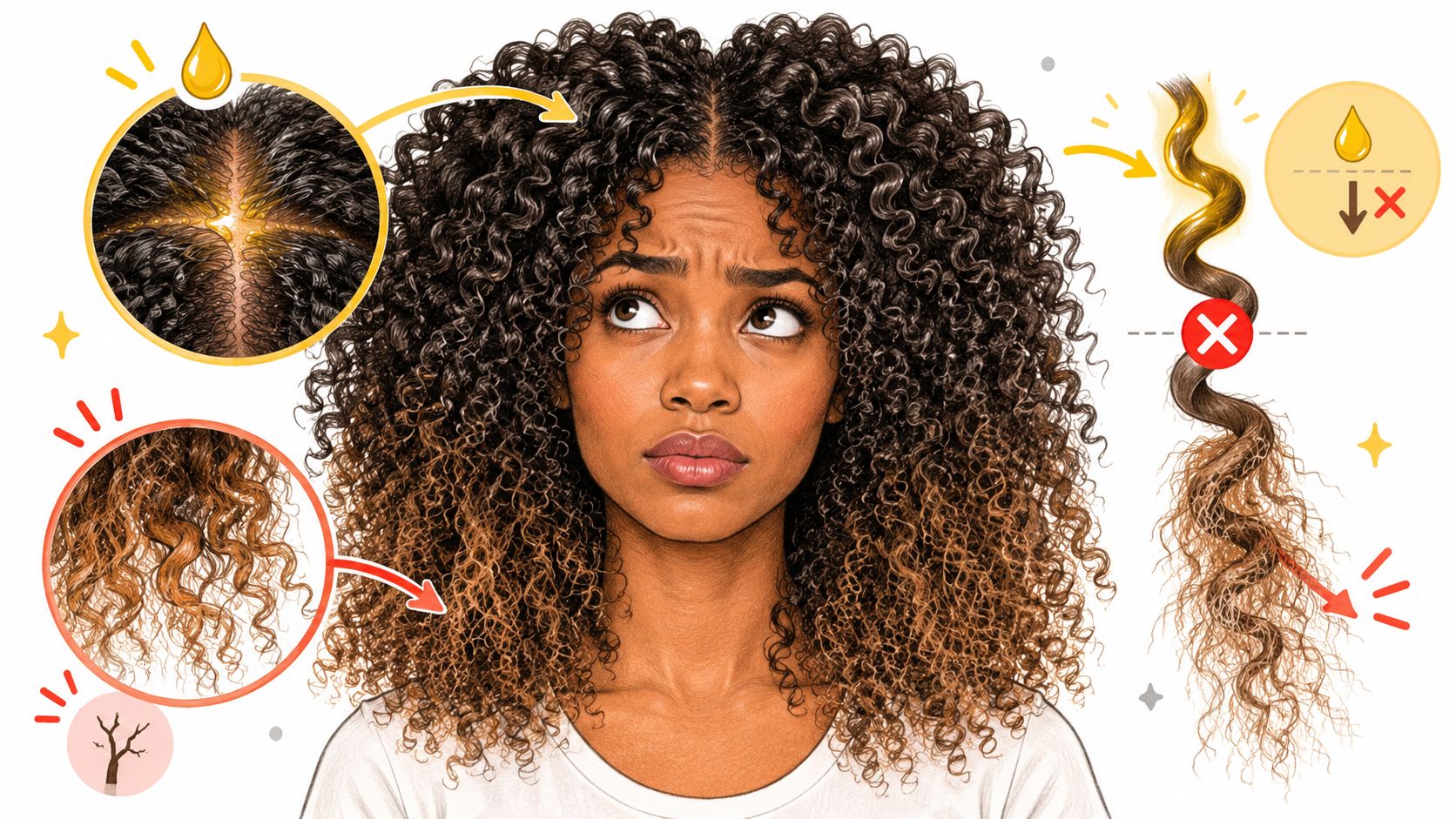
On wash day, your roots can feel oily while your ends still feel dry. That mismatch is common with 3C curls, whose tight corkscrew shape makes it harder for scalp oil to travel along the hair shaft.
Why the Ends Run Dry
3C is a subtype of curly hair, not a scientific diagnosis. The naming comes from the Andre Walker hair-typing system, which sorts hair into four categories and was presented in Walker's 1997 book Andre Talks Hair, as a review in the Journal of Cosmetic Dermatology recounts. In practice, 3C usually describes densely packed corkscrews around the diameter of a pencil, tighter than 3A and 3B. The letter subdivisions came later, and two people who identify as 3C can still have very different hair.
The bends in a curl make it harder for sebum to spread from root to tip. A review of curl-pattern fiber research describes this uneven distribution of natural oils and notes that highly curled hair can be drier, more brittle and more vulnerable to chemical and physical damage than straighter hair.
Dryness is only part of the picture. Harsh cleansing can leave lengths feeling drier, while rough detangling, high heat, tight styling and chemical straightening increase the risk of breakage. Chemical straightening can also contribute to dryness, so consider its effect on your hair before adding more processing.
The curl label alone cannot set your routine. Two people with 3C curls may need different care if one has porous ends after colouring and the other has dense, untreated hair. Porosity, density, chemical history and scalp condition all affect how the hair responds.
Keep two clocks in mind: cleanse the scalp according to its needs, and condition the lengths according to how dry they feel. Pay attention to moisture and friction when handling your curls, and limit heat exposure. Those factors help explain why the scalp and lengths may need different care.
How to Wash and Condition Step by Step
Wash day carries most of the routine's weight, and the order of operations matters more than the brand on the bottle. Here's the sequence to run, with the reason behind each move.
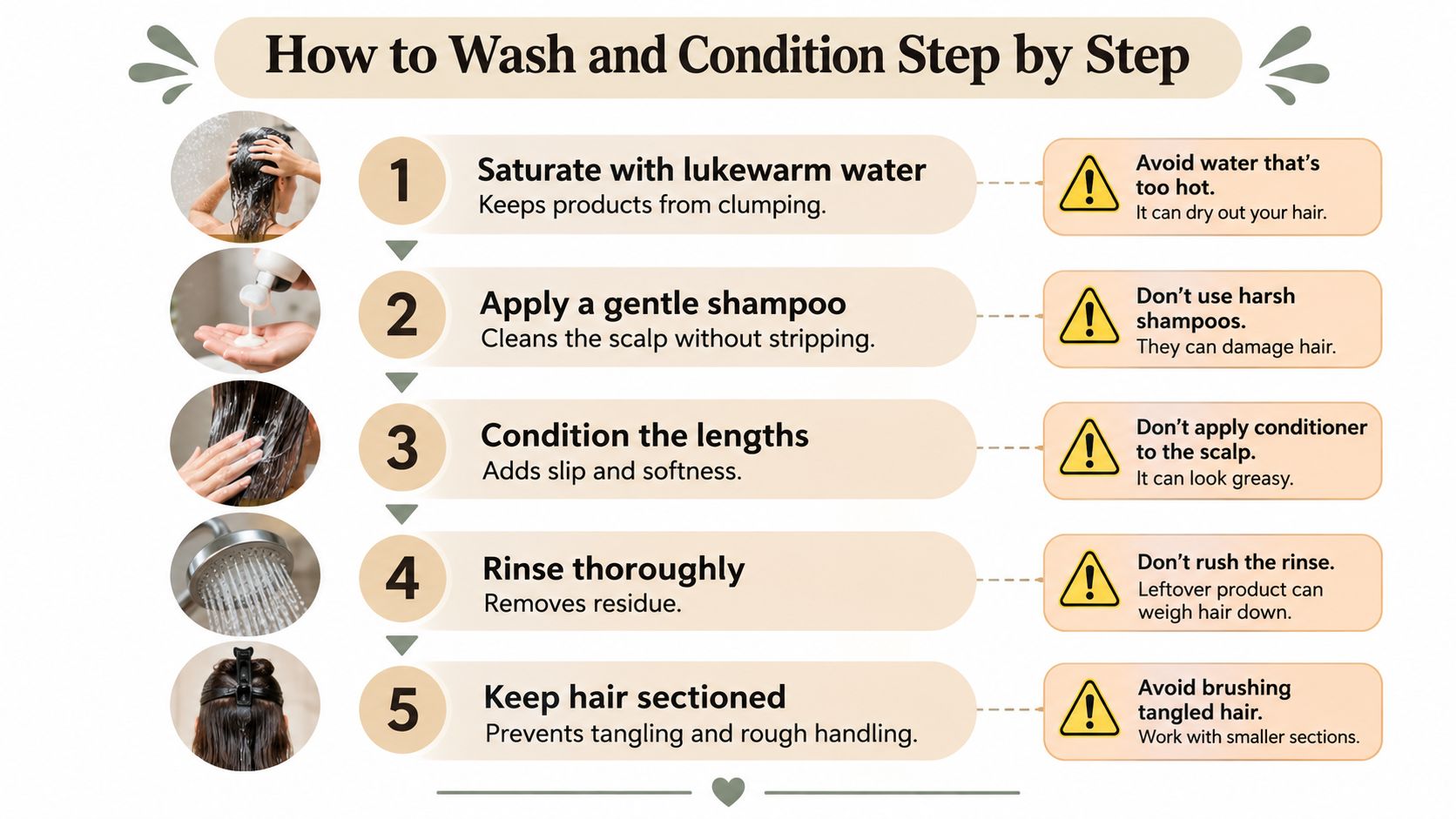
- Saturate with lukewarm water. Soak the hair until it stops absorbing. Product spreads evenly on saturated hair and clumps on hair that's only half wet. Hot water strips oil from a scalp that already struggles to keep it.
- Shampoo the scalp only, with fingertips. Work the shampoo into the scalp in small circles and let the suds run down the lengths on their own. Scrubbing the lengths tangles them and pulls moisture out of the part that needs it most.
- Rinse longer than feels necessary. Residue left behind is a leading cause of frizz and that dry, coated feeling at the ends. Rinse until the water runs clear and the hair feels slack rather than squeaky.
- Condition generously, section by section. Use more than you think, in four to six sections, and leave it for the time on the label, usually a few minutes. The common slip is a thin, apologetic application that gives you no slip at all when the comb arrives.
- Finish with a cool rinse and squeeze, don't rub. Cool water helps the cuticle lie flat. Press the water out with a microfibre towel or a cotton T-shirt, because terry cloth catches loops of curl and turns them into frizz.
- Apply a water-based leave-in while the hair is still wet. Work from mid-lengths down, skipping the roots. Oil is not a substitute here; what a leave-in conditioner actually does is add water and hold it, which oil can only seal, never supply.
- Layer a cream or gel on top, then scrunch. This is the step that sets the hold and the clump. Scrunch upward with damp hair, squeeze out the excess water, and leave the curls alone while they dry.
If you'd rather watch the sectioning and scrunching than read it, this walkthrough follows the same order.
What Wash Day Should Feel Like
Before you reach for a comb, run your fingers through one section. The hair should feel slippery and yielding, not coated or tacky, and sections should separate without a snag.
The test: if a section resists, you need more conditioner, not more force and not more product.
Detangling and Drying Without Breakage
A knot at the ends can turn a careful detangling session into a tug at the roots. Work on wet, conditioned hair, divide it into sections, and clear the ends before moving upward. The steps matter more than the tool.
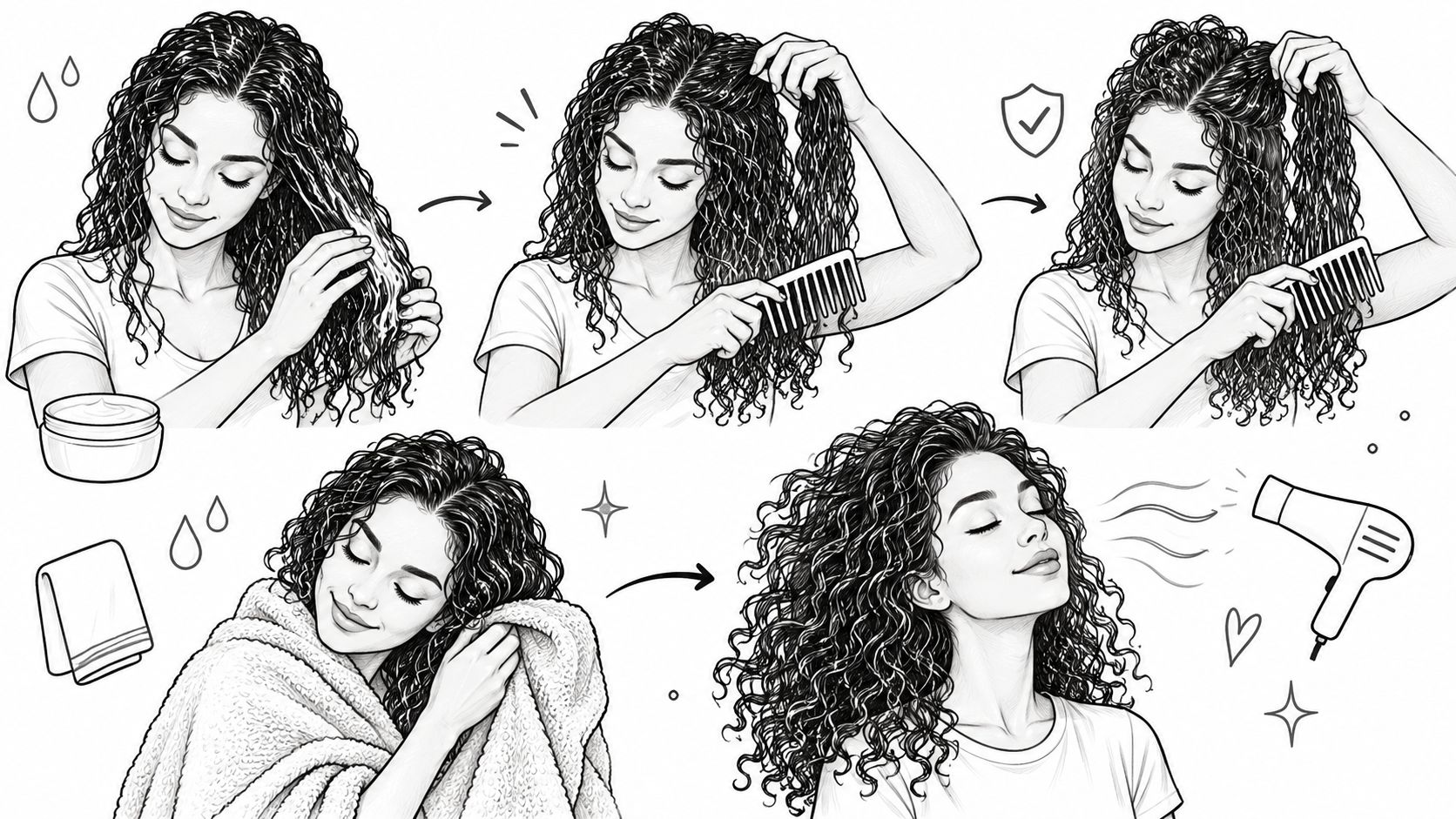
Detangle From the Ends Up
Divide the hair into four to six sections. Use your fingers first, then a wide-tooth comb if needed. Start a few inches from the ends and work through that area before moving closer to the roots. Hold the section above a knot to keep tension from pulling on the scalp.
Keep the brush for dry styling, not detangling. If a comb stalls, pause and add conditioner for more slip. Forcing it through can snap strands; more pressure does not clear a knot more effectively.
Air Dry or Diffuse
| Method | Speed | Effect on curls | Breakage risk |
|---|---|---|---|
| Air dry | Slowest | Can help limit frizz | No dryer heat or airflow |
| Low-heat diffuse at gentle speed | Faster | Can preserve curl definition | Lower with moderate heat and gentle airflow |
| High heat with tight pressure | Fast | Can disrupt definition and increase frizz | Higher from heat and forceful airflow |
To diffuse, hover the bowl near the roots and use low heat with gentle airflow. Once a cast begins to form, avoid moving the dryer around. If you have time, air drying curly hair is another option. It takes longer, so plan around your schedule rather than expecting a quick finish.
Repeated rough handling can wear on strands. A single-fiber fatigue study of 3C samples reported a characteristic lifetime of 38,400 cycles, with a 9.4% modeled breakage probability after 500 cycles. Those findings concern repeated mechanical stress in the study, not a daily combing limit. The practical takeaway is to use enough slip and gentle tension, and avoid unnecessary passes.
Protect the Overnight Hours
A satin bonnet or pillowcase can reduce friction while you sleep. Gather hair into a loose puff or two loose braids so curls are not pressed flat against the fabric. Avoid tight ties that pull at the same section night after night.
Fit drying to your day. If the back shrinks more than the crown and you have limited time, diffuse the crown while letting the back air dry under a loose clip. The trade-off is faster drying at the top, with less control over the shape at the back.
If hair snags during detangling, add conditioner before adding force.
Scalp Care When Lengths and Scalp Disagree
Here's the conflict almost nobody addresses. Your scalp may need cleansing while your lengths need moisture, and no single shampoo does both well. Most routines solve the lengths and ignore the scalp until it complains, then overcorrect with a stripping wash that undoes a week of conditioning.
The American Academy of Dermatology's curly hair guidance draws a practical line: thick, curly hair may not need daily or weekly washing, but it should still be cleansed at least every 2 to 3 weeks for scalp and hair health. It also advises applying dandruff shampoo to the scalp while using a moisturizing shampoo on the lengths. That's the two-clock model in one sentence.
How Often Is Actually Normal
Published hair-care observations show washing habits ranging from every 2 to 3 days to less than once a week. Nobody is doing it wrong. There's no universal schedule, which is why a fixed 3C calendar fails so many people.
A worked example makes the adjustment concrete. Oily scalp, dry ends, heavy cream in the rotation. Cleanse the scalp about weekly with a gentle shampoo and keep the lengths conditioned only, no shampoo there at all. Frizz stays controlled because the ends were never stripped, and the roots stop itching because they're no longer waiting two weeks for attention.
Under-washing isn't automatically protective. It preserves dryness-prone lengths beautifully while leaving a flaky or congested scalp untreated for weeks.
When to Hand It Over
Persistent scalp pain, itching that doesn't settle, scaling, redness or any hair loss goes to a dermatologist. Those are medical signs, not routine problems, and no schedule adjustment fixes them.
| Scalp condition | Scalp care | Length care | See a dermatologist when |
|---|---|---|---|
| Oily scalp with dry ends | Scalp cleanse every 1-2 weeks | Moisturizing conditioner only, no shampoo on lengths | Oil buildup with redness or soreness |
| Dry, itchy scalp | Gentle cleanse every 2 weeks | Light moisturizing routine on lengths | Itch or scaling that does not ease after 2-3 weeks |
| Dandruff or flaking | Dandruff shampoo on scalp, left on for the label time | Moisturizing shampoo on lengths | Flaking or redness that does not improve |
| Product buildup with heavy feel | Clarifying cleanse on scalp once | Lighter products on lengths | Buildup returns within days or hair falls out in clumps |
One clarification worth stating plainly: hair advice here is general information and not medical advice, and persistent scalp or hair-loss problems should be checked by a dermatologist. If your scalp is dry and tight rather than oily, dry scalp care for curly hair covers the gentler version of this routine.
Fix Frizz and Start This Week
Frizz by the second day, dry ends, or curls that fall flat each point to a different adjustment. Match the change to the symptom, then alter one thing at a time.
- Frizz by day two: check your drying method before blaming the product. Use a water-based leave-in rather than an oil-based one.
- Dry, straw-like ends: add one deep-conditioning session and skip oil layered over hair that is already dry.
- Limp curls with no clump: use less heavy product or switch to a lighter cream, applied to wetter hair.
- Buildup, dullness, or a gritty feel: clarify the scalp once, then return to your usual routine.
- A spike in shedding: reduce detangling tension and check whether long gaps between washes are allowing shed hairs to accumulate.
Change one variable and give it three wash cycles. Then decide whether it helped. If definition improves while breakage rises, the trade-off is not working.
Pick One Row and Run It
Choose the schedule row closest to your hair and follow the wash-day steps for three cycles. After each wash, record frizz, softness, shedding, and breakage separately. That makes it easier to spot a gain without overlooking a setback.
Coil builds a routine from your curl type, porosity, density, and scalp. At daily check-in, tick off what you did, rate how your curls feel, and optionally add a selfie. Coil lines your curl score up against your products and habits, then reshapes the routine around what you did. Treat the schedule as a starting point; let your curls and scalp guide the next adjustment.
Coil turns this walkthrough into a routine built around your curl type, porosity, density, and scalp, then adapts it to what you did rather than what you planned. The daily check-in lets you tick off steps and rate how your curls feel; your curl score helps track results alongside products and habits. Visit Coil to start with your own wash day and see what three cycles show you.